Giving Up Housekeeping

Whilst looking for information on her daughter’s marriage in 1917, I stumbled across this intriguing advertisement in the newspaper placed by Alice Ann Glaister (nee White) the same year:

“TUESDAY, 27th NOVEMBER,
At 2 o’clock.
On the Premises, No. 17 Springhill road, Mornington (off Glen avenue).
Instructed by Mrs Glaister, who is giving up housekeeping…”

…followed by an impressive list of household possessions.
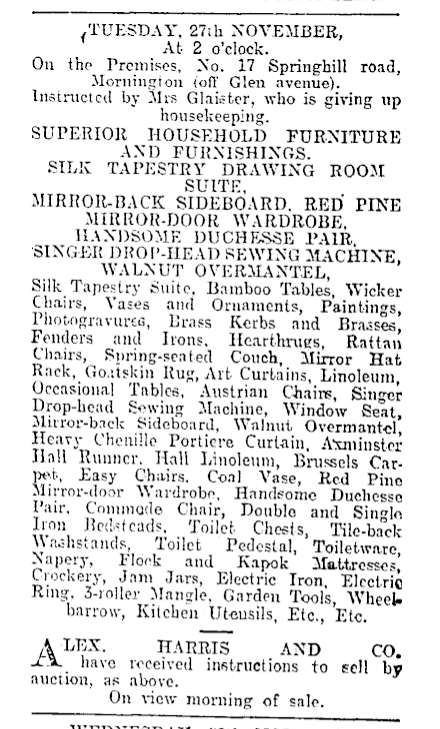
clipping of newspaper advertisement
Evening Star, 26 Nov 1917, p5

I had not heard the expression, ‘giving up housekeeping’ before but it seems to refer to a time when people are no longer able to maintain their own home and need to ‘give up’ or sell their possessions.

Alice’s husband was coachbuilder, William Glaister, who died 9 November, and was buried 11 November 1917. A couple of weeks later, Alice was auctioning off her household furniture and furnishings from her home at 17 Springhill Road – where the couple had lived since at least 1890. (Their daughter, Mary, had even married at the address earlier that year.)

Interestingly, the family had starting advertising the home to be let as early as 20 October 1917. William was suffering from stomach cancer and the family probably knew his time was coming to an end and so were making preparations for the future.
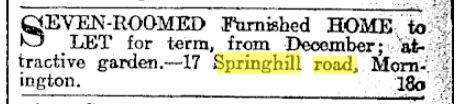
Otago Daily Times, 20 Oct 1917, p9

In 1933, 16 years after William’s death, Alice died ‘at the residence of her daughter, 616 Cumberland Street’. But which daughter? She had had seven daughters and two sons.
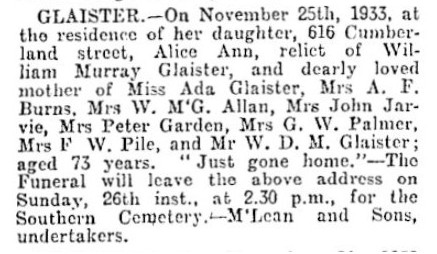
Evening Star, 25 Nov 1933, p12

Alice’s second youngest daughter, Ada, was recorded at the Springhill Road residence with her parents in 1914. Ada would remain a spinster so this seems an obvious choice of family member to live with.

However, electoral records show that the home she died in was that of her eldest daughter, Laura, who had married Alfred Burns in 1908. The electoral rolls show her living there with her husband in 1931 and 1935.
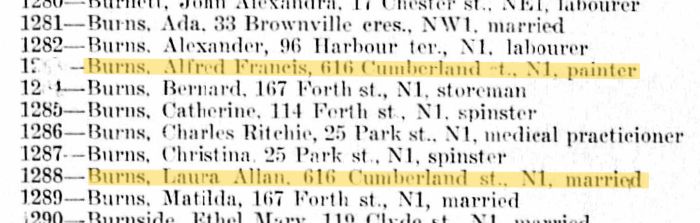
1935 electoral roll showing Laura and Alfred at 616 Cumberland Street

Why not Ada Victoria?

Alice and Ada had been recorded moving from place to place together since 1919.

  • 1919 – Hugh Street, Sawyers Bay (near Port Chalmers)  (daughter Barbara was nearby in Glendermid – possibly even the same house)
  • 1922 – 14 Maitland Street
  • 1925 – 8 Jones Street
  • 1928 – 8 Jones Street, then 117 Dundas Street
  • 1931 – 117 Dundas Street

14 Maitland Street appeared to be some kind of boarding house based on advertisements in the newspapers.
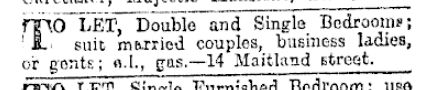
Evening Star, 6 Oct 1925, p7

8 Jones Street was let as a 4-room house in 1924 – perhaps this was the ad seen by Alice and Ada when planning their move from Maitland Street?

Otago Daily Times, 8 Jul 1924, p12

117 Dundas Street appeared to be owned (and lived in) by an Alfred Edwin Maitland and his family until at least 1949. There appears to be no family relationship to the Glaisters so perhaps they were simply renting a room?

In 1935, Ada was still at 117 Dundas Street and remained there for at least a few more years. This suggests she had not also been living in her sister’s house when Alice died in 1933. Ada may have had some form of employment which meant she could not care for her ailing mother, but no profession was given in the electoral rolls. Alice and Ada were described throughout the electoral rolls only as ‘widow’ and ‘spinster’, but this, along with, ‘married’, seemed to be the case for all the women on the page.

Although the phrase ‘giving up housekeeping’ had initially caught my attention, it led me to a valuable insight into my 2nd great grandmother’s life after her husband died and illustrated how much her circumstances changed. Alice went from having her own 7-bedroom home for about three decades, to moving between various rentals and boarding houses, possibly relying on her daughters for support.

A map of Alice Glaister’s residences from 1917 can be seen here.
Related posts:

Patently Improved

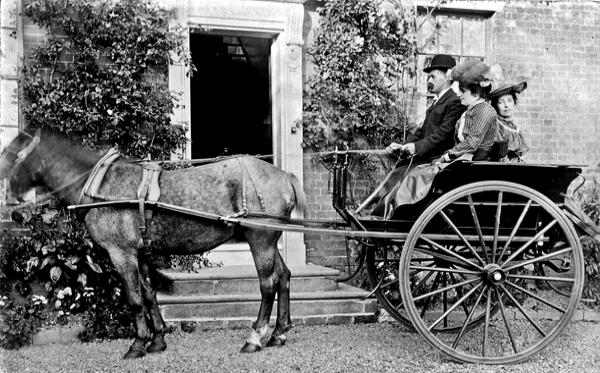
A two-wheeled dogcart (via Gail Thornton)

William Glaister, my 2nd great-grandfather, was a coachbuilder in Dunedin, New Zealand in the late 19th and early 20th century. A couple of years ago, I discovered he was also an inventor.

In 1892, William filed a patent for ‘An invention for improvement in two-wheeled vehicles’. An abstract was published in the New Zealand Gazette on 31 March 1892 (available via Ancestry).

New Zealand Gazette (Supplement), 31 Mar 1892, p1

If a member of the public wanted to purchase copies of the patent documents, they would pay 2 shillings and 6 pence for the written description of the invention, and 3 shillings for the accompanying technical illustration. William, himself, would have paid at least a few pounds for actually filing the patent. (Source: New Zealand Legislation – 1889 fee schedule)

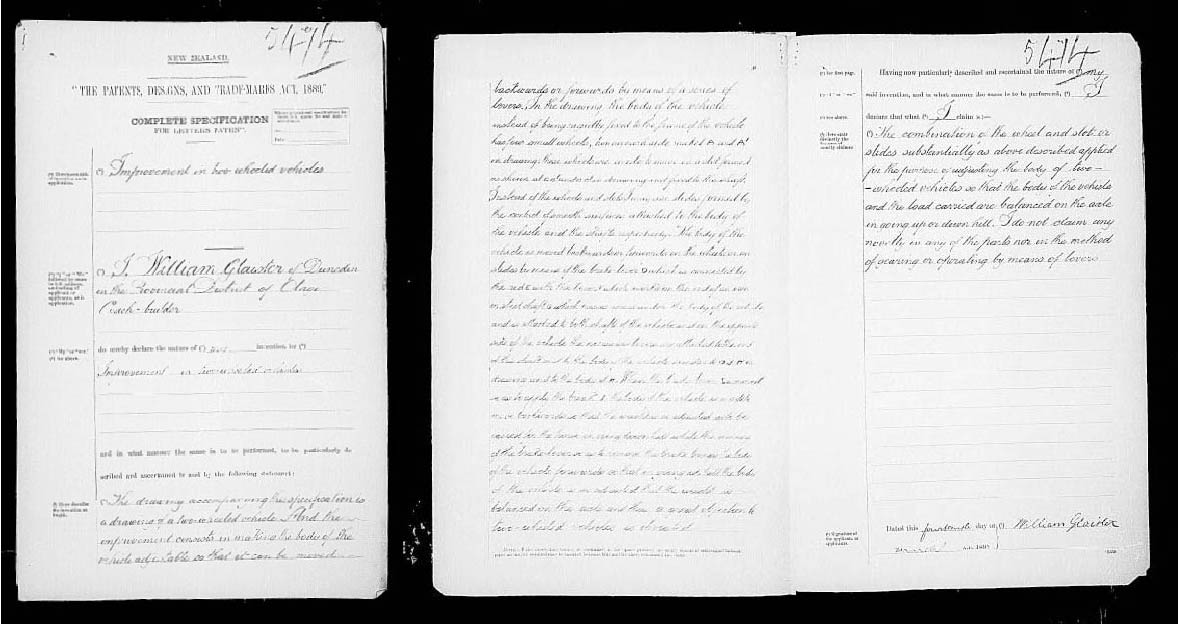
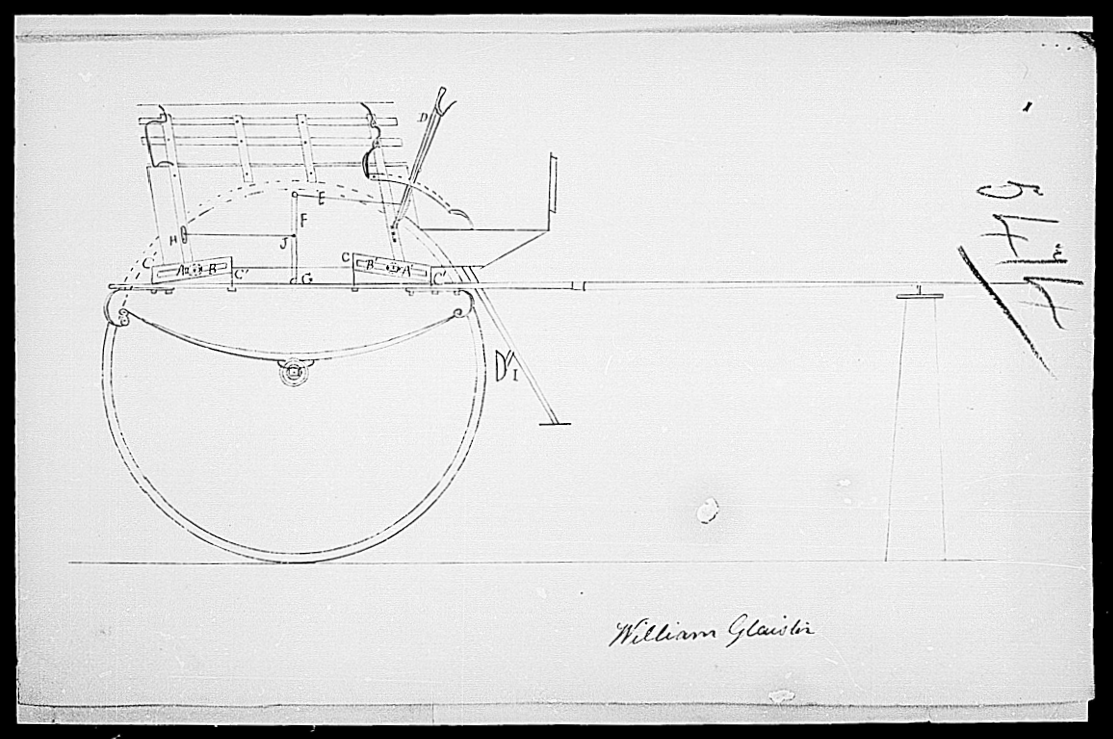
Using the Intellectual Property Office New Zealand Patents register, I was able to view the original patent document in which included a description (in his own handwriting) and a drawing of the concept.

An Invention for Improvement in Two-Wheeled Vehicles – William Glaister

I have transcribed the specification, adding punctuation and paragraphs for ease of reading.

Here describe the invention at length

The drawing accompanying this specification is a drawing of a two-wheeled vehicle, and the improvement consists in making the body of the vehicle adjustable so that it can be moved backwards or forwards by means of a series of levers.

In the drawing, the body of the vehicle instead of being rigidly fixed to the frame of the vehicle has four small wheels, two on each side marked A and A1 in drawing: these wheels are made to move in a slot formed as shown at C C1 and C C1 in drawing and fixed to the shaft.

Instead of the wheels and slots, I may use slides formed by the conduct of smooth surfaces attached to the body of the vehicle and the shafts respectively.

The body of the vehicle is moved backwards or forwards on the wheels (or on slides) by means of the brake-lever D which is connected by the rod E with the lever F which works on the end of an iron or steel shaft G which passes across under the body of the vehicle and is attached to both shafts of the vehicle and on the opposite side of the vehicle the necessary levers are attached to the end of this shaft and to the body of the vehicle similar to G J H in drawing and to the body at H.

When the brake-lever D is moved so as to apply the break (I), the body of the vehicle is made to move backwards so that the weight is so adjusted as to be easiest for the horse in going down hill, while the moving of the brake-lever so as to remove the brake, brings the body of the vehicle forwards so that in going up hill the body of the vehicle is so adjusted that the weight is balanced on the axle and thus a great objection to two-wheeled vehicles is obviated.

Having now particularly described and ascertained the nature of my said invention, and in what manner the same is to be performed, I declare that what I claim is:

The combination of the wheel and slot or slides substantially as above described applied for the purpose of adjusting the body of two-wheeled vehicles so that the body of the vehicle and the load carried are balanced on the axle in going up or down hill. I do not claim any novelty in the any of the parts nor in the method of gearing or operating by means of levers.

Dated this fourteenth day of March A.D. 1892 [signed] William Glaister

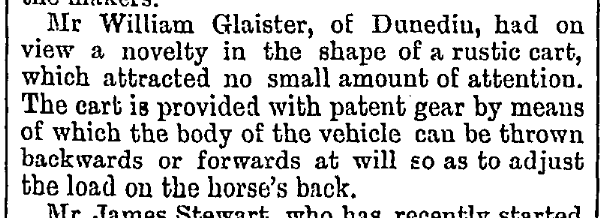
It’s still a bit difficult to understand (for me), but the Otago Daily Times gave a pretty good summary when William presented a cart using his invention at the Otago Agricultural Show that same year: “The cart is provided with patent gear by means of which the body of the vehicle can be thrown backwards or forwards at will so as to adjust the load on the horse’s back”. Load-balance was apparently a well-known issue for users of this type of vehicle.

Otago Daily Times, 3 Dec 1892, p6 (Supplement), c4

I’m not sure how successful the invention was or whether it was utilised by other coachbuilders. Perhaps someone in the know could shed some light on that for me?

Related posts:

Wills and Williams

I was overjoyed to find the will of William GLAISTER (1816 – 1883) on the FamilySearch site in the Archives New Zealand probate records collection.  He was a {white & black}smith of Kelso in Roxburghshire, Scotland before emigrating to Dunedin, New Zealand in 1872.   [This William was also the subject of a previous post – Addressing Up]

In summary (from what I can make out):

  • All his tools were to be given to his son Edward
  • Ten pounds were to be given to each of his three (male) grandchildren
  • Janet was to be allowed to use and occupy his house and home and given an income for life (she was to die only 2 years later)
  • Section 235 & 236 of The Glen were to be given to his sons Edward & Thomas (as long as his debts were satisfied)
  • Everything else was to be sold off and the money shared between all his children

However, I was curious as to why only two of his sons, Edward and Thomas, and three of his grandchildren were mentioned by name in his will?  Also, his two executors, William Sinclair and Alfred Kingston Smith were not his sons so who were they?

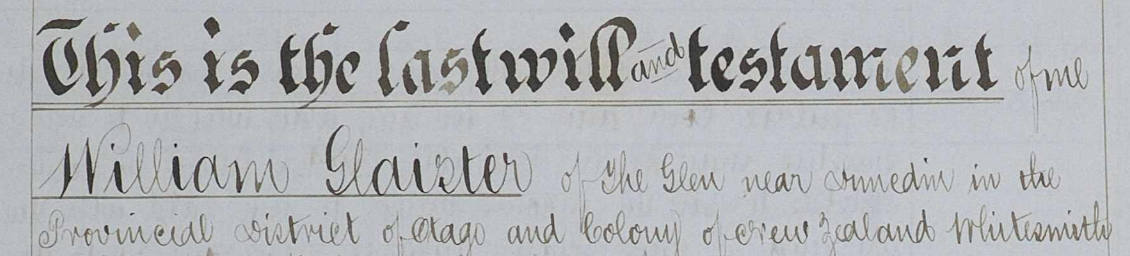
Below is a transcription of the will (written 3rd of March 1883) with the names in bold typeface [indentation added by me for ease of reference]:

This is the last will and testament of me William Glaister of The Glen near Dunedin in the Provincial district of Otago and Colony of New Zealand Whitesmith. I appoint William Sinclair of Dunedin aforesaid Warehouseman and Alfred Kingston Smith of the same place Fishmonger Executors of this my will

I give and bequeath to my son Edward Glaister all the tools of my trade and to each of my grand children William Smith, William Sinclair the younger and William Glaister the sum of Ten pounds

I give devise and bequeath unto the said William Sinclair and Alfred Kingston Smith and the survivor of them the heirs executors and administrators of such survivor hereinafter referred to as my said Trustees all my real and personal estate upon trust to permit and suffer my wife Janet Glaister to use occupy and enjoy all my real estate whatsover without impeachment of waste and also all my household furniture and such of my personal estate (other than money) as my said attorney wife may require without being responsible for any loss or diminution in value which may arise therefrom

And as to the residue (if any) of my personal estate upon trust to sell and convert the same into money and after payment of all my just debts legacies funeral and testamentary expense to invest or apply the same as hereinafter appears

And from and after the death of my said wife as to section two hundred and thirty five (235) The Glen upon trust for my son Edward Glaister subject to the proviso hereinafter contained and as to section two hundred and thirty six (236) The Glen upon trust for my son Thomas Glaister subject to the proviso hereinafter contained

And as to all the residue of my real and personal estate upon trust to sell and convert the same (or such part thereof as shall not consist of money into money and shall stand possessed of the moneys to arise from such sale and conversion of my estate and such part thereof as shall consist of money upon trust for all my children equally share and share alike

And I hereby declare that any money in the hands of my Trustees may be invested by them of depositing the same in any Bank, Building Society or public Company or in any way which my said Trustees may seem desirable

And I hereby empower my said Trustees to pay the income thereof to my said wife during her life and if they shall deem it necessary so to do to apply the whole or any part of the principal sum then in their hands for her support and maintenance anything herein to the contrary notwithstanding.

And I do hereby declare that if my personal estate shall prove insufficient for the payment of my just debts, funeral and testamentary expenses and the legacies to my grand children the deficiency shall be paid by my sons Edward Glaister and Thomas Glaister in equal shares and if both or either of them shall fail or neglect to pay the sum necessary for this purpose within twelve months after the same shall have been demanded from them or him it shall be lawful for my said Trustees to sell the sections or section to which they or he would have been entitled and after payment thereout of all my expenses attending such sales or sale and the proportionate amount so required for payment of the said debts expenses and legacies to stand possessed of the proceeds of such sales or sale for the persons or person who would have been entitled to the said sections or section if such sale or sales had not been made [In witness] whereof I have hereunto set my hand this third day of March One thousand eight hundred and eighty three

Signature of William Glaister (1816 – 1883) as it appears on his last will and testament


William married twice; his first wife Margaret MURRAY died sometime between 1853 and 1857 when he married his second wife, Janet Waldie.  He had 8 children – 4 with each wife:

Children with 1st wife Margaret:
Robert 1844
Janet 1846
Margaret 1851
William Murray 1853

Children with 2nd wife Janet:
Barbara 1858
John 1860
Edward 1863
Thomas 1866

First step was to work out who was still alive at the time the will was written.

Janet died at just 2 years of age in 1848 and John died 2 years before the will was written at the age of 21.

Burial entry of Janet Glaister 1846-1848


Death notice of John Glaister, Otago Daily Times, Issue 6106, 5 September 1881

Next step, the surnames of the grandchildren were a hint that his executors were actually his sons-in-law.  Searching NZ BDM online gave a William Richard Smith born to Alfred Kingston Smith and Margaret in 1874 and William Donald Sinclair born to William Sinclair and Barbarain 1878.  This then led me to the marriages of William’s two surviving daughters, Margaret and Barbara confirming that they were indeed married to the two executors. I then searched for the grandchildren using the parents’ names:

Children of Margaret Glaister & Alfred Kingston Smith
Possible children of Barbara Glaister and William Sinclair

Children with 1st wife Margaret:
Robert
1844
Janet 1846 – 1848died at 2 years of age
Margaret 1851 – married Alfred Kingston Smith in 1874 (executor); their first son, William Richard Smith (b.1874) (1st grandson mentioned)
William Murray 1853 – 1917 – his son, William David Murray Glaister (b.1879) (3rd grandson mentioned)

Children with 2nd wife Janet:
Barbara
1858 – married William Sinclair in 1878 (executor); their first son, William Donald Sinclair (b.1878) (2nd grandson mentioned)
John 1860 – 1881 – died 2 years before the will was written
Edward 1863
Thomas 1866

[The names of people referred to in the will in green bold typeface]

So it seems as though only Edward & Thomas were specifically provided for as they were underage at the time (not yet 21); the 3 grandchildren were the eldest grandsons and possibly the only males alive at the time (though no deaths or other records have yet been found for James Robertson Sinclair); and the executors of the will were William’s daughters husbands. The daughters & grandaughters, as was often the custom in these times, were ignored.

It still doesn’t clear up why his eldest son, Robert (who appears not to have married) nor his second eldest, William Murray (my ancestor) were not the executors, let alone mentioned at all.

Next Steps:

  • Find out more about eldest son, Robert Glaister b. 1844

Related posts:

Genealogical Jurisprudence

Professor John Glaister (1856 – 1932)

Professor John Glaister (1856 – 1932) was a Scottish forensic scientist who often appeared as an expert witness in famous legal cases of the time. He authored A Text-book of Medical Jurisprudence and Toxicology which was apparently quite an important reference work in those medical/legal circles of the time.

There has been a long held belief in my family that we are related to him, however I have never been able to find evidence of this.  My grandmother had first mentioned it to me but there is also a reference to the relationship in a letter my grandfather wrote to his son in 1979:

When we were in N.Z. someone told us that Aunt Amy when she was in Scotland looked up the Glaisters & Gerard Glaister is one of our relations. My maternal Grand-father was the only Glaister that wasn’t a Dr – [written above: (he was a blacksmith & my cousin Tom Allan showed me his coach-builders hand book when were in NZ.) ] & we had one of his books on veterinary [surgery] with coloured plates of horses insides when I was a kid. Tom Allen had a photo of my Grand-dad Glaister’s FATHER’s house on a Scottish estate – the house was given to him on his retirement as vet. So it looks something like this:

Incidently my uncle Murray Glaister met Prof. Glaister before the war.

+ one of his two sons (my cousin) was in the N.Z. New Years Honours list for his contribution to the meat industry.

*I believe the uncle he refers to as Murray is actually William David Murray Glaister (a solicitor in Auckland) as he was the only boy of William Murray GLAISTER & Alice Ann WHITE that lived; Aunt Amy is likely Amy Glaister/Pile; Gerard Glaister seems to refer to the British television producer and director ; I’m not sure who cousin Tom Allen refers to or the ‘meat industry contributor’.*

Seemingly lots of family information to help me piece things together but unfortunately, I know immediately that Grandad was mistaken in a few things:

  1. It was actually his maternal great great Grandfather who was a vet (Robert GLAISTER).
  2. His grandfather’s father, William GLAISTER (missing from this sketch) was also a blacksmith and it was actually HIS father who was the vet.
  3. The DR S recorded as a brother to the coach builder (William Murray GLAISTER) does not exist (at least not as this relationship – He had a brother called Stephen Glaister who was also a blacksmith.)
  4. Professor John Glaister’s grandfather was a John Glaister NOT Robert GLAISTER the veterinarian
  5. ‘…only Glaister that wasn’t a Dr…’ – no known doctors in this part of the family apart from a few veterinary surgeons

So my general assumption was that the family were mistaken and there is no link to my family.

HOWEVER:

While trawling the NZ Papers Past website for the Glaister name, I came across this article from 1932:


Auckland Star – 19 December 1932


…His death reveals a link with Auckland and New Zealand. When his daughter, now Mrs. Woodruff, was passing through Auckland to Melbourne to be married in 1919, she accidentally came into contact with the name Glaister, and made the acquaintance of Mr. W. P. M. Glaister,barrister, of this city. Subsequently Professor Glaister, who was compiling a history of the Glaister clan, communicated with Mr. Glaister, and as a result was able to furnish a genealogical history of the New Zealand branch of the Glaister clan from about 1800. Besides his specialist work in criminology Professor Glaister had wide interests, medical and scientific.

So according to this, ‘Uncle Murray’ had contact with Professor Glaister’s daughter and eventually communicated with him.  It doesn’t say ‘met’ but this was certainly ‘before the war’ so there WAS some truth to that statement.  The comment, ‘as a result was able to furnish a genealogical history of the New Zealand branch of the Glaister clan from about 1800’ isn’t exactly clear but does seem to imply that there WAS some link between both families. So for now, my search goes on…

Next Steps:

  • Determine exactly who cousin Tom Allen was & the ‘meat industry contributor’
  • Contact relatives who may still hold the books, papers and photographs referred to in the letter
  • Prepare tree of descendants of Robert GLAISTER to compare to Grandad’s sketch
  • Find link to Professor John Glaister’s family

Related posts:

Addressing Up

It’s been a while since I looked into my Scottish forebears but was enticed back to search the Valuation Rolls held by Scotlands People. Happy to find William GLAISTER, smith, listed as occupier at the Smithy in Kelso (Bridge St & Abbey Row).  The owner of the property was David FLEMING, Blacksmith.

William Glaister appears in the 1865 Valuation Rolls

The next (and only other) Glaister mention was a Mrs Janet Glaister, occupying a house and stable at 56 Horsemarket, Kelso.

Mrs Janet Glaister appears in the 1875 Valuation Rolls

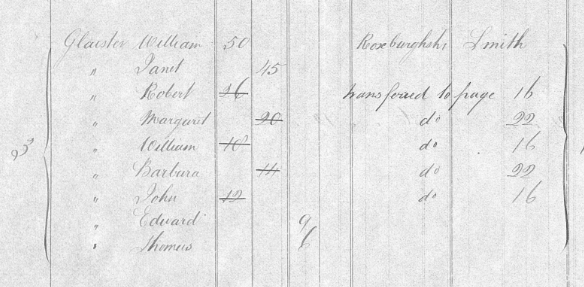
This threw me for a bit, as by 1875, William had emigrated to New Zealand.  The 1872 Hydaspes passenger list shows that his second wife, Janet, travelled with him so how could she be listed as tenant in Kelso?  Then I realised this Janet was the wife of William’s brother, Thomas who died in 1870.

William Glaister & family on board the Hydaspes (emigrating to New Zealand) in 1872

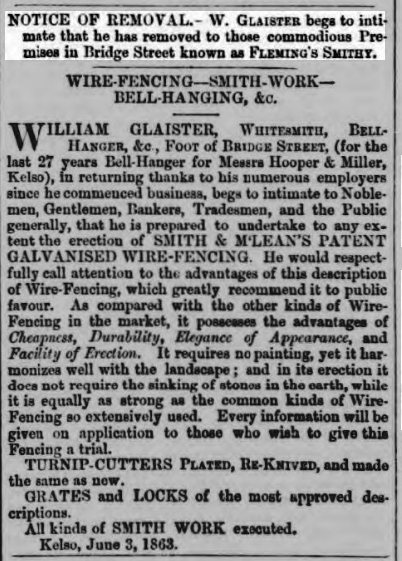
This encouraged me to find out more about exactly where the family lived and worked in Kelso.  I trawled the Kelso Chronicle for any GLAISTER mentions and managed to find address details through advertisements;

“W. GLAISTER begs to intimate that he has removed to those commodious Premises in Bridge Street known as FLEMING’S SMITHY.” (Kelso Chronicle, 03 July 1863, p1 c6)

Newspaper advertisement for William Glaister’s business (Kelso Chronicle 03 July 1863, p1 c6)

birth announcements;

“At Forest Field, Kelso, on the 9th inst, the wife of Mr William Glaister, smith and bellhanger, of a son.” (Kelso Chronicle 10 April 1863, p3 c6)

Edward Glaister’s birth announcement (Kelso Chronicle 10 April 1863, p3 c6)

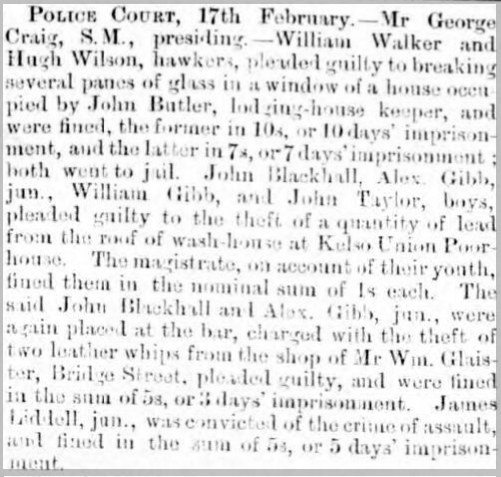
and court reports:

Report of theft from the Glaister shop on Bridge St (Kelso Chronicle 21 February 1868, p2 c6)

The valuation rolls, birth records and newspapers have thus helped me to more accurately trace the movements of this family around the town between the census years and enabled me to pinpoint buildings in which they lived and worked.  The historical maps on the National Library of Scotland site, have allowed me to be even more precise.  For example, the Bridge Street smithy is actually labelled on the 1847 Kelso town plan.  Also, modern Forestfield is now a street name – old Forestfield seems to now be addressed as Inch Road.

[Fleming’s] Smithy as labelled on the 1857 Kelso Town Map

So, the addresses I have pieced together so far are:

1841 – Woodmarket, Kelso (with mother)

1843 – Kelso (marriage certificate)

1851 – Roxburgh Street, Kelso

1853 – Kelso (birth of son – parish record)

1857 – Forrestfield, Kelso (marriage to 2nd wife)

1858 – 9 Forrest Field, Kelso (birth of daughter)

1860 – 9 Forrest Field, Kelso (birth of son)

1861 – 4 Forrestfield, Kelso (transcription error for 9?)

1862 – Shop at the foot of Horsemarket, Kelso (May 26) (newspaper advertisement)

1863 – Premises at Fleming’s Smithy, Bridge Street, Kelso (June 3) (newspaper advertisement)

1863 – 9 Forrest Field, Kelso (birth of son – register & newspaper)

1865 – Smithy (Bridge Street & Abbey Row), Kelso (Valuation Rolls)

1866 – Foot of Bridge Street, Kelso (Abbey Row – birth of son – newspaper announcement)

1868 – Bridge St (theft) (newspaper article)

1869 – House and shop in Bridge St, Kelso (until Whitsunday 1869)

1871 – 4 Coal Market Square, Kelso (then R Glaister & Co 18 Woodmarket)

1872 – New Zealand


Related posts: