Giving Up Housekeeping

Whilst looking for information on her daughter’s marriage in 1917, I stumbled across this intriguing advertisement in the newspaper placed by Alice Ann Glaister (nee White) the same year:

“TUESDAY, 27th NOVEMBER,
At 2 o’clock.
On the Premises, No. 17 Springhill road, Mornington (off Glen avenue).
Instructed by Mrs Glaister, who is giving up housekeeping…”

…followed by an impressive list of household possessions.
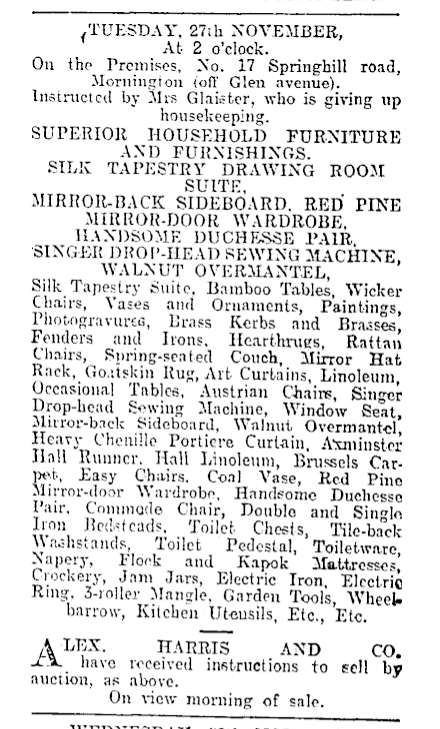
clipping of newspaper advertisement
Evening Star, 26 Nov 1917, p5

I had not heard the expression, ‘giving up housekeeping’ before but it seems to refer to a time when people are no longer able to maintain their own home and need to ‘give up’ or sell their possessions.

Alice’s husband was coachbuilder, William Glaister, who died 9 November, and was buried 11 November 1917. A couple of weeks later, Alice was auctioning off her household furniture and furnishings from her home at 17 Springhill Road – where the couple had lived since at least 1890. (Their daughter, Mary, had even married at the address earlier that year.)

Interestingly, the family had starting advertising the home to be let as early as 20 October 1917. William was suffering from stomach cancer and the family probably knew his time was coming to an end and so were making preparations for the future.
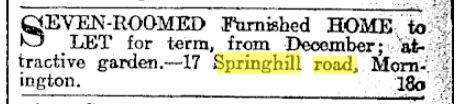
Otago Daily Times, 20 Oct 1917, p9

In 1933, 16 years after William’s death, Alice died ‘at the residence of her daughter, 616 Cumberland Street’. But which daughter? She had had seven daughters and two sons.
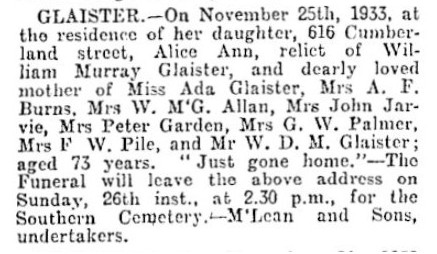
Evening Star, 25 Nov 1933, p12

Alice’s second youngest daughter, Ada, was recorded at the Springhill Road residence with her parents in 1914. Ada would remain a spinster so this seems an obvious choice of family member to live with.

However, electoral records show that the home she died in was that of her eldest daughter, Laura, who had married Alfred Burns in 1908. The electoral rolls show her living there with her husband in 1931 and 1935.
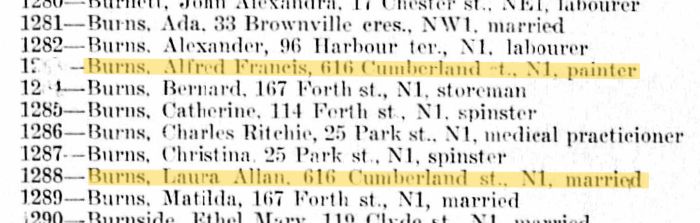
1935 electoral roll showing Laura and Alfred at 616 Cumberland Street

Why not Ada Victoria?

Alice and Ada had been recorded moving from place to place together since 1919.

  • 1919 – Hugh Street, Sawyers Bay (near Port Chalmers)  (daughter Barbara was nearby in Glendermid – possibly even the same house)
  • 1922 – 14 Maitland Street
  • 1925 – 8 Jones Street
  • 1928 – 8 Jones Street, then 117 Dundas Street
  • 1931 – 117 Dundas Street

14 Maitland Street appeared to be some kind of boarding house based on advertisements in the newspapers.
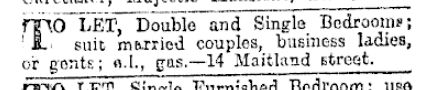
Evening Star, 6 Oct 1925, p7

8 Jones Street was let as a 4-room house in 1924 – perhaps this was the ad seen by Alice and Ada when planning their move from Maitland Street?

Otago Daily Times, 8 Jul 1924, p12

117 Dundas Street appeared to be owned (and lived in) by an Alfred Edwin Maitland and his family until at least 1949. There appears to be no family relationship to the Glaisters so perhaps they were simply renting a room?

In 1935, Ada was still at 117 Dundas Street and remained there for at least a few more years. This suggests she had not also been living in her sister’s house when Alice died in 1933. Ada may have had some form of employment which meant she could not care for her ailing mother, but no profession was given in the electoral rolls. Alice and Ada were described throughout the electoral rolls only as ‘widow’ and ‘spinster’, but this, along with, ‘married’, seemed to be the case for all the women on the page.

Although the phrase ‘giving up housekeeping’ had initially caught my attention, it led me to a valuable insight into my 2nd great grandmother’s life after her husband died and illustrated how much her circumstances changed. Alice went from having her own 7-bedroom home for about three decades, to moving between various rentals and boarding houses, possibly relying on her daughters for support.

A map of Alice Glaister’s residences from 1917 can be seen here.
Related posts:

Patently Improved

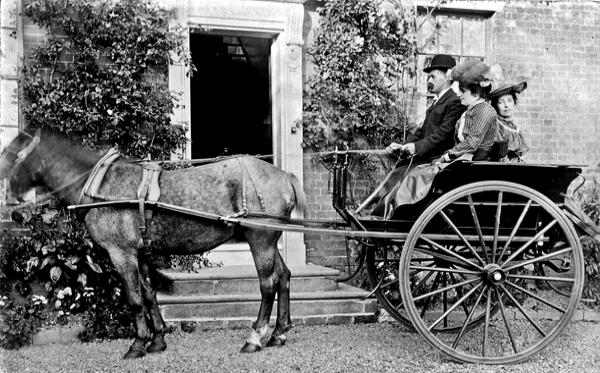
A two-wheeled dogcart (via Gail Thornton)

William Glaister, my 2nd great-grandfather, was a coachbuilder in Dunedin, New Zealand in the late 19th and early 20th century. A couple of years ago, I discovered he was also an inventor.

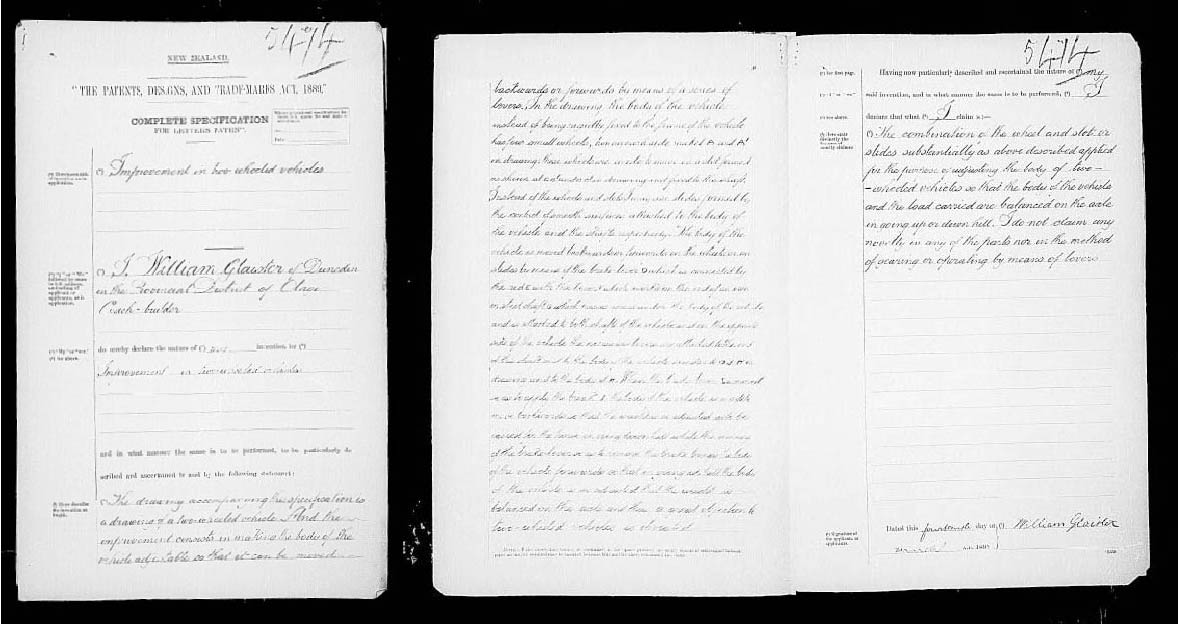
In 1892, William filed a patent for ‘An invention for improvement in two-wheeled vehicles’. An abstract was published in the New Zealand Gazette on 31 March 1892 (available via Ancestry).

New Zealand Gazette (Supplement), 31 Mar 1892, p1

If a member of the public wanted to purchase copies of the patent documents, they would pay 2 shillings and 6 pence for the written description of the invention, and 3 shillings for the accompanying technical illustration. William, himself, would have paid at least a few pounds for actually filing the patent. (Source: New Zealand Legislation – 1889 fee schedule)

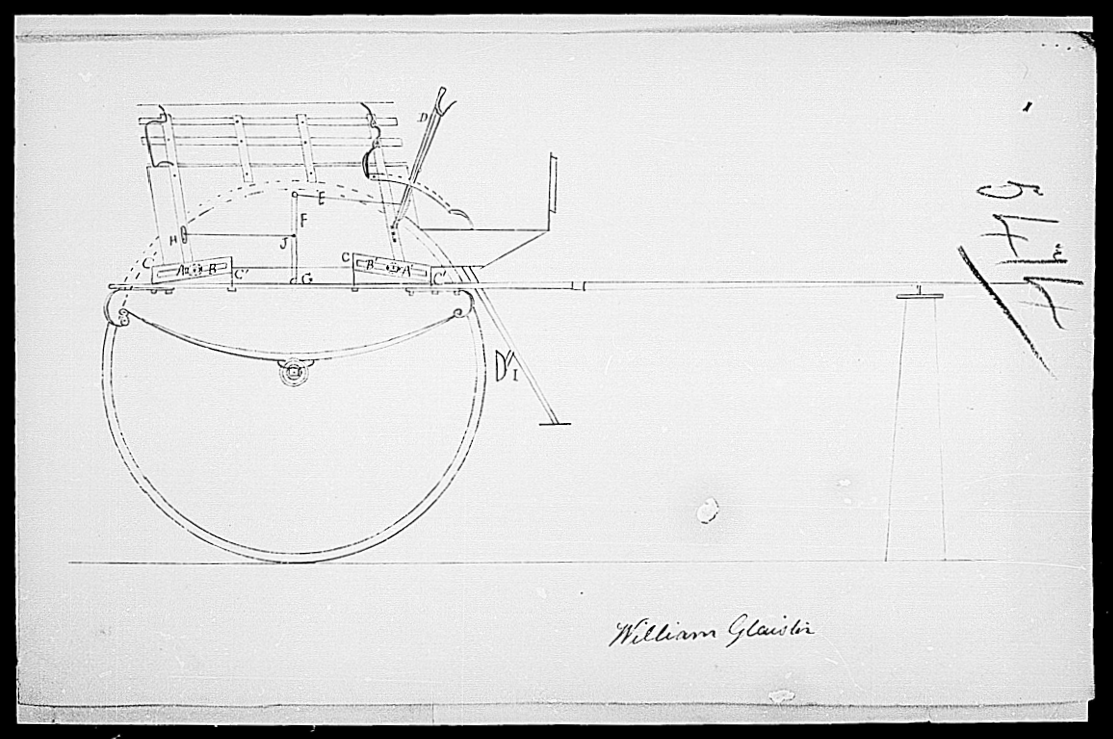
Using the Intellectual Property Office New Zealand Patents register, I was able to view the original patent document in which included a description (in his own handwriting) and a drawing of the concept.

An Invention for Improvement in Two-Wheeled Vehicles – William Glaister

I have transcribed the specification, adding punctuation and paragraphs for ease of reading.

Here describe the invention at length

The drawing accompanying this specification is a drawing of a two-wheeled vehicle, and the improvement consists in making the body of the vehicle adjustable so that it can be moved backwards or forwards by means of a series of levers.

In the drawing, the body of the vehicle instead of being rigidly fixed to the frame of the vehicle has four small wheels, two on each side marked A and A1 in drawing: these wheels are made to move in a slot formed as shown at C C1 and C C1 in drawing and fixed to the shaft.

Instead of the wheels and slots, I may use slides formed by the conduct of smooth surfaces attached to the body of the vehicle and the shafts respectively.

The body of the vehicle is moved backwards or forwards on the wheels (or on slides) by means of the brake-lever D which is connected by the rod E with the lever F which works on the end of an iron or steel shaft G which passes across under the body of the vehicle and is attached to both shafts of the vehicle and on the opposite side of the vehicle the necessary levers are attached to the end of this shaft and to the body of the vehicle similar to G J H in drawing and to the body at H.

When the brake-lever D is moved so as to apply the break (I), the body of the vehicle is made to move backwards so that the weight is so adjusted as to be easiest for the horse in going down hill, while the moving of the brake-lever so as to remove the brake, brings the body of the vehicle forwards so that in going up hill the body of the vehicle is so adjusted that the weight is balanced on the axle and thus a great objection to two-wheeled vehicles is obviated.

Having now particularly described and ascertained the nature of my said invention, and in what manner the same is to be performed, I declare that what I claim is:

The combination of the wheel and slot or slides substantially as above described applied for the purpose of adjusting the body of two-wheeled vehicles so that the body of the vehicle and the load carried are balanced on the axle in going up or down hill. I do not claim any novelty in the any of the parts nor in the method of gearing or operating by means of levers.

Dated this fourteenth day of March A.D. 1892 [signed] William Glaister

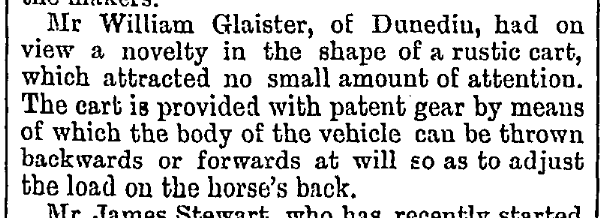
It’s still a bit difficult to understand (for me), but the Otago Daily Times gave a pretty good summary when William presented a cart using his invention at the Otago Agricultural Show that same year: “The cart is provided with patent gear by means of which the body of the vehicle can be thrown backwards or forwards at will so as to adjust the load on the horse’s back”. Load-balance was apparently a well-known issue for users of this type of vehicle.

Otago Daily Times, 3 Dec 1892, p6 (Supplement), c4

I’m not sure how successful the invention was or whether it was utilised by other coachbuilders. Perhaps someone in the know could shed some light on that for me?

Related posts:

Bankrupt or Insolvent?

The debtors prison at St Briavels Castle c1858

The last time I looked into the financial woes of my ancestor George Wreford, I wanted a simple explanation into the change in bankruptcy laws in 1861. I’ve since learned the key to understanding is knowing the difference between bankruptcy and insolvency.

Bankruptcy or Insolvency?

Whether a person was declared bankrupt or insolvent, was dependent on the profession of the debtor.

Only traders could apply for bankruptcy and have access to some kind of relief – an ‘Order of Discharge’ – which would effectively clear the debt, and allow them to rebuild their business or finances. Any money earned after bankruptcy was theirs to keep.

Non-traders were not able to do this, and would be liable for their debts forever. Any future assets or inheritance could be seized by creditors to pay off old debts, and they could be kept in gaol indefinitely.

Why was this case?

It was a long-held belief that financial failure in commerce was a natural risk of business (think: ‘market fluctuations’), whereas failure in private life was a moral or personal failing (think: ‘extravagant lifestyles’). Debtor’s prisons were seen as a punitive measure to discourage living beyond one’s means.

What changed in 1861?

After the new Bankruptcy Act (effective October 1861), non-traders could also apply for bankruptcy – an ‘Order of Discharge’ – so that they, too, could have their debts cleared.

Unfortunately for George, he became insolvent in March 1861 while still under the old laws.

So why would George be considered a non-trader?

The answer seems to lie in the fact that as well as being an innkeeper, butcher, and journeyman butcher, George was also described as a farmer.

Farmers were excluded from bankruptcy because their livelihood depended on the ‘labour of the soil’ and the ‘uncertainty of the seasons’, NOT commercial trade.

So although George was a butcher and innkeeper, his farming defined his primary legal status. This meant the courts viewed his capital as being tied up in land and livestock reared by himself, rather than goods bought and sold. The meat he sold was likely butchered from his own animals rather than animals bought from someone else.

Being a ‘journeyman butcher’ also suggested that he was an employee rather than a business owner, and therefore could not declare bankruptcy.

The Petition

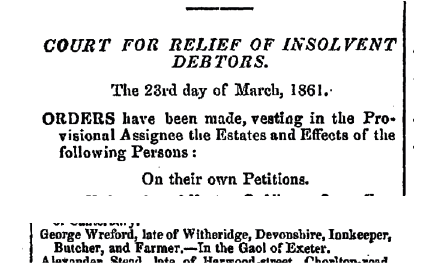
The London Gazette, 26 Mar 1861, issue 22495, pp1360-1361

This notice in the London Gazette tells us that George voluntarily declared insolvency. He would have recognised he was in serious financial trouble and filed his own petition, giving over all his assets to the court to pay off his debts. Had he not done this, a creditor could have had George sent to prison and controlled whether he was released.

The ‘Benefit of the Act’

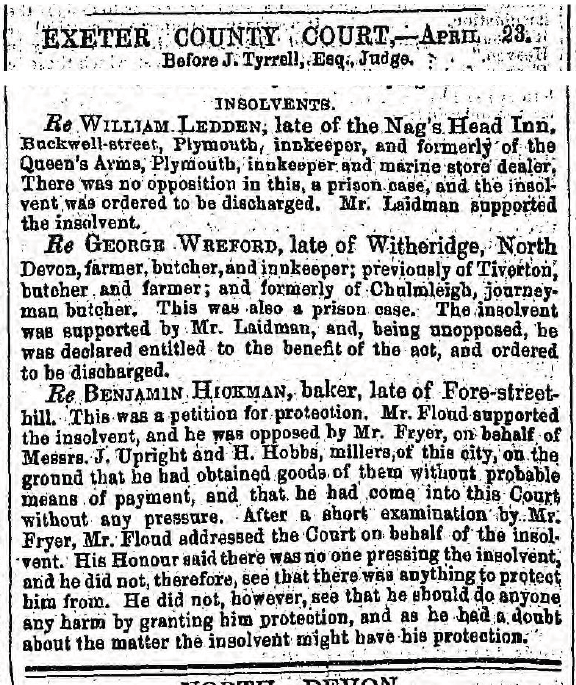
Exeter Flying Post, 24 April 1861, p7, c3
On 23 April 1861, George was declared “entitled to the benefit of the act, and ordered to be discharged”. In his case, ‘the benefit of the act’ meant that he would be discharged from prison because the court was satisfied that he’d surrendered all his assets and not committed fraud. Apparently it protected him from being imprisoned again for those specific debts BUT could still have future money and assets taken away to pay off creditors.
No wonder he took off to New Zealand a few years later!
(NB: Mr John Laidman (c. 1799–1871) was a prominent Exeter solictor (and City Treasurer) who specialised in bankruptcy law. He even wrote a legal guide, Bankruptcy and Insolvency: Practical Observations on the Laws, in 1857.)

Related posts:

“Is There Anyone to Save My Life?”

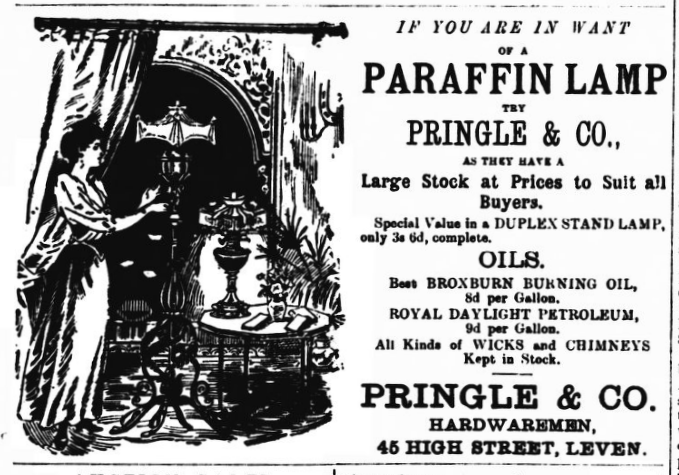
Paraffin lamp advertisement from 1897 (Leven Advertiser, 28 Jan 1897, p2)

Samuel Perkins and Elizabeth Collins were both born in Market Harborough and married there in 1846. By 1851, the couple had taken up residence in Sun Yard.

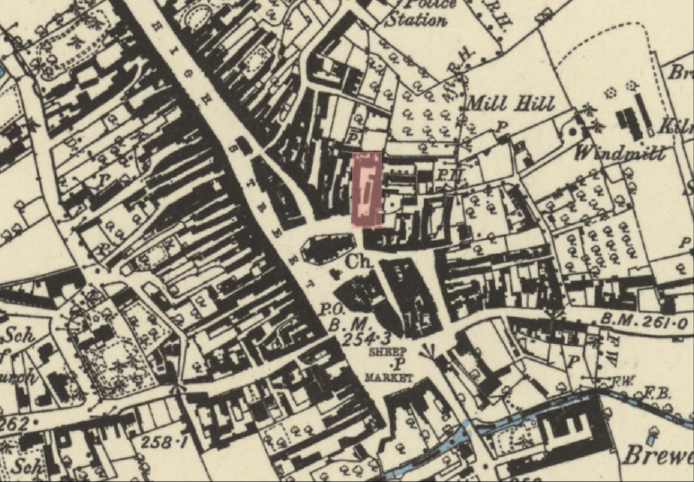
The yards of Market Harborough ran off the High Street and adjoining roads, behind the more substantial shops, inns and houses. The residential yards were similar to court housing – low quality, high density property where poor people were housed, often in less than desirable conditions. Sun Yard, now demolished, was situated behind the church in which they married – roughly where Roman Way now leads off from Church Square and Adam and Eve Street.

Samuel and Elizabeth, who did not have any children, continued to live in Sun Yard until a tragic event occurred in early 1892.

Sun Yard highlighted on a map of Market Harborough c1885

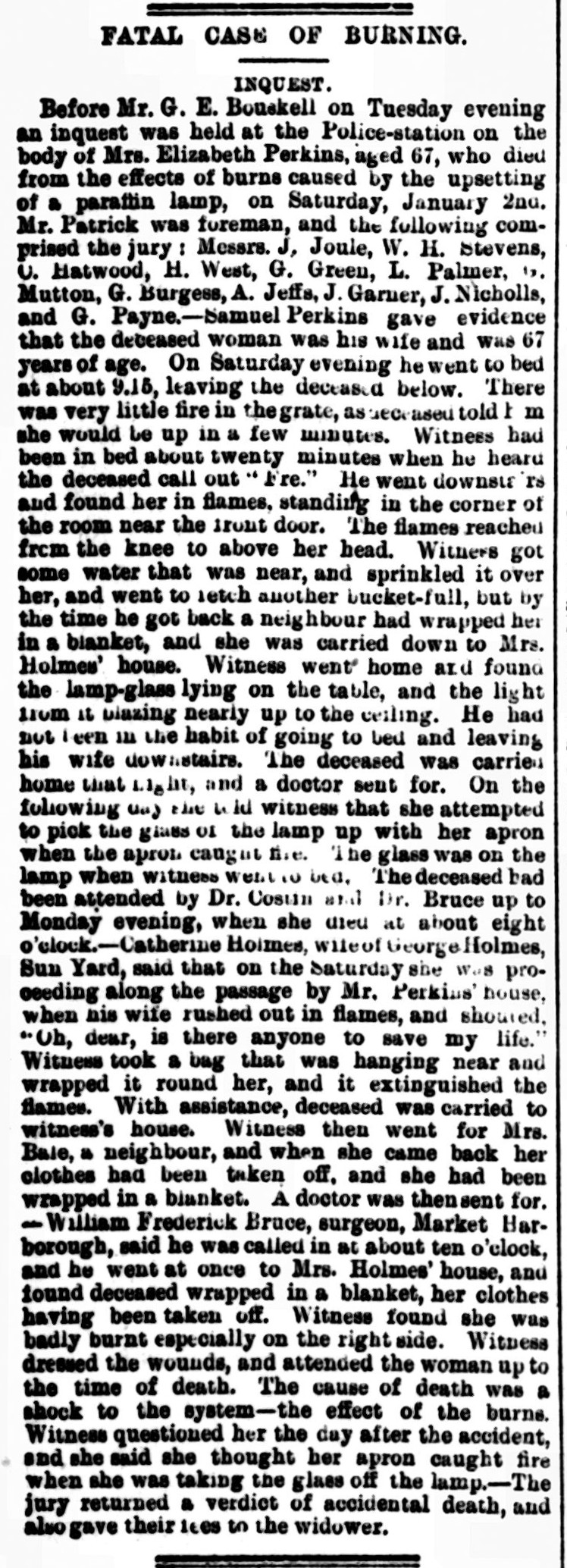
On the night of Saturday 2 January, about quarter past 9, Samuel decided to go to bed, and left his wife Elizabeth sitting by a small fire – she said she would go to bed herself in a few minutes.

After about 20 minutes, Samuel heard Elizabeth shouting, “Fire!” and rushed downstairs to find his wife in flames. She was standing in a corner near the door which led into the yard, with her clothing in flames from her knees up over her head. He threw some water over her that he kept in the room in case of fire, and went out to fetch more water.

While he was gone, their neighbour, Catherine Holmes, who had been coming down the passage at the end of the Perkins’ house, saw Elizabeth rush out in flames shouting, “Oh, dear, is there anyone to save my life?”

Mrs. Holmes took a bag (or sack) that was hanging nearby and put it around her shoulders to extinguish the flames. With assistance, Elizabeth was carried into Mrs. Holmes’ house. She went to get another neighbour, Mrs. Bale, and when she came back Elizabeth’s clothes had been taken off, and she was wrapped in a blanket.

When Samuel returned to his house, he found the lamp-glass lying on the table, and the light from it blazing nearly up to the ceiling. Elizabeth was carried back home, and Mrs Holmes’ then sent one of her young sons to fetch a doctor.

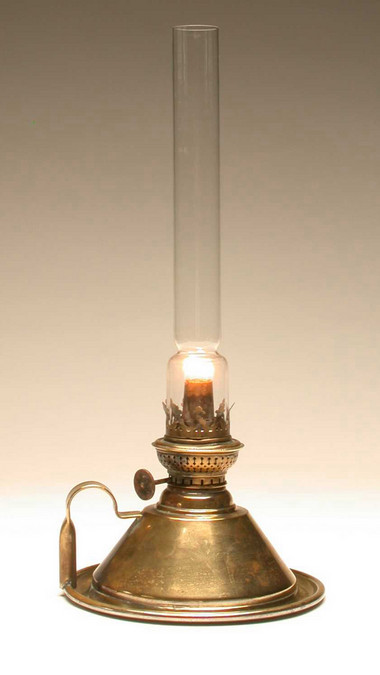
An 1860s lamp (via ObjectLessons.org)

The next day, Samuel asked Elizabeth how the accident happened. She said she was trying to put the glass over the lamp with her apron, when the apron caught fire.

Despite continuing medical treatment from doctors, Elizabeth died about 8 o’clock Monday evening.

An inquest was held at the police station on Tuesday 12 January.

Mr. William Frederick Bruce, the surgeon who attended her, stated that he found Elizabeth suffering from extensive burns on the body, especially on the right side, the throat, and mouth. He dressed the wounds and attended her until her death which he thought was caused by shock to the system.

Samuel said he had not been in the habit of going to bed and leaving his wife downstairs, and that when he had gone upstairs the glass was on the lamp.

The jury returned a verdict that Elizabeth was accidentally burnt to death by the upsetting of a paraffin lamp. Touchingly, the jury, in an act of sympathy and/or charity, gave their fees to Samuel.

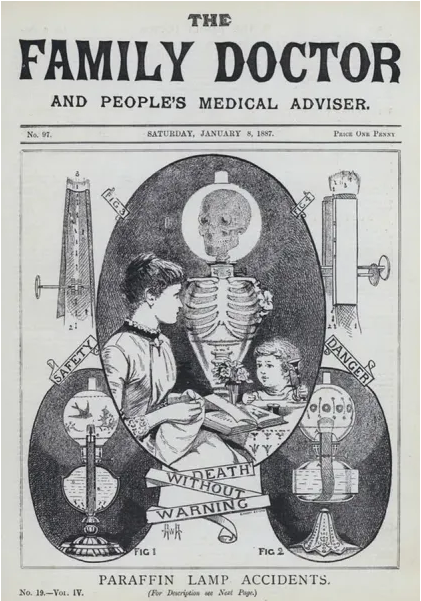
This 1887 cover of ‘The Family Doctor and People’s Medical Adviser’ cautioned against the dangers of paraffin lamps.

Poor Elizabeth was just one of many deaths attributed to the use of paraffin lamps in the home. Although there are no specific numbers and statistics, a look through the newspapers shows just how prevalent paraffin lamp accidents were in Victorian times. In an age where gas and electricity were not yet widely available (gas lighting was only introduced to Leicestershire in 1879, and electricity in 1899), these lamps offered more affordable, brighter and longer-lasting light than candles.

Market Harborough Advertiser, 19 Jan 1892, p5, c1

Elizabeth was my husband’s 3rd great-grandaunt.

She was the sister of Sarah Collins who was the wife of Thomas Ebben. Thomas died in Market Harborough in 1878, and it seems quite likely that he also died in Sun Yard, maybe even in the home of Elizabeth and Samuel.

Newspaper Sources:

  • Shocking Case of Burning: Market Harborough Advertiser, 12 Jan 1892, p4, c1
  • Shocking Paraffin Lamp Accident; Leicester Chronicle, 16 Jan 1892, p7, c8
  • Fatal Case of Burning: Market Harborough Advertiser, 19 Jan 1892, p5, c1

Related posts:

Lower Shobrooke

‘Lower Shobrooke’ was a property owned by members of the Wreford family. Often described as being situated in Morchard Bishop, it is closer to the Hamlet of Morchard Road (within the parish of Down St Mary). It is described as a ‘detached period farmhouse‘ or a ‘period cottage’ but the exact period this refers to is unspecified.

c1809 map
‘Shobrook’ shown in proximity to Morchard Bishop and Down St Mary c1809

It is unclear when the property entered Wreford hands but the estate was mentioned in the Domesday Book as ‘Schipebroc’ (Sheepbrook), and apparently even earlier in a charter of 930 AD.

The estate passed from Matthew Wreford (1712-1752) to his eldest son Matthew (1741-1821) and (it seems) subsequently to his son John (1765-1845).

Matthew (junior) had to wait until he turned 24 before inheriting – he was only 11 when his father died. (Matthew senior died at the age 40, and eleven years before his own father Matthew Wreford ‘of Middlecott’ (1682-1763).

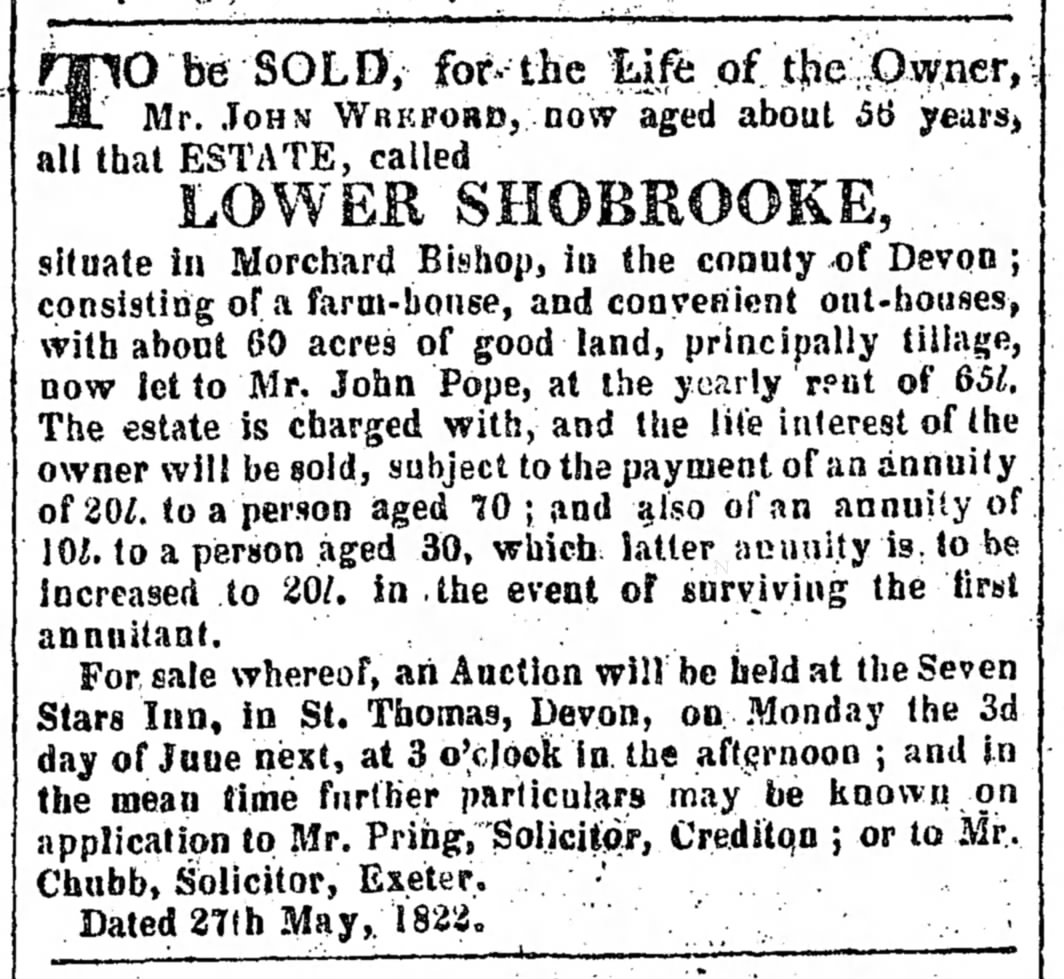
In 1822, Lower Shobrooke was put up for auction “to be SOLD for the Life of the Owner, Mr. JOHN WREFORD, now aged about 56 years…”

However, it is unclear whether the property sold as his wife, Betty (nee Hosegood), was described as ‘of Lower Shobrooke’ when she was buried in 1829.

In the 1841 census, three families were living at ‘Shobrook’, including the family of John Wreford (1817-1892). (He was the great grandson of Matthew Sr’s brother William Wreford (1717-1763). This John Wreford was recorded at ‘Higher Shobrooke’ in the 1851 census.

In the 1851 census, two families were recorded at ‘Lower Shobrooke’, named Mann and Warren. The heads were recorded as agricultural labourers so would not have owned the property.

Image of part of the 1851 census
The Mann family at Lower Shobrooke in the 1851 census
Image of part of the 1851 census
The Mann family at Lower Shobrooke in the 1851 census

My ancestry

Matthew Wreford (1712-1752) was my 7th great-grandfather.

Links related to Lower Shobrooke:

Location on modern map

Location on c1904 map

Location on c1886 map

Location on c1809 map

Shobrooke Farmstead on Heritage Gateway (Devon & Dartmoore HER)

Real estate catalogue

Lower Shobrooke, Wreford Name Study wikitree category – lists profiles of Wrefords connected with the property

Related posts: