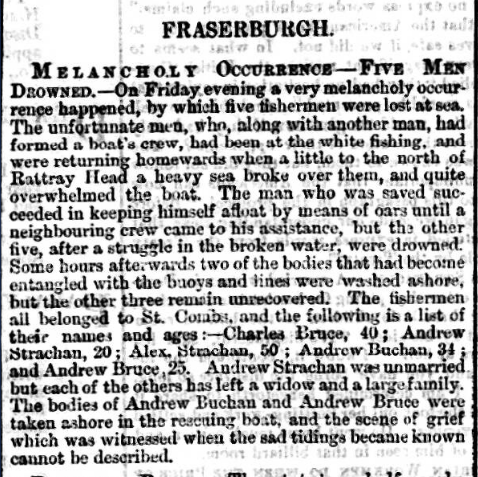
…two of the bodies that had become entangled with the buoys and lines were washed ashore, but the other three remain unrecovered. Buchan Observer and East Aberdeenshire Advertiser, 16 February 1872, p3, c3
The Three Buried at Sea
Of the five men who drowned when their boat was overturned near Rattray Head on 9 February 1872, the bodies of Charles Bruce (40), and father and son, Alexander (50) and Andrew (20) Strachan, were never recovered.
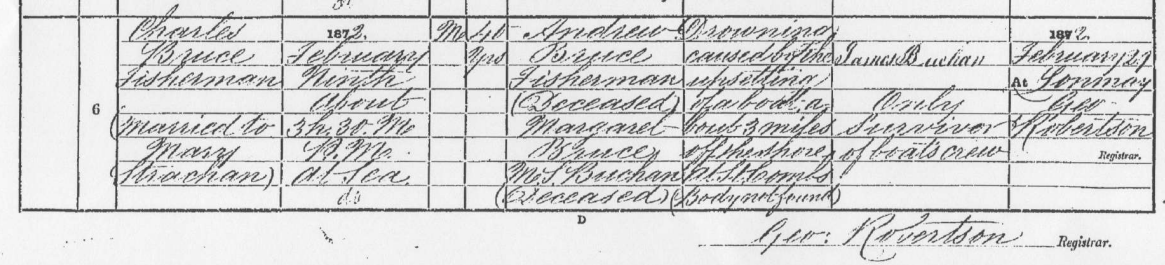
Charles Bruce
Charles was the son of fisherman Andrew Bruce and Margaret Buchan. He was one of at least eight siblings who grew up in the small fishing cottage of 35 St Combs.
He married Mary Strachan on 23 February 1854 and by 1871, they had at least seven children. They were all recorded living at number 99 (East Row) on the 1871 census.
Death record of Charles Bruce
After the tragedy, Mary appears to have remained at no. 99. She was recorded there in the 1881 census with two of their sons, Andrew (13) and William (10), her visiting daughter Jane (24) and infant granddaughter Mary Stephen (4 months). Daughter Mary was working as a servant a few doors away (house 95).
All of Charles’ children appeared to have either worked in the fishing industry, or married fishermen and remained nearby, except Mary, who married printer/compositor James Joss in 1886 and emigrated to Canada c1912.
(A memorial for Charles and Mary was erected by their family in the Lonmay Kirkyard.)
Alexander and Andrew Strachan
Alexander and Andrew Strachan were father and son.
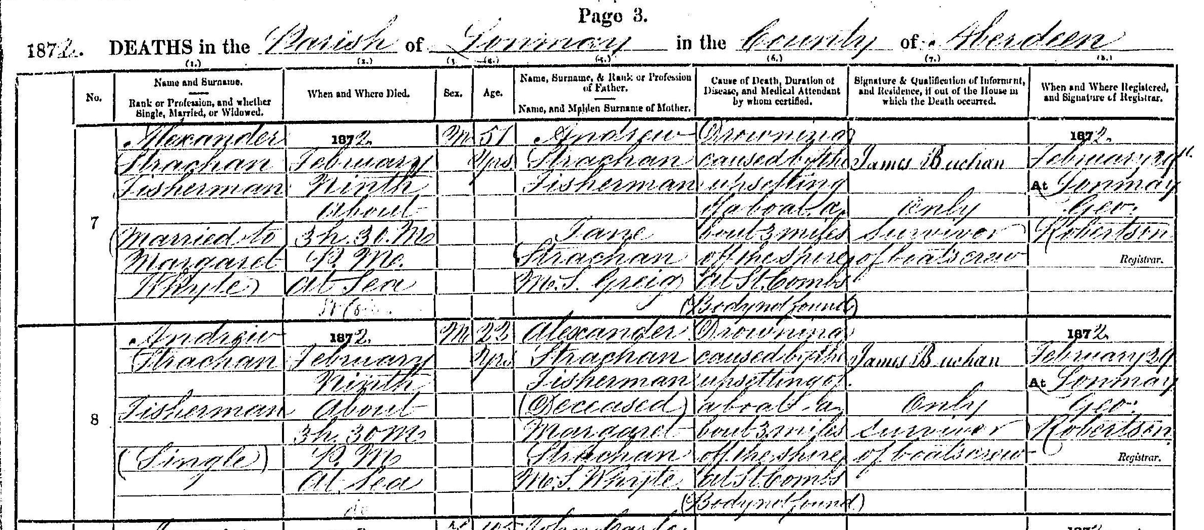
Alexander was the son of Andrew Strachan and Jane Greig. He married Margaret Whyte on 4 October 1846 at Lonmay.
Alexander and Margaret’s son Andrew was born about 1850 and grew up in St Combs with his three younger siblings, Barbara, Gordon and John, before following in his father’s footsteps to become a fisherman.
Death records of Alexander and Andrew Strachan
After the deaths of her husband and son, Margaret remained at 85 East Street until at least 1891. In the 1901 census, she was recorded at 19 East Street with her daughter Gordon (yes, daughter!), who had stayed with her mother since the tragic event.
Eldest daughter Barbara married fisherman Andrew Noble in 1875. They lived at nearby Cairnbulg (no 60) with their four children for most (if not all) of their lives.
Youngest son John stayed in the area but did not appear to remain in the fishing industry – he was recorded as a tailor in 1881, a carter in 1891, and a butcher’s labourer in 1901. He had married young Elizabeth Ann Buchan in 1890 and they had a daughter, Maggie Ann.
Two of the bodies were also picked up by the boat, but both were quite dead. Dundee Courier, 12 February 1872, p2, c6
The Two Recovered
Of the five men who drowned when their boat was overturned near Rattray Head on 9 February 1872, only two were recovered. The bodies of Andrew Buchan (34) and Andrew Bruce (24) were taken ashore in the boat that rescued James Buchan, the sole survivor.
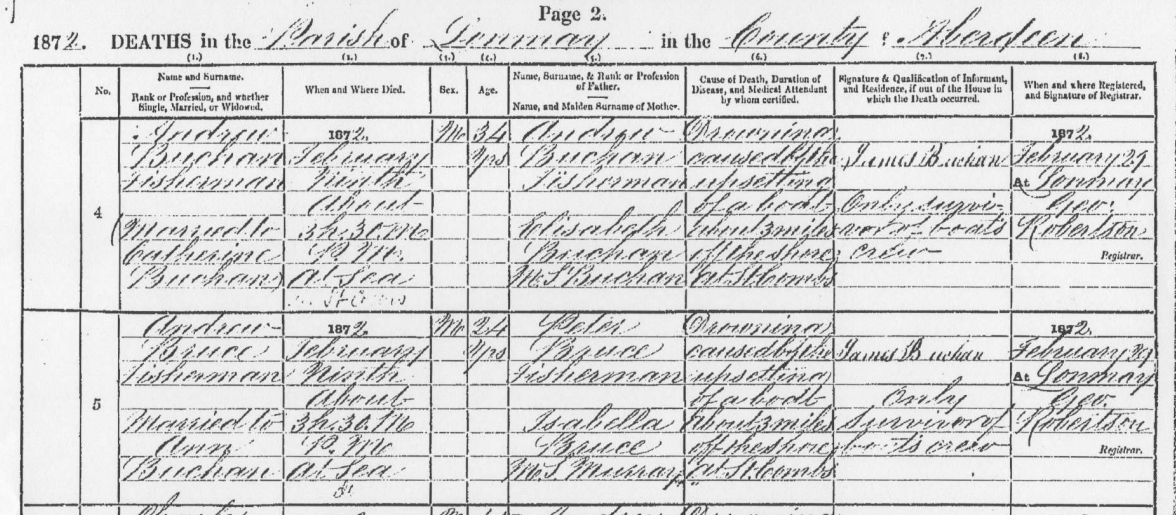
Death records of Andrew Buchan and Andrew Bruce
Andrew Buchan
Andrew Buchan was the son of fisherman Andrew Buchan and his wife Elizabeth Buchan. He was the eldest of eight siblings, all born and bred at St Combs.
Andrew married Catherine Buchan on 7 November 1861.
In 1871, Andrew and Catherine were recorded at 54½ Mid Row, St Combs with their four young children, Mary, Elspet, Andrew, and James.
After Andrew’s tragic death, his widow Catherine was recorded in the 1881 census still at 54½ with their sons, Andrew and James, now 13 and 11. She appears to have at least had some support from Andrew’s parents who were ‘next door’ in number 54 (54 and 54½ appear to be attached).
Eldest daughter Mary married James McLean in 1886 and Catherine was recorded in their Peterhead home on the 1891 census. Catherine appears not to have remarried.
Daughter Elspet (15) appears to be working as a servant for Peter Bruce in 1881. She later married fisherman William Shand in 1886 and lived in Peterhead.
Son James broke with family tradition and became a baker in Govan, Lanarkshire, marrying Willamina McDonald in 1893.
It is unclear what became of Andrew – due to his common name, tracing him reliably (and cheaply) was not possible. Any information would be welcome.
Andrew Bruce
Andrew Bruce was the son of fisherman Peter Bruce and his wife, Isabella Murray. He grew up with at least six other siblings in St Combs.
Andrew married Ann Buchan, daughter of fisherman John Buchan and Elizabeth Cow in 7 April 1870. Their first child, Peter, was born only five months later. He was born at Peterhead, which may have been the home of a relative. Andrew stated that he was present at the birth when registering it a few days later.
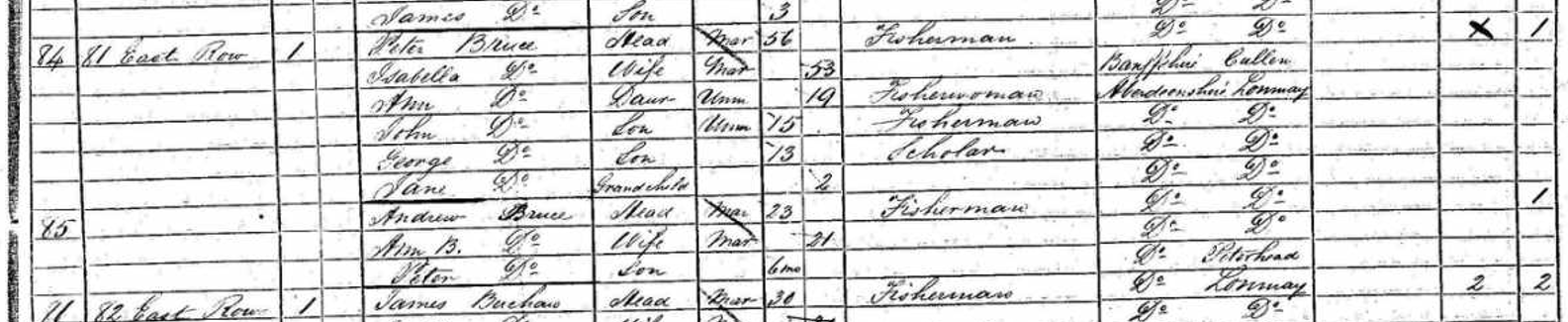
In 1871, Andrew, Ann, and 6-month-old Peter were recorded in the census at 81 East Row – the home of his father. Nine people were in the house that night (2 April).
Andrew Bruce with his wife and son in the 1871 census
Less than a year later, Andrew was drowned. At the time, his wife Ann was a few months pregnant with their second child. Their daughter was born in July (at 96 St Combs) and was named Andrew Ann in honour of her father.
Ann never remarried. In the 1881 census, she was recorded with her son Peter, and her widowed father, John Buchan at 96 St Combs. Ann was described as a grocer. In 1891, she and her father were still at Number 96 but Ann was now recorded as a ‘merchant (Bread-seller). This time, 18-year-old daughter, ‘Andrewina’ was with them.
Son Peter had broken with family tradition and become a joiner. He had moved to Lanarkshire by 1891 and married Margaret Anderson the next year, staying there until his death in 1924.
Ann died at 96 St Combs in 1895, aged 45, of “Influenza Bronchitis”. Two years later, daughter Andrew married fisherman William Strachan and lived in St Combs until her death in 1954.
At about 4 o’clock on a winter’s afternoon, off the north east coast of Scotland, a fishing boat was swamped by a heavy wave while returning home from a day’s work. Of the six men aboard, only one survived.
The tragedy occurred on Friday, 9 February 1872, about three miles from land, just north of Rattray Head. All of the crew were from the village of St Combs, in the parish of Lonmay, Aberdeenshire. As can be imagined, the incident had a devastating effect on the inhabitants of this tiny coastal village.
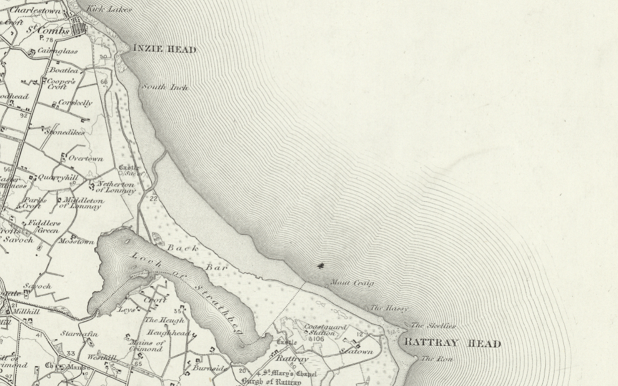
St Combs and Rattray Head shown on a map c1894
The sole survivor, James Buchan, signed as informant on the death records for his deceased crewmates – Andrew Buchan (34), Andrew Bruce (24), Charles Bruce (40), Alexander Strachan (50), and Andrew Strachan (20). The cause of death was recorded for all as “Drowning caused by the upsetting of a boat about 3 miles off the shore of St Combs”. “Body not found” was added in parentheses to the latter three, whose bodies were not recovered.
In following posts, I hope to share more about the lives of these unfortunate fishermen, and uncover the links, if any, to my own family.
ABERDEENSHIRE BOAT SWAMPED. FIVE FISHERMEN DROWNED. About four o’clock on Friday afternoon a fishing boat belonging to St Comb’s, parish of Lonmay, having on board a crew of six fishermen, while returning from the fishing, was swamped by a heavy sea when about four miles off the land, and five of the crew were drowned. The names of the unfortunate men are Charles Bruce, aged 40; Andrew Strachan, 20; Alexander Strachan, 50; Andrew Buchan, 34; Andrew Bruce, 25; all fishermen residing in St Comb’s. The other man, named James Buchan, succeeded in keeping himself afloat by clinging to the oars until a boat which was also returning from the fishing arrived at the scene and rescued him. Two of the bodies were also picked up by the boat, but both were quite dead. The lamentable occurrence has caused a feeling of depression throughout the whole neighbourhood. Dundee Courier, 12 February 1872, p2, c6
MELANCHOLY OCCURENCE—FIVE MEN DROWNED.—On Friday evening a very melancholy occurrence happened, by which five fishermen were lost at sea. The unfortunate men, who along with another man, had formed a boat’s crew, had been at the white fishing, and were returning homewards when a little to the north of Rattray Head a heavy sea broke over them, and quite overwhelmed the boat. The man who was saved succeeded in keeping himself afloat by means of oars until a neighbouring crew came to his assistance, but the other five, after a struggle in the broken water, were drowned. Some hours afterwards two of the bodies that had become entangled with the buoys and lines were washed ashore, but the other three remain unrecovered. The fishermen all belonged St. Combs, and the following is a list of their names and ages :—Charles Bruce, 40; Andrew Strachan, 20; Alex. Strachan, 50; Andrew Buchan, 34; and Andrew Bruce, 25. Andrew Strachan was unmarried but each of the others has left a widow and a large family. The bodies of Andrew Buchan and Andrew Bruce were taken ashore in the rescuing boat, and the scene of grief which was witnessed when the sad tidings became known cannot be described.
Buchan Observer and East Aberdeenshire Advertiser, 16 February 1872, p3, c3
In a previous post, I included a message from Rose Richards which ended casually with:
Cathy had a sister – Nellie Cash. She had a baby and hid it in the chimney. It was found by firemen I think. I don’t know what happened to her. How’s that for a tale?
Of course, I needed to find out more… and it is quite a tale indeed.
The Mental Defective
Nellie Cash was born on the 3rd of January 1915 and her father, sadly, died around the same time. A few years later, in 1918, her mother married Arthur G Morgan and soon after had Nellie’s half sister, Kathleen (the Cathy mentioned by Rose above). The girls’ mother seems to have died around 1930 and both girls remained with Arthur. Nellie, who was said to be a ‘mental defective’, kept house for her stepfather and sister at 19 Sims Avenue, Derby. A doctor would later state that “In his opinion it must have been evident to anyone who saw her frequently that she was feeble-minded, unless the person concerned was feeble-minded too.”
The Body
On 26 February 1938, the body of an infant was recovered by police from the front bedroom of 19 Sims Avenue (reports do not mention who first brought it to their attention). The baby girl, which had been wrapped in a blue frock and placed in a mat bag, was first put into a cupboard and later placed in the bedroom chimney. A post mortem examination determined that the baby died due to inattention but had not taken a breath. Nellie admitted that she had recently given birth to a child and was taken to the police station to give her statement.
The Affair
Two years earlier, 21-year-old Nellie had become acquainted with 58-year-old David Dean. Dean, who lived at 36 Cobden Street and had been married for 30 years with three children, kept a tobacconist shop from which Nellie would fetch tobacco for her stepfather.
A tobacco wholesaler on London Road, Derby (c1930) via The Guardian
At some point, they began some kind of ‘relationship’ and Nellie was of the opinion that she was ‘going out with him’. Dean gave a rather dubious account that he had been ‘pestered’ by Cash at a time when he had no work to do, and had ‘yielded’ to her.
Nellie told the police she had previously given birth to another child of Dean’s in December 1936 and told him it was dead. She had put the baby in a bag and together they emptied the ‘contents’ of the bag in the River Derwent. After Nellie gave birth for a second time on February 17, she told Dean it was dead and he said they would put it in the river.
Nottingham Journal, 22 June 1938, p1 c2
Dean was charged under the Mental Deficiency Act of ‘a serious offence against a woman who was a mental defective’. He was found guilty and sentenced to six months’ imprisonment.
Bail for Nellie was allowed in the sum of £10, on the condition that she went to the Boundary House Institution (the former workhouse and later Manor Hospital). This condition seems to have been agreed to, as Nellie was recorded at the institution the following year on the 1939 register.
The Aftermath
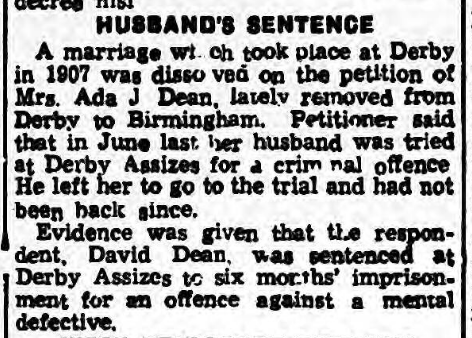
In November 1938, Dean’s wife of 30 years was granted a decree nisi. She had moved to Birmingham, most likely to escape the scandal and gossip her husband’s actions had caused. Dean’s offence and imprisonment were given in evidence, and the court was told that he left her to go to the trial and had not been back since.
Nottingham Journal, 28 November 1938, p1 c4
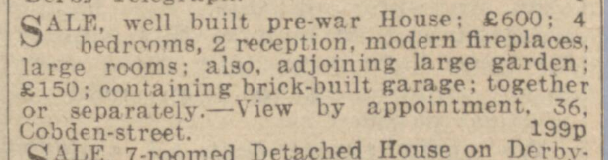
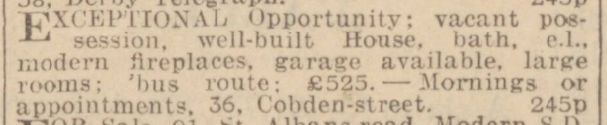
Interestingly, 36 Cobden Street was advertised for sale in the Derby Daily Telegraph in August; and again in October at a reduced price. It is not surprising that his wife would want to cut ties and leave the area as soon as possible.
Derby Daily Telegraph, 20 August 1938, p3 c3Derby Daily Telegraph, 12 October 1938, p2 c6
David Dean served his time and the next year was recorded in the 1939 register at the Church Army Hostel on 20 Bridge Street (albeit with 10 years shaved off his age). He died a few years later in 1942.
As for Nellie, it is unclear how long she stayed at Boundary House but in 1955 she married a man named John O’Sullivan. I like to think that she lived happily ever after.
CHILD’S BODY IN CHIMNEY
HINT OF OTHER PROCEEDINGS
DERBY INQUEST
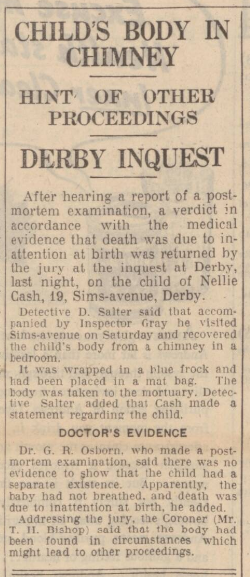
After hearing a report of a post-mortem examination, a verdict in accordance with the medical evidence that death was due to inattention at birth was returned by the jury at the inquest at Derby, last night, on the child of Nellie Cash, 19, Sims-avenue, Derby.
Detective D. Salter said that accompanied by Inspector Gray he visited Sims-avenue on Saturday and recovered the child’s body from a chimney in a bedroom.
It was wrapped in a blue frock and had been placed in a mat bag. The body was taken to the mortuary. Detective Salter added that Cash made a statement regarding the child.
DOCTOR’S EVIDENCE
Dr. G. R. Osborn, who made a post-mortem examination, said there was no evidence to show that the child had a separate existence. Apparently, the baby had not breathed, and death was due to inattention at birth, he added.
Addressing the jury, the Coroner (Mr. T. H. Bishop) said that the body had been found in circumstances which might lead to other proceedings. Derby Daily Telegraph, 01 March 1938, p5, c2
Derby Daily Telegraph, 22 June 1938, p7
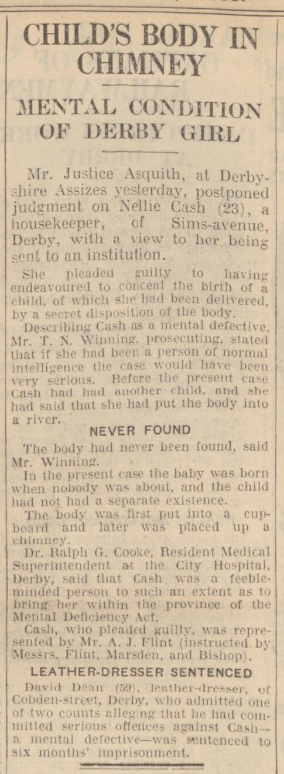
CHILD’S BODY IN CHIMNEY
MENTAL CONDITION OF DERBY GIRL
Mr. Justice Asquith, at Derbyshire Assizes yesterday, postponed judgment on Nellie Cash (23), a housekeeper, of Sims-avenue, Derby, with a view to her being sent to an institution.
She pleaded guilty to having endeavoured to conceal the birth of a child, of which she had been delivered, by a secret disposition of the body.
Describing Cash as a mental defective, Mr. T. N. Winning, prosecuting, stated that if she had been a person of normal intelligence the case would have been very serious. Before the present case Cash had had another child, and she had said that she put the body into a river.
NEVER FOUND
The body had never been found, said Mr. Winning.
In the present case the baby was born when nobody was about, and the child had not had a separate existence.
The body was first put into a cupboard and later was placed up a chimney.
Dr. Ralph G. Cooke, Resident Medical Superintendent at the City Hospital, Derby, said that Cash was a feeble-minded person to such an extent as to bring her within the province of the Mental Deficiency Act.
Cash, who pleaded guilty, was represented by Mr. A. J. Flint (instructed by Messrs. Flint, Marsden and Bishop).
LEATHER-DRESSER SENTENCED
David Dean (59), leather-dresser of Cobden-street, Derby, who admitted one of two counts alleging that he had committed serious offences against Cash – a mental defective – was sentenced to six months’ imprisonment. Derby Daily Telegraph, 22 June 1938, p7
From the Derby Daily Telegraph, 21 April 1938, p10 c5:
LEATHER DRESSER ACCUSED
David Dean (60), a leather-dresser, of 36, Cobden-street, Derby, was accused of a serious offence against a woman who was a mental defective, between January 1 and February 17.
Mr. E. H. Nichols, assistant solicitor to the Derby Corporation, prosecuting, said that the case was brought under the Mental Deficiency Act.
Arthur George Morgan, a labourer, of 19, Sims-avenue, Derby, said that his step-daughter, Nellie Cash, was 23, and kept house for himself and his daughter.
He knew of a tobacconist’s shop kept by Dean, and Nellie Cash used to go there for his tobacco.
Nellie Cash, who was warned by the Clerk (Colonel W. R. H. Whiston) that she was not obliged answer any questions which might incriminate her, said that she had known Dean for about two years and had been going out with him.
Mr. F. W. Barnett, who represented Dean, objected to further questions.
Dr. Ralph G. Cooke, Resident Medical Superintendent of the City Hospital, Derby, said that Cash was admitted on February 26 last in a debilitated condition.
Her history was that she had given birth to a child on February 17 and her condition was consistent with that.
UNDER OBSERVATION
He had had her under observation, and in his opinion she was a feeble-minded person to a sufficient degree to bring her within the province of the Mental Deficiency Act.
In his opinion it must have been evident to anyone who saw her frequently that she was feeble-minded, unless the person concerned was feeble-minded too.
Mr. Barnett submitted that the prosecution had failed to make out a case under any criminal charge.
The magistrates decided that there was a prima facie case against Dean, and he was committed for trial at the next Derbyshire Assizes, bail being allowed in the sum of £10.
Dean said that he did not wish to give evidence or to call witnesses.
BODY IN CHIMNEY
Evidence of a child’s body being recovered from a chimney was given when Cash, who was described as a housekeeper of 19, Sims-avenue, Derby, was accused of endeavouring to conceal the birth on February 17 of a female child, of which she had been delivered, by the secret disposition of its body. Detective-constable D. Salter said that he saw Cash at her home on February 26, and after being cautioned she admitted that she had recently given birth to a child. He took her to the police station, where she made a statement.
The officer read this statement, in which Cash was alleged to have stated that she gave birth to a child in December, 1936, and she told Dean it was dead.
She had put the baby in a bag, the statement added, had gone out with Dean, and he had emptied the contents of the bag in the River Derwent.
The statement added that she gave birth to another baby on February 17 this year, and when she told Dean it was dead he said they would put it in the river.
In the statement Cash alleged that Dean was the father of both the children born to her.
WRAPPED IN FROCK
Detective Salter added that Cash took him to the front bedroom of her home, and he recovered from the chimney the body of a female child which was wrapped in an old blue frock and in a bag.
Dr. G. R. Osborne, pathologist at Derbyshire Royal Infirmary, said that a post mortem examination disclosed that the baby born in February had not had a separate existence, and death was due to inattention at birth.
Cash was committed for trial at Derbyshire Assizes, Mr. F. W. Barnett, who appeared on her behalf, offering no objection.
Bail was allowed in the sum of £10, on condition that she went to Boundary House. Derby Daily Telegraph, 21 April 1938, p10 c5
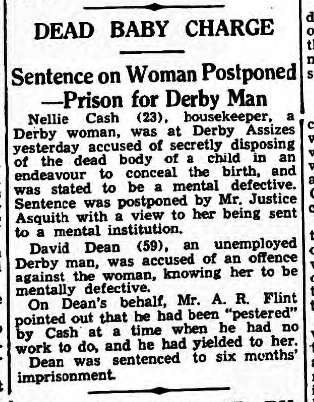
From the Nottingham Journal, 22 June 1938, p1, c2:
DEAD BABY CHARGE
Sentence on Woman Postponed
-Prison for Derby Man
Nellie Cash (23), housekeeper, a Derby woman, was at Derby Assizes yesterday accused of secretly disposing of the dead body of a child in an endeavour to conceal the birth, and was stated to be a mental defective. Sentence was postponed by Mr. Justice Asquith with a view to her being sent to a mental institution.
David Dean (59), an unemployed Derby man, was accused of an offence against the woman, knowing her to be mentally defective.
On Dean’s behalf, Mr. A. R. Flint pointed out that he had been “pestered” by Cash at a time when he had no work to do, and he had yielded to her.
Dean was sentenced to six months’ imprisonment. Nottingham Journal, 22 June 1938, p1, c2
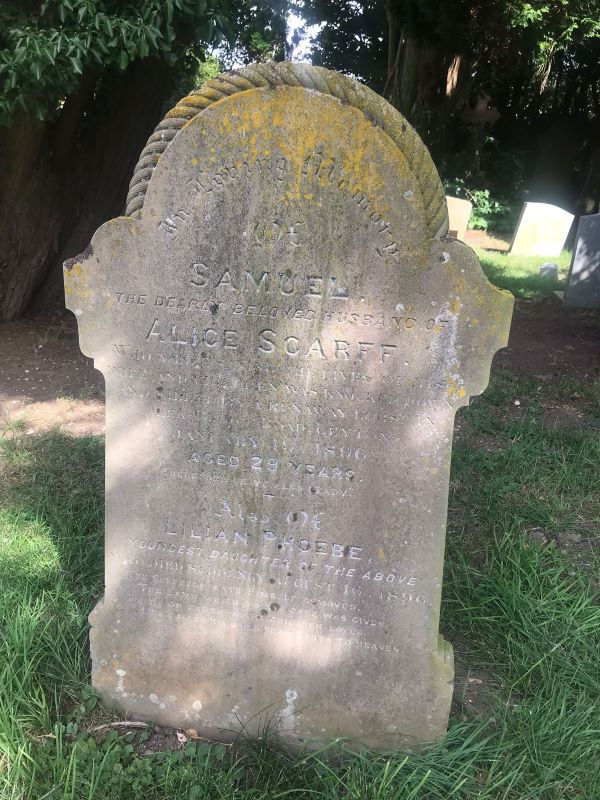
Under the shade of trees in a rural Suffolk churchyard of Combs, there stands a gravestone with an intriguing epitaph.
In Loving Memory
Of
SAMUEL The dearly beloved husband of
ALICE SCARFF
Who while saving the lives of his
wife and children was knocked down
and killed by a runaway horse in
Lea-Bridge Road, Leyton.
JANUARY 19, 1896.
AGED 29 YEARS.
“Therefore be ye also ready.”
Also Of
LILIAN PHOEBE
Youngest daughter of the above
WHO DIED SUDDENLY AUGUST 16, 1896.
The shepherd hath himself removed,
The lamb to which His care was given,
For He on earth whom children loved,
Hath called His child from earth to heaven.
Samuel Scarff was born in Combs to woodcarter John Scarff and Elizabeth Grimwood. By 1891, he had moved to London and was working as a carman in Marylebone. His future bride, Alice Horne, was also from Combs and working as a general servant in nearby Blenheim Road at the time.
In 1894, Samuel and Alice married at Walthamstow, Essex and two daughters, Sissie and Lilian, quickly followed. Unfortunately, tragedy would strike this young family on a winter’s day in 1896.
Essex Standard, 25 January 1896, p7 c4
SHOCKING FATAL ACCIDENT. -A MAN KILLED BY A RUNAWAY HORSE. -A shocking accident occurred on Sunday afternoon, Jan. 19. in Chesnut Walk, Walthamstow. Samuel Scarff, aged 28, in the employment of Spiers and Pond, and living in Boundary Road, Walthamstow, was walking towards the Forest on the broad footway, accompanied by his wife and by their two little children in a basinette. A horse attached to a hooded buggy, driven by Joseph Lyon, of Lower Clapton, who was accompanied by Samuel Pearce, of Forest Gate, and John McDougall, of Leytonstone, bolted at Whipps Cross and galloped down Chesnut Walk at a terrific rate, the young men being unable to control it. At an opening in the row of trees opposite the residence of Mr. Helme the horse turned on to the footpath, and continued its mad career. Scarff managed to get his wife and children clear, but he was himself knocked down with terrible violence, and was conveyed in an unconscious state to the Walthamstow Hospital. His injuries were very severe, and he died the same evening the presence of his wife, who was distracted with grief. The runaway horse eventually came to a standstill through crashing into a fence. The three occupants were thrown out, but were not injured.
Essex Standard, 25 January 1896, p7 c4
An inquest was held which ultimately returned a verdict of ‘Accidental Death’ and deep sympathy was expressed towards his young widow Alice.
London Evening Standard, 23 January 1896, p7, c5
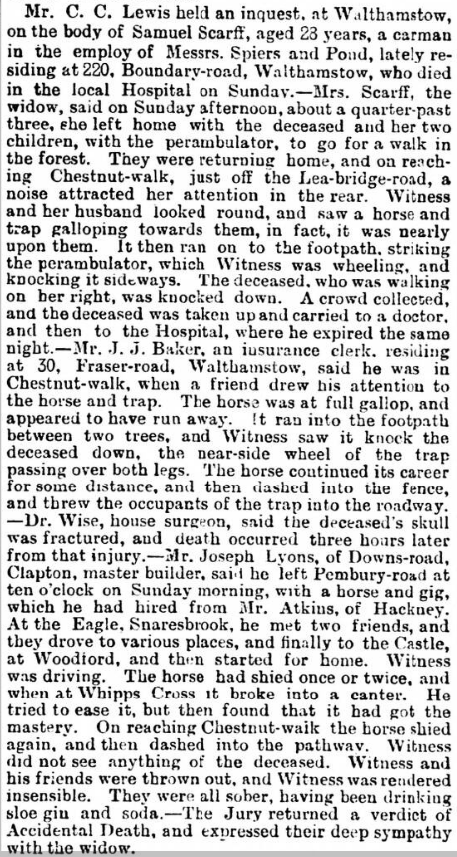
Mr. C. C. Lewis held an inquest, at Walthamstow, on the body of Samuel Scarff, aged 28 years, a carman in the employ of Messrs. Spiers and Pond, lately residing at 220, Boundary-road, Walthamstow, who died in the local Hospital on Sunday. -Mrs. Scarff, the widow, said on Sunday afternoon, about a quarter-past three, she left home with the deceased and her two children, with the perambulator, to go for a walk in the forest. They were returning home, and on reaching Chestnut-walk, just off the Lea-bridge-road, a noise attracted her attention in the rear. Witness and her husband looked round, and saw a horse and trap galloping towards them, in fact, it was nearly upon them. It then ran on to the footpath, striking the perambulator, which Witness was wheeling, and knocking it sideways. The deceased, who was walking on her right, was knocked down. A crowd collected and the deceased was taken up and carried to a doctor, and then to the Hospital, where he expired the same night. -Mr. J. J. Baker, an insurance clerk, residing at 30, Fraser-road, Walthamstow, said he was in Chestnut-walk, when a friend drew his attention to the horse and trap. The horse was at full gallop, and appeared to have run away. It ran into the footpath between two trees, and Witness saw it knock the deceased down, the near-side wheel of the trap passing over both legs. The horse continued its career for some distance, and then dashed into the fence, and threw the occupants of the trap into the roadway. -Dr. Wise, house surgeon, said the deceased’s skull was fractured, and death occurred three hours later from that injury. -Mr. Joseph Lyons, of Downs-road, Clapton, master builder, said he left Pembury-road at ten o’clock on Sunday morning, with a horse and gig, which he had hired from Mr. Atkins, of Hackney. At the Eagle, Snaresbrook, he met two friends, and they drove to various places, and finally to the Castle at Woodford, and then started for home. Witness was driving. The horse had shied once or twice, and when at Whipps Cross it broke into a canter. He tried to ease it, but then found that it had got the mastery. On reaching Chestnut-walk the horse shied again, and then dashed into the pathway. Witness did not see anything of the deceased. Witness and his friends were thrown out, and Witness was rendered insensible. They were all sober having been drinking sloe gin and soda. -The Jury returned a verdict of Accidental Death, and expressed their deep sympathy with the widow. London Evening Standard, 23 January 1896, p7, c5
It was heartening to discover that shortly after the accident, a committee was formed to raise funds to assist Alice and her children. Samuel’s employers and colleagues at Spiers & Pond, had also contributed and in February, Alice received over £100 – at least £15 of which “two little children named Beresford” had, heartwarmingly, “got together… in small sums”.
Chelmsford Chronicle, 07 February 1896, p7, c7Chelmsford Chronicle, 21 February 1896, p7, c6
Unfortunately, poor Alice would receive another blow in August the same year when little Lilian Phoebe, not yet a year old, died suddenly. The child’s death was registered in Stow district which suggests Alice had returned to her family in Combs after Samuel’s death.
Samuel and Alice’s surviving daughter Sissie, recorded with Alice’s parents in 1901 and Alice’s sister in 1911, would grow up to marry a man named James Alexander Donaldson and live a long life.
Alice never remarried and diedin 1964 at the ripe old age of 94.