Whilst looking for information on her daughter’s marriage in 1917, I stumbled across this intriguing advertisement in the newspaper placed by Alice Ann Glaister (nee White) the same year:
“TUESDAY, 27th NOVEMBER,
At 2 o’clock.
On the Premises, No. 17 Springhill road, Mornington (off Glen avenue).
Instructed by Mrs Glaister, who is giving up housekeeping…”
…followed by an impressive list of household possessions.
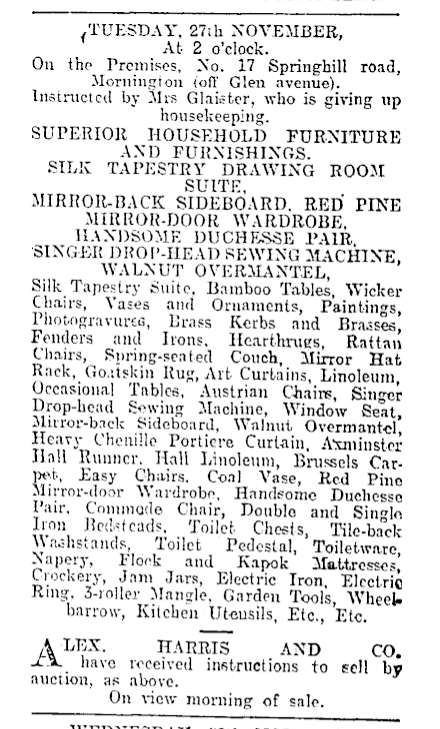
I had not heard the expression, ‘giving up housekeeping’ before but it seems to refer to a time when people are no longer able to maintain their own home and need to ‘give up’ or sell their possessions.
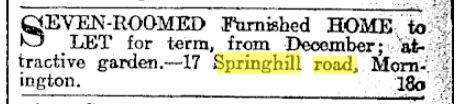
Alice’s husband was coachbuilder, William Glaister, who died 9 November, and was buried 11 November 1917. A couple of weeks later, Alice was auctioning off her household furniture and furnishings from her home at 17 Springhill Road – where the couple had lived since at least 1890. (Their daughter, Mary, had even married at the address earlier that year.)
Interestingly, the family had starting advertising the home to be let as early as 20 October 1917. William was suffering from stomach cancer and the family probably knew his time was coming to an end and so were making preparations for the future.
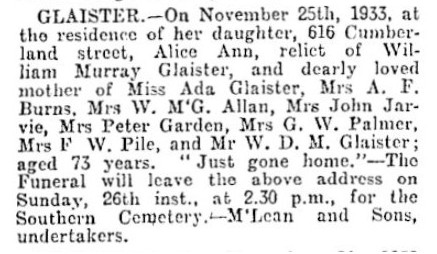
In 1933, 16 years after William’s death, Alice died ‘at the residence of her daughter, 616 Cumberland Street’. But which daughter? She had had seven daughters and two sons.
Alice’s second youngest daughter, Ada, was recorded at the Springhill Road residence with her parents in 1914. Ada would remain a spinster so this seems an obvious choice of family member to live with.
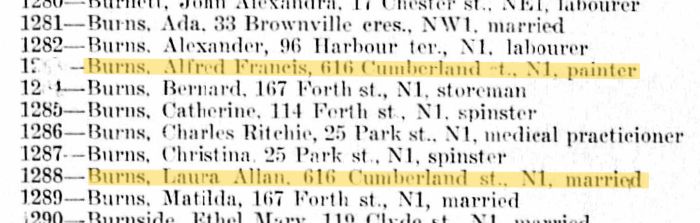
However, electoral records show that the home she died in was that of her eldest daughter, Laura, who had married Alfred Burns in 1908. The electoral rolls show her living there with her husband in 1931 and 1935.
Why not Ada Victoria?
Alice and Ada had been recorded moving from place to place together since 1919.
- 1919 – Hugh Street, Sawyers Bay (near Port Chalmers) (daughter Barbara was nearby in Glendermid – possibly even the same house)
- 1922 – 14 Maitland Street
- 1925 – 8 Jones Street
- 1928 – 8 Jones Street, then 117 Dundas Street
- 1931 – 117 Dundas Street
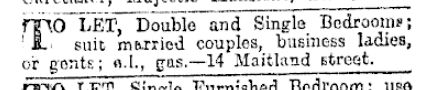
14 Maitland Street appeared to be some kind of boarding house based on advertisements in the newspapers.
8 Jones Street was let as a 4-room house in 1924 – perhaps this was the ad seen by Alice and Ada when planning their move from Maitland Street?

117 Dundas Street appeared to be owned (and lived in) by an Alfred Edwin Maitland and his family until at least 1949. There appears to be no family relationship to the Glaisters so perhaps they were simply renting a room?
In 1935, Ada was still at 117 Dundas Street and remained there for at least a few more years. This suggests she had not also been living in her sister’s house when Alice died in 1933. Ada may have had some form of employment which meant she could not care for her ailing mother, but no profession was given in the electoral rolls. Alice and Ada were described throughout the electoral rolls only as ‘widow’ and ‘spinster’, but this, along with, ‘married’, seemed to be the case for all the women on the page.
Although the phrase ‘giving up housekeeping’ had initially caught my attention, it led me to a valuable insight into my 2nd great grandmother’s life after her husband died and illustrated how much her circumstances changed. Alice went from having her own 7-bedroom home for about three decades, to moving between various rentals and boarding houses, possibly relying on her daughters for support.
A map of Alice Glaister’s residences from 1917 can be seen here.

 One of my favourite things about genealogy is feeling like a detective, and today gave me another opportunity to don my deerstalker and grab my pipe.