
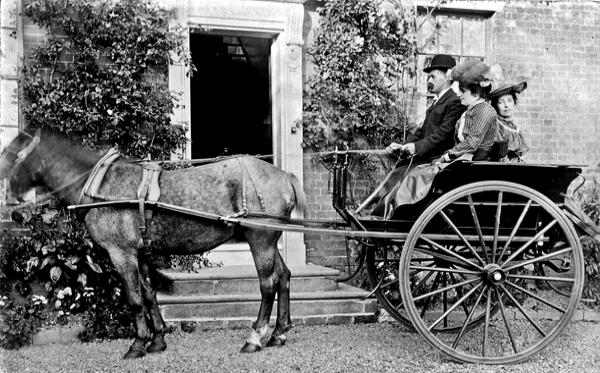
William Glaister, my 2nd great-grandfather, was a coachbuilder in Dunedin, New Zealand in the late 19th and early 20th century. A couple of years ago, I discovered he was also an inventor.
In 1892, William filed a patent for ‘An invention for improvement in two-wheeled vehicles’. An abstract was published in the New Zealand Gazette on 31 March 1892 (available via Ancestry).

If a member of the public wanted to purchase copies of the patent documents, they would pay 2 shillings and 6 pence for the written description of the invention, and 3 shillings for the accompanying technical illustration. William, himself, would have paid at least a few pounds for actually filing the patent. (Source: New Zealand Legislation – 1889 fee schedule)
Using the Intellectual Property Office New Zealand Patents register, I was able to view the original patent document in which included a description (in his own handwriting) and a drawing of the concept.
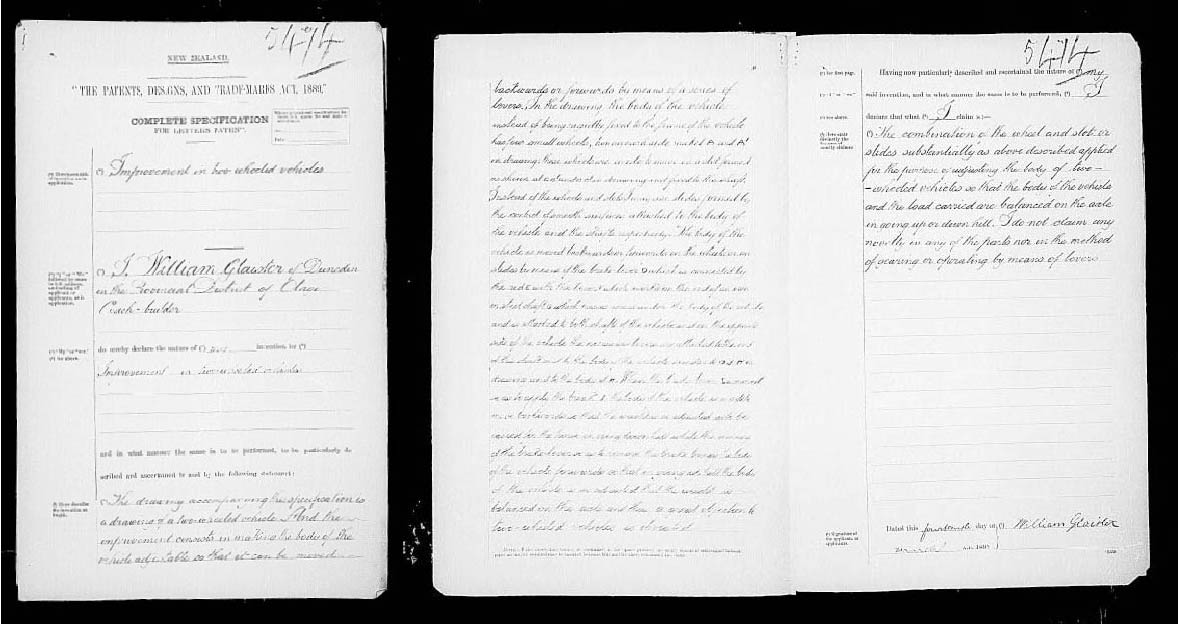
I have transcribed the specification, adding punctuation and paragraphs for ease of reading.
Here describe the invention at length
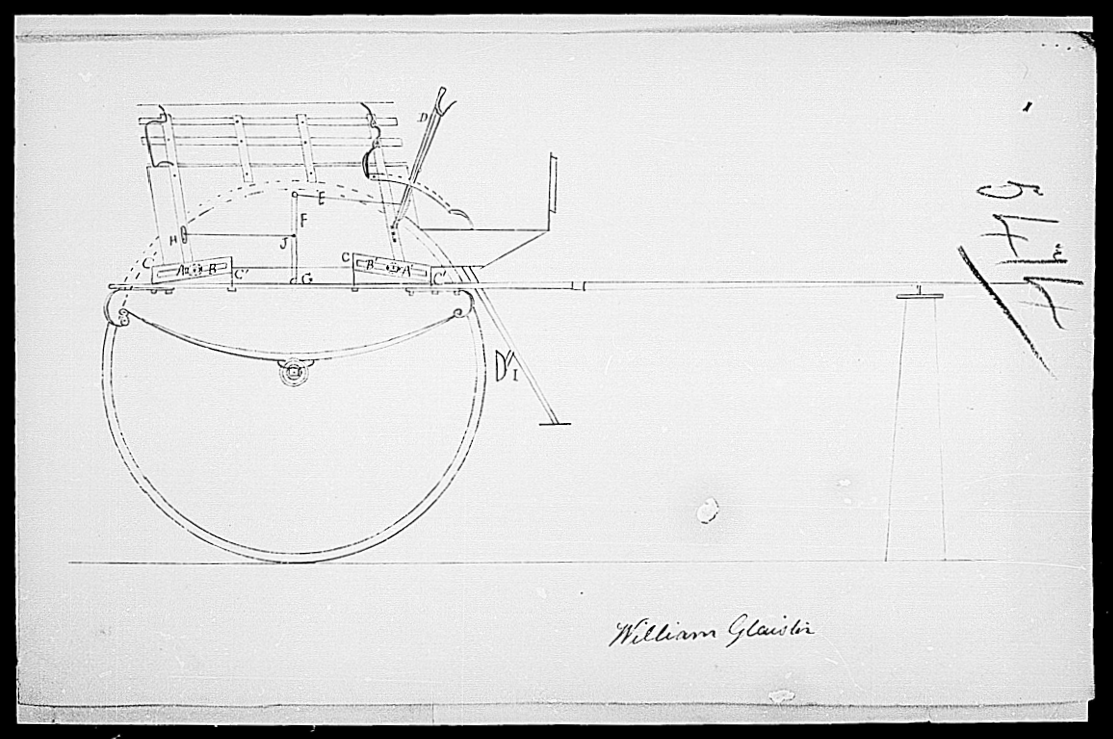
The drawing accompanying this specification is a drawing of a two-wheeled vehicle, and the improvement consists in making the body of the vehicle adjustable so that it can be moved backwards or forwards by means of a series of levers.
In the drawing, the body of the vehicle instead of being rigidly fixed to the frame of the vehicle has four small wheels, two on each side marked A and A1 in drawing: these wheels are made to move in a slot formed as shown at C C1 and C C1 in drawing and fixed to the shaft.
Instead of the wheels and slots, I may use slides formed by the conduct of smooth surfaces attached to the body of the vehicle and the shafts respectively.
The body of the vehicle is moved backwards or forwards on the wheels (or on slides) by means of the brake-lever D which is connected by the rod E with the lever F which works on the end of an iron or steel shaft G which passes across under the body of the vehicle and is attached to both shafts of the vehicle and on the opposite side of the vehicle the necessary levers are attached to the end of this shaft and to the body of the vehicle similar to G J H in drawing and to the body at H.
When the brake-lever D is moved so as to apply the break (I), the body of the vehicle is made to move backwards so that the weight is so adjusted as to be easiest for the horse in going down hill, while the moving of the brake-lever so as to remove the brake, brings the body of the vehicle forwards so that in going up hill the body of the vehicle is so adjusted that the weight is balanced on the axle and thus a great objection to two-wheeled vehicles is obviated.
Having now particularly described and ascertained the nature of my said invention, and in what manner the same is to be performed, I declare that what I claim is:
The combination of the wheel and slot or slides substantially as above described applied for the purpose of adjusting the body of two-wheeled vehicles so that the body of the vehicle and the load carried are balanced on the axle in going up or down hill. I do not claim any novelty in the any of the parts nor in the method of gearing or operating by means of levers.
Dated this fourteenth day of March A.D. 1892 [signed] William Glaister
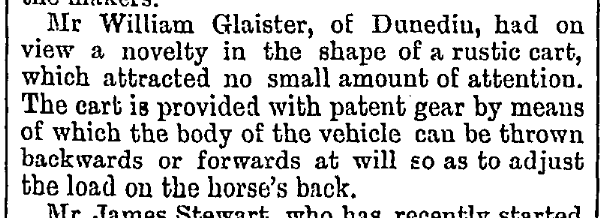
It’s still a bit difficult to understand (for me), but the Otago Daily Times gave a pretty good summary when William presented a cart using his invention at the Otago Agricultural Show that same year: “The cart is provided with patent gear by means of which the body of the vehicle can be thrown backwards or forwards at will so as to adjust the load on the horse’s back”. Load-balance was apparently a well-known issue for users of this type of vehicle.
I’m not sure how successful the invention was or whether it was utilised by other coachbuilders. Perhaps someone in the know could shed some light on that for me?