Bankrupt or Insolvent?

The debtors prison at St Briavels Castle c1858

The last time I looked into the financial woes of my ancestor George Wreford, I wanted a simple explanation into the change in bankruptcy laws in 1861. I’ve since learned the key to understanding is knowing the difference between bankruptcy and insolvency.

Bankruptcy or Insolvency?

Whether a person was declared bankrupt or insolvent, was dependent on the profession of the debtor.

Only traders could apply for bankruptcy and have access to some kind of relief – an ‘Order of Discharge’ – which would effectively clear the debt, and allow them to rebuild their business or finances. Any money earned after bankruptcy was theirs to keep.

Non-traders were not able to do this, and would be liable for their debts forever. Any future assets or inheritance could be seized by creditors to pay off old debts, and they could be kept in gaol indefinitely.

Why was this case?

It was a long-held belief that financial failure in commerce was a natural risk of business (think: ‘market fluctuations’), whereas failure in private life was a moral or personal failing (think: ‘extravagant lifestyles’). Debtor’s prisons were seen as a punitive measure to discourage living beyond one’s means.

What changed in 1861?

After the new Bankruptcy Act (effective October 1861), non-traders could also apply for bankruptcy – an ‘Order of Discharge’ – so that they, too, could have their debts cleared.

Unfortunately for George, he became insolvent in March 1861 while still under the old laws.

So why would George be considered a non-trader?

The answer seems to lie in the fact that as well as being an innkeeper, butcher, and journeyman butcher, George was also described as a farmer.

Farmers were excluded from bankruptcy because their livelihood depended on the ‘labour of the soil’ and the ‘uncertainty of the seasons’, NOT commercial trade.

So although George was a butcher and innkeeper, his farming defined his primary legal status. This meant the courts viewed his capital as being tied up in land and livestock reared by himself, rather than goods bought and sold. The meat he sold was likely butchered from his own animals rather than animals bought from someone else.

Being a ‘journeyman butcher’ also suggested that he was an employee rather than a business owner, and therefore could not declare bankruptcy.

The Petition
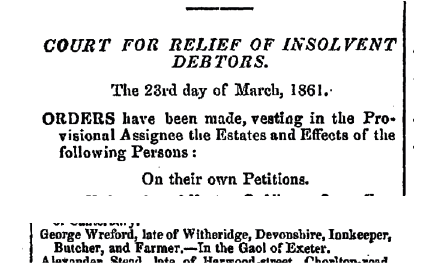
The London Gazette, 26 Mar 1861, issue 22495, pp1360-1361

This notice in the London Gazette tells us that George voluntarily declared insolvency. He would have recognised he was in serious financial trouble and filed his own petition, giving over all his assets to the court to pay off his debts. Had he not done this, a creditor could have had George sent to prison and controlled whether he was released.

The ‘Benefit of the Act’
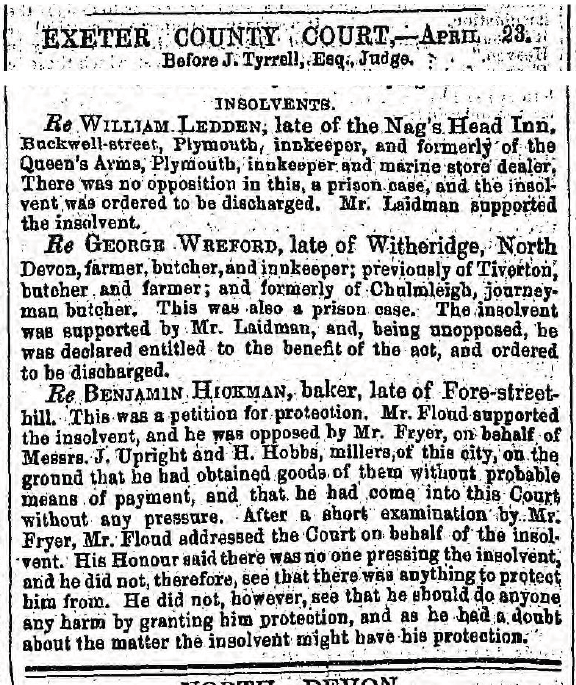
Exeter Flying Post, 24 April 1861, p7, c3
On 23 April 1861, George was declared “entitled to the benefit of the act, and ordered to be discharged”. In his case, ‘the benefit of the act’ meant that he would be discharged from prison because the court was satisfied that he’d surrendered all his assets and not committed fraud. Apparently it protected him from being imprisoned again for those specific debts BUT could still have future money and assets taken away to pay off creditors.
No wonder he took off to New Zealand a few years later!
(NB: Mr John Laidman (c. 1799–1871) was a prominent Exeter solictor (and City Treasurer) who specialised in bankruptcy law. He even wrote a legal guide, Bankruptcy and Insolvency: Practical Observations on the Laws, in 1857.)

Related posts:

Pedigree Collapse

Cousin marriage is given the side eye these days but it was a relatively common thing for our ancestors. It seemed to happen a lot with the Wrefords in Devon, and the Buchans in North East Aberdeenshire, but I’ve actually only been able to find it once in my direct ancestral line (so far).

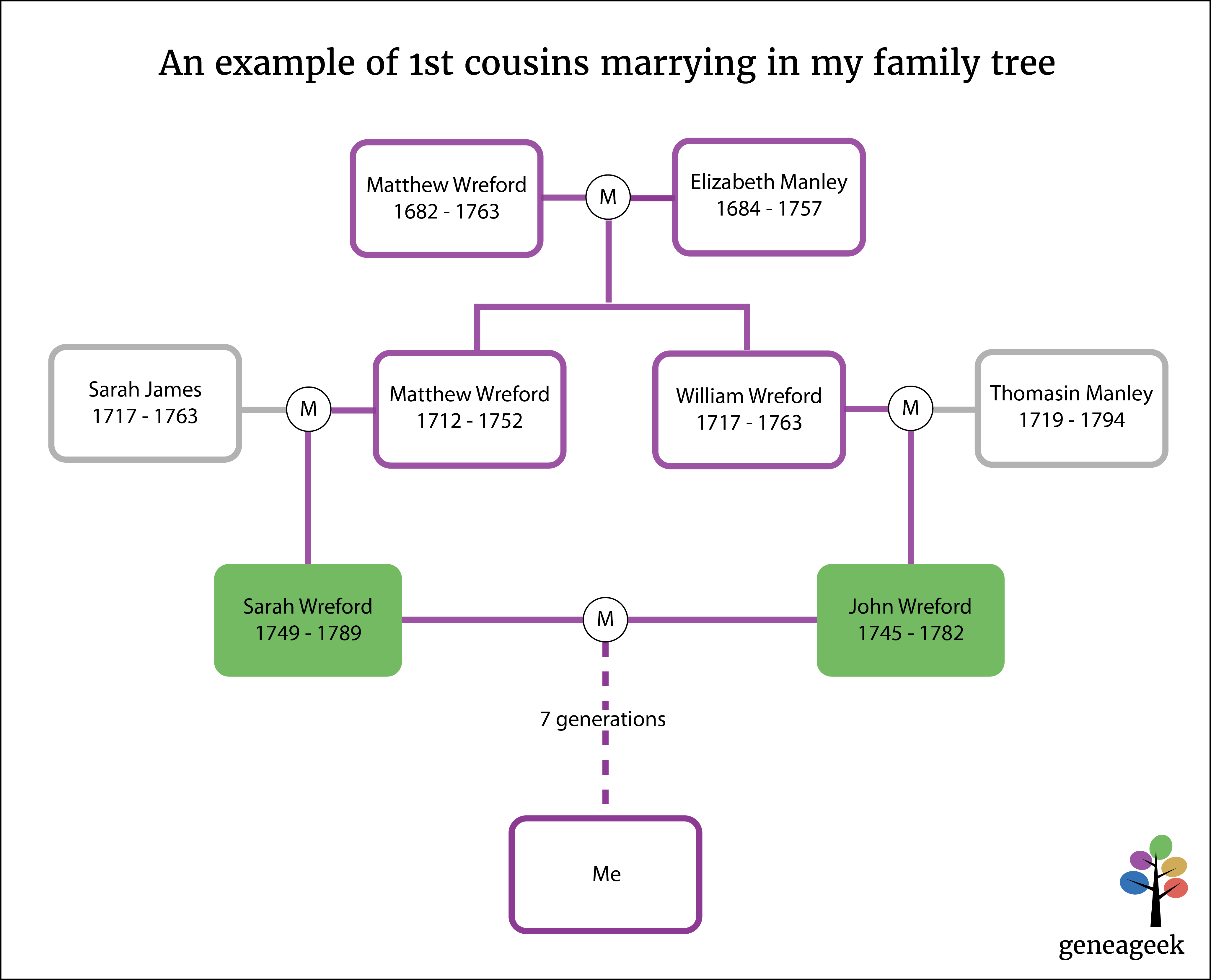
Way back in the mid 18th century, my 6th great-grandparents, Sarah Wreford and John Wreford, married. Sarah and John were 1st cousins – their fathers were brothers.

This kind of situation leads to what is known as ‘pedigree collapse’.

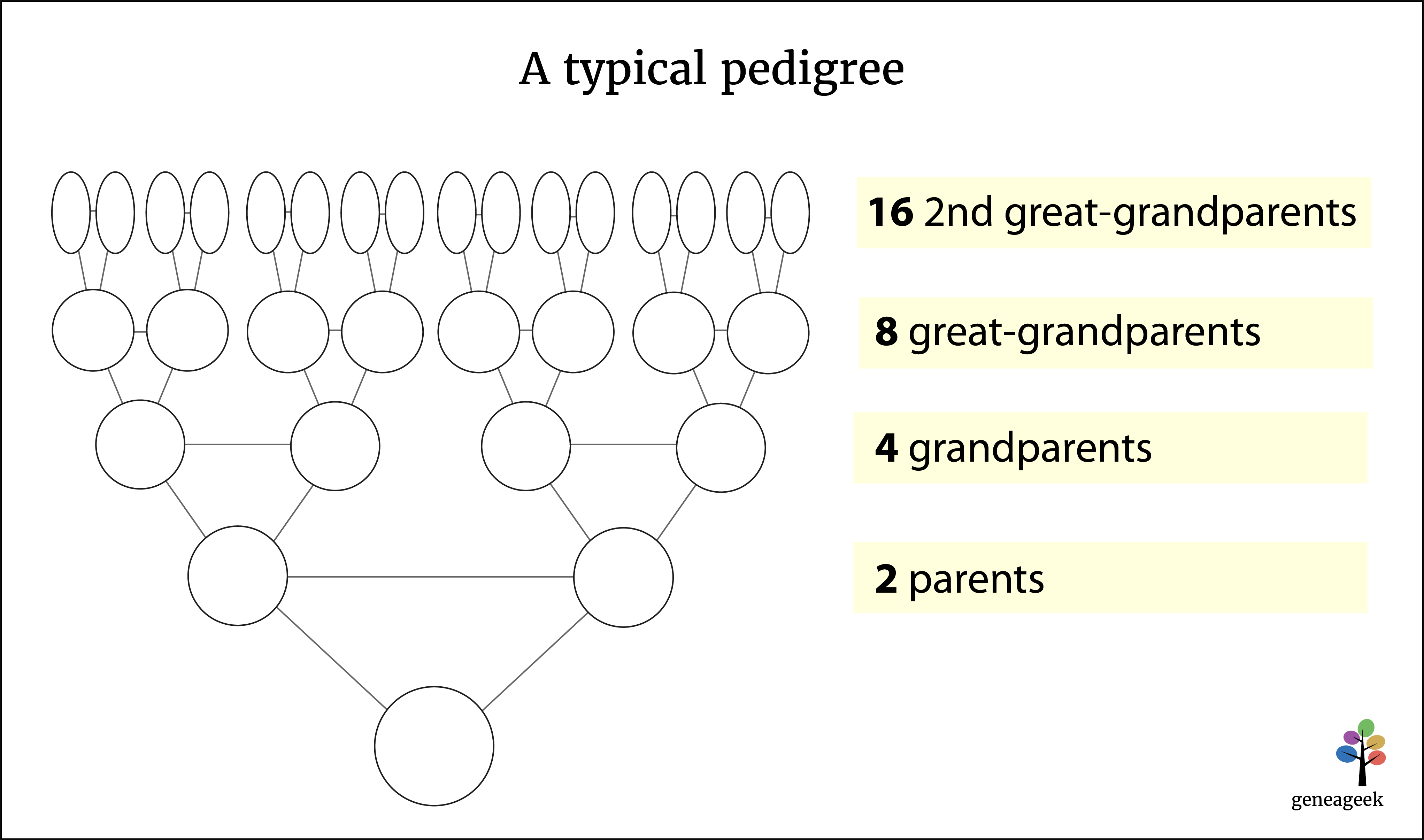
A typical pedigree assumes each set of parents are unrelated to each other and each generation doubles (since each person has 2 parents).

Pedigree collapse occurs when two people who share ancestors reproduce.  

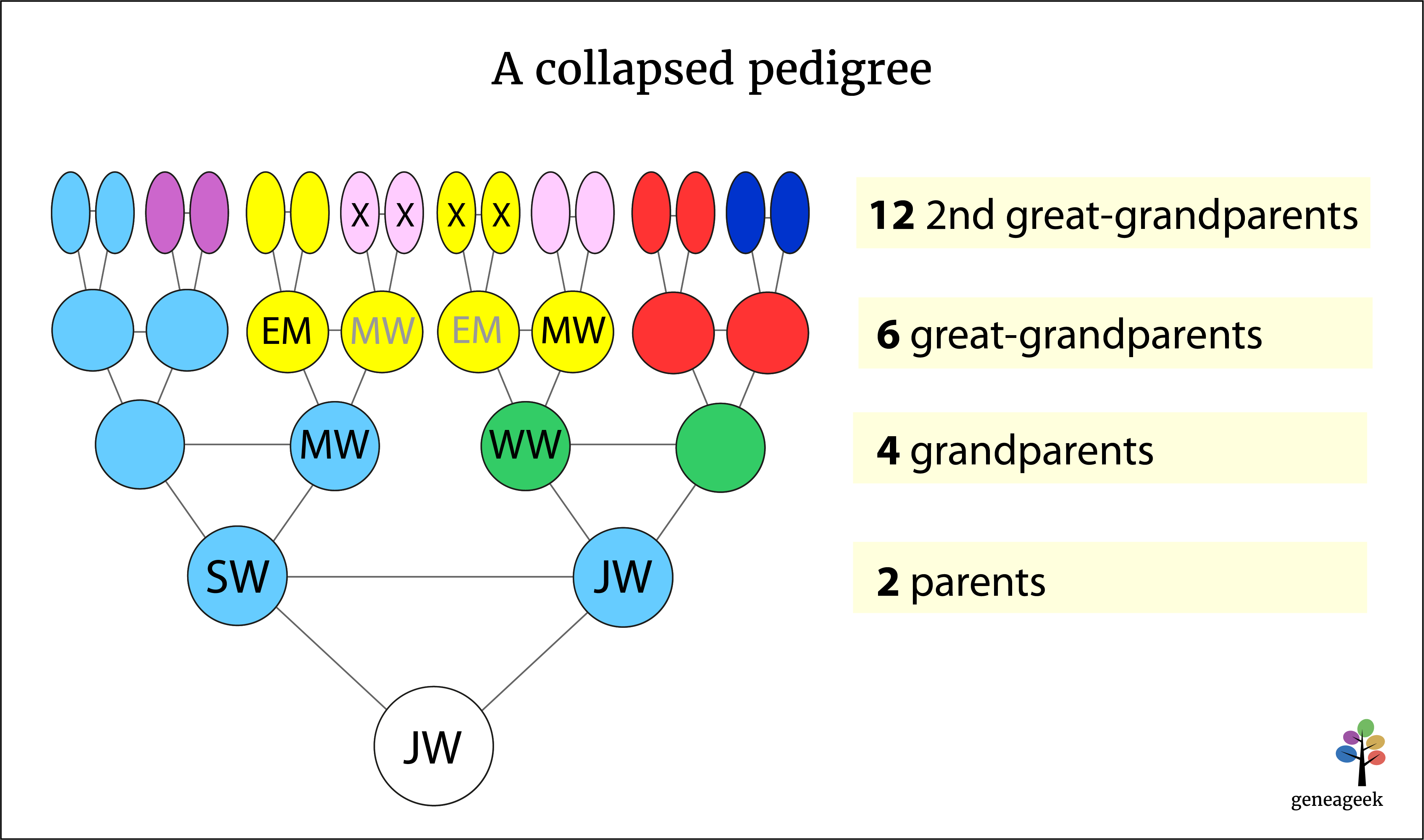
This is demonstrated in the pedigree of Sarah and John’s son (and my 5th great-grandfather), John Wreford:

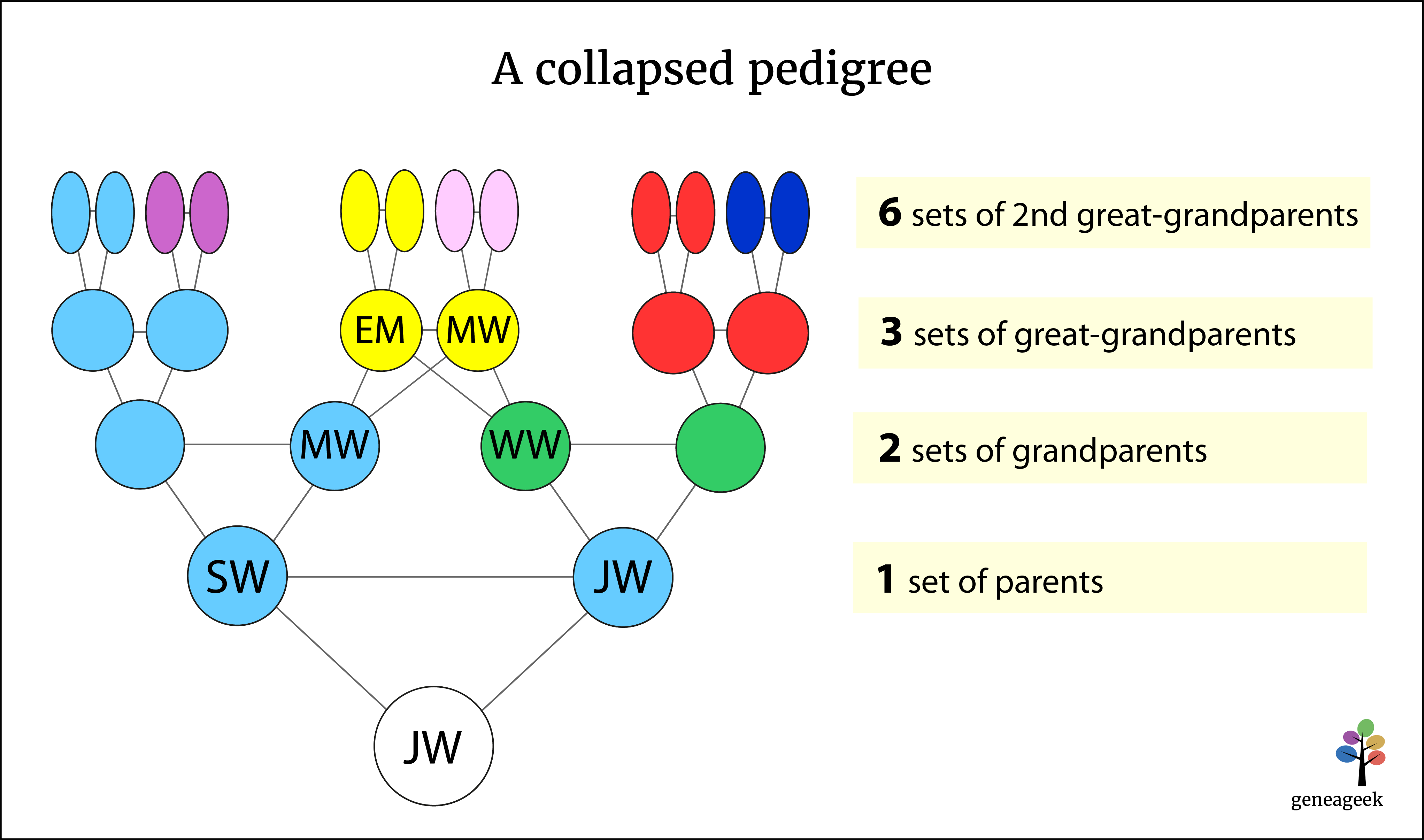
Instead of having four distinct sets of great-grandparents, Sarah and John’s children had only three.

Their children had only 6 great-parents instead of 8; 12 second great-grandparents instead of 16; 24 third great-grandparents instead of 32; and so on. (The number of ancestors lost each generation doubles: 8 -2; 16 -4; 32 -8; etc.)

This got me wondering. What knock on effect would 2 less ancestors have on my overall ancestor count?

My pedigree is typical until the 11th generation, where I lose 2 8x great grandparents. So instead of 1024 8xGGP, I have 1022; instead of 2048 9xGGP, I have 2044 ; instead of 4096 10xGGP, I have 4088; and so on.

My ancestor count (so far) looks like this:

Generation Relationship Typical Number My Number Ancestors Lost
1 Me
2 Parents 2 2
3 Grandparents 4 4
4 1x Great grandparents 8 8
5 2x Great grandparents 16 16
6 3x Great grandparents 32 32
7 4x Great grandparents 64 64
8 5x Great grandparents 128 128
9 6x Great grandparents 256 256
10 7x Great grandparents 512 512
11 8x Great grandparents 1024 1022 -2
12 9x Great grandparents 2048 2044 -4
13 10x Great grandparents 4096 4088 -8
14 11x Great grandparents 8192 8176 -16
15 12x Great grandparents 16384 16352 -32
16 13x Great grandparents 32768 32704 -64
17 14x Great grandparents 65536 65408 -128
TOTAL 131070 130816 -254

Further calculations will need to be made if/when I find more kissing cousins.

Related posts:

Double Marriage Entry

Came across something very curious last night…

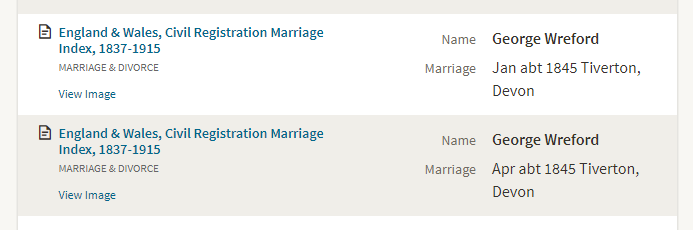
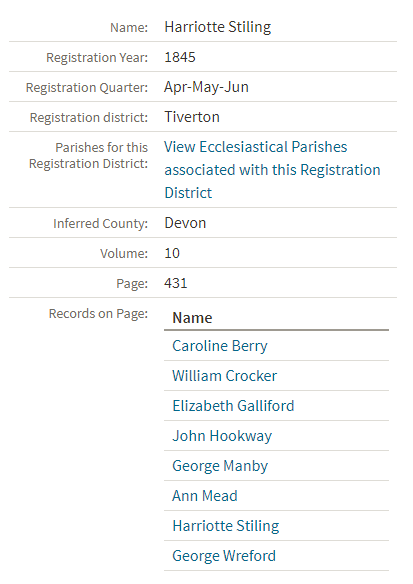
The marriage of George WREFORD and Harriet STILING (for which I have both the original parish entry AND official copy of entry, as well as the record of banns) was recorded twice in the registers – same parish, church, year and even volume – within pages of each other.

Jan-Mar Quarter 1845, Volume 10 page 407
April-Jun Quarter 1845, Volume 10 page 431

At first I thought it may be a different George Wreford since Wrefords abound in Devonshire, but Harriet is mentioned in both entries (albeit with different spelling).

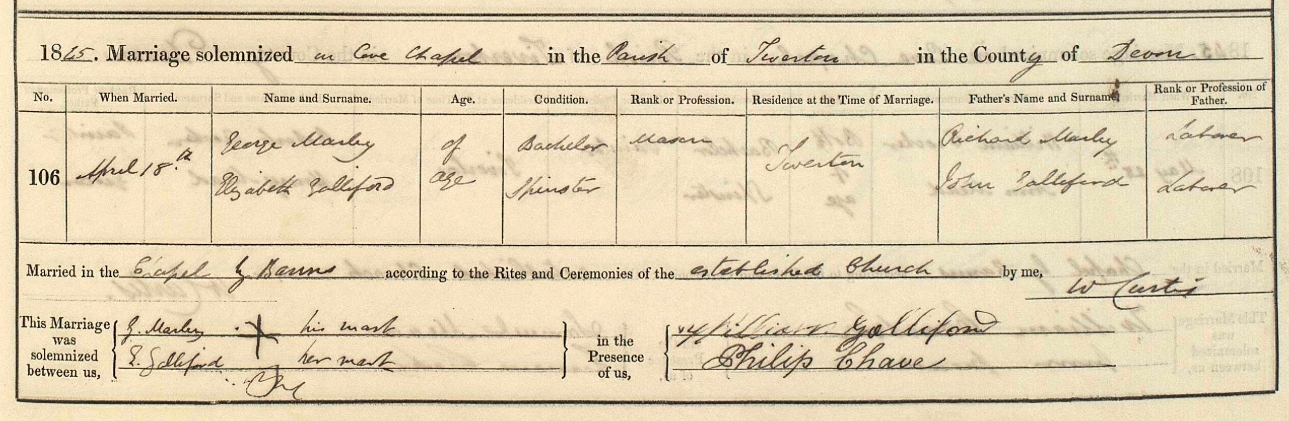
Perhaps the clue lies with the only other name from both entries – Elizabeth Galliford recorded as marrying George Marley/George Manby.  Perhaps it was just recorded twice to clear up the spelling mistakes but that also doesn’t make sense as the parish records show both marriages actually took place in the April Quarter.

Marriage of George Marley to Elizabeth Galliford
Marriage of George Wreford to Harriotte Stiling

I have tried searching for a second ceremony in the Tiverton area via the Devon Parish Registers on findmypast but there doesn’t appear to be any.

Why would the marriage which took place in May be initially recorded in the previous quarter?  I guess the next step is to order the record from page 407 although I don’t want to spend more money just to get the exact same copy sent to me.

Notes:

  1. I will now begin spelling Miss Stiling’s name as Harriotte as that is how she signed the register herself.
  2. I found out while researching this that Phillip Chave, who appears in both entries as witness and several times in the Cove registers was actually the assistant to Mr William North Row of Cove House – magistrate for Devon.  I presume this meant he often ‘sat in’ as witness for these smaller ceremonies where required.  I had originally thought he may have been a friend or relative.

Next Steps:

  • Order Jan qtr marriage certificate
  • Revisit Harriet STILING to find connection to Cove area

Related posts:

Blind Leading the Blind

At the top of my ancestry ‘To Do’ list for many years now has been ‘Find out who Blind Wreford is’.

Today I’ve finally found out…

I’m not even sure where I first heard of Blind Wreford but I’ve kept an eye out for any mention of him.  Finally I found mention of him in obituary for another old wrestler, John Bolt.


He was full of anecdotes of “Blind Wreford,” a wealthy farmer of Cheriton, who died in 1835 at a very advanced age, and who, notwithstanding his blindness, was a renowned wrestler, often followed the hounds without sustaining severe falls, and was an excellent judge of the weight and general qualities of cattle.”


According to this, he had been totally blind since he was 8. “He was a strongly limbed, well grown and powerful man, about 5 feet 10 in. in height, and was usually led into the ring by a boy, as a guide, and indulged with the privilege of taking hold of his antagonist by the collar…”

I’m really surprised that it’s been so hard to find mention of this guy as he really does seem quite extraordinary.

Related posts:

Pedigree Chums

georgewrefordpedigreeauthor_edited
George Wreford of Gray’s Inn

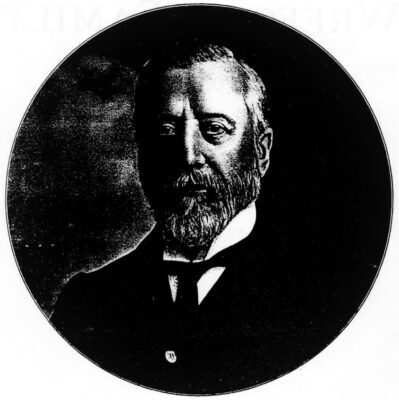
I am fortunate enough that part of my family history – the WREFORDs – was already recorded years ago.  Long before I came along, George WREFORD of Gray’s Inn, Barrister at Law was the family historian.  He compiled a  ‘Pedigree and Sketch of the Wreford Family of Clannaborough and Morchard Bishop, Devonshire’ back in 1888 and a revised edition, ‘Records and Pedigree of the Wreford Family of Devonshire’ in 1909.

Genealogy was a completely different’ kettle of fish’ back then and I (as well as many of my Wreford cousins, I’m sure) am grateful that George took the time to do it.  But I can’t have him taking all my fun, so over the years I’ve fact-checked, evidenced and fleshed out the details pertaining to my direct line.

You can access physical copies at the West Country Studies Library in Exeter but I have chosen to include the pages pertaining to my line here.  You can access these via the top menu or click here to start.
Title_page

Related posts: