Bigamy Blues – Part 3

Featured Image: Long Bridge over the River Derwent in the 1930s via Derbyshire Live

(Continued from previous posts Bigamy Blues and Bigamy Blues Part 2)

Records show that Reuben and Mary eventually remarried in 1963 – 25 years after the bigamy trial. I wondered how that came about. Had they met up again years later and rekindled the romance? Had Mary stuck by Reuben despite the dishonesty? It seemed unlikely I would ever find out.

A Brave Act

Back in 1937, Reuben was reported in the newspapers as having rescued a child that had fallen in the River Derwent. For his efforts, the 16-year-old Reuben received a Royal Humane Society Certificate while a patient at the Royal Infirmary.
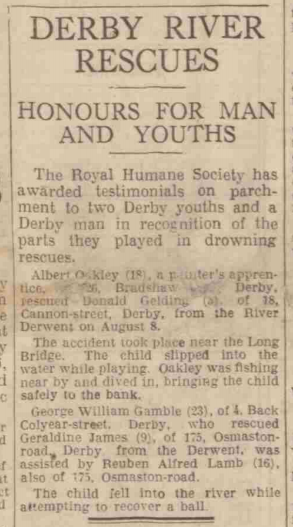
Derby Daily Telegraph, 17 December 1937, p1, c3

DERBY RIVER RESCUES
HONOURS FOR MAN AND YOUTHS
The Royal Humane Society has awarded testimonials on parchment to two Derby youths and a Derby man in recognition of the parts they played in drowning rescues…

George William Gamble (23), of 4, Back Colyear-street, Derby, who rescued Geraldine James (9), of 175, Osmaston-road, Derby from the Derwent, was assisted by Reuben Alfred Lamb (16), also of 175, Osmaston-road.
The child fell into the river while attempting to recover a ball.

(Derby Daily Telegraph, 17 December 1937, p1, c3)
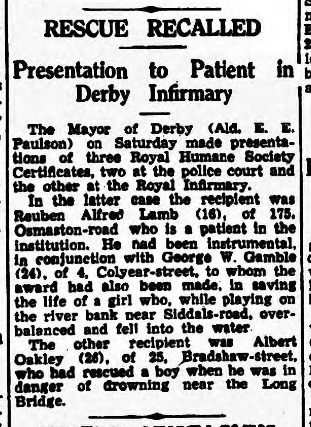
Nottingham Journal, 21 February 1938, p3, c2

RESCUE RECALLED
Presentation to Patient in Derby Infirmary
The Mayor of Derby (Ald. E. E. Paulson) on Saturday made presentations of three Royal Humane Society Certificates, two at the police court and the other at the Royal Infirmary.
In the latter case the recipient was Reuben Alfred Lamb (16), of 175, Osmaston-road who is a patient in the institution. He had been instrumental, in conjunction with George W. Gamble (24), of 4, Colyear-street, to whom the award had also been made, in saving the life of a girl who, while playing on the river bank near Siddals-road, over-balanced and fell into the water…

(Nottingham Journal, 21 February 1938, p3, c2)

The article annoyingly failed to mention why Reuben was in the infirmary.

I had resigned myself to probably never knowing the answers to any of my questions, when I remembered asking Rose (Reuben’s sister) about this incident before she died. Luckily I found the conversation…

[after being asked about her brother’s bigamy]

I had forgotten about that. She said she was pregnant, he believed her and said he’d marry her. Then he and his friend Bill Gamble saw a child in the river Derwent and Alfie jumped in and saved it. He got a certificate from the Humane Society for bravery, but got an infection and was seriously ill and likely to die so Dad, who had refused to let him marry, relented. The pregnancy lasted two years!!!! He was called up for the army, the yanks came to Derby and Cathy was in heaven, but Alfie left her and later married Mary. They had four or five children and were very happy. Cathy (Morgan) had a sister – Nellie Cash. She had a baby and hid it in the chimney. It was found by firemen I think. I don’t know what happened to her. How’s that for a tale?

(Rose Richards, 6 August 2016, punctuation edited for clarity)

It was such a joy (and a relief!) to reread this message. Of course Rose may have been biased, but although Cathy’ isn’t painted in a very positive light, this family version of events really helps to clear things up. It even alludes to the ‘associating with other men’ mentioned in the trials. I had previously seen articles about ‘the rescue’, so it was interesting that a seemingly unrelated incident had also played a part in this story.

And so, a rough timeline appears as follows:

1937 – Reuben (16) and Kathleen (18) discuss getting married; his father refuses
1937 – December – Reuben rescues child from river and comes close to death

1938 – February – Reuben receives award in hospital; his father consents to the marriage
1938 – abt June – Reuben marries Kathleen Morgan

1939 – Reuben is living with wife Kathleen and her father in Derby (30 Bradshaw Street)

1945 – Reuben separates from Kathleen (unclear whether this was before or after meeting Mary)
1945 – April – Reuben meets widow Mary Evans Mitchell at Nottingham Castle NAAFI canteen

1946 – Feb 2nd – Reuben marries Mary
1946/7 – Reuben visits Kathleen in Derby (in response to a telegram)

1947 – Jan 21st – Kathleen visits in Mansfield and reveals all
1947 – Jan 29th – Reuben is charged with bigamy
1947 – Feb 18th – Reuben is sentenced to 3 months prison for bigamy

1962 – Kathleen dies

1963 – Reuben and Mary marry

All’s Well That Ends Well

Reuben and Mary’s marriage in early 1963 appears to coincide with Kathleen’s death the previous year (no evidence of divorce has been found and Kathleen’s death was registered under the surname Lamb).

So there was a happy ending after all. Despite not being legally wed, Reuben and Mary remained a couple and built a family together before they were able to ‘make it official’ in 1963.

As for the baby in the chimney..? Now, that‘s another story altogether…
Related posts:

Forbidden Marriage


While researching some extended family members, I came across an unusual marriage.

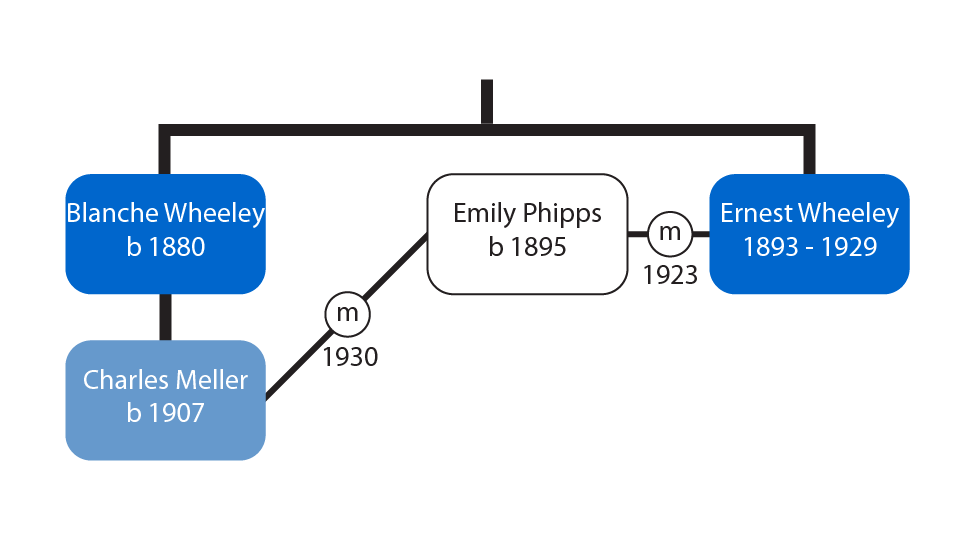
Ernest Wheeley and Emily Marian Phipps were married in 1923 and their daughter, Cissie was born the following year. Sadly, Ernest died only a few years later in 1929 and Emily married the next year. Although a widow remarrying is very common and can be expected, what makes this case unusual is that Emily had married the nephew of her deceased husband.

Ernest’s nephew, Charles Meller – who was was roughly 12 years younger than Emily – was the son of his sister Blanche Wheeley and Joseph Meller.

Tree diagram to illustrate family relationships
Charles was the nephew of Emily’s first husband, Ernest


There has long been a list of ‘forbidden marriages’ based on the bible. Way back in 1503, even King Henry VIII had to request a special dispensation so he could marry his brother Arthur’s widow, Katherine of Aragon. In 1907 the law changed to allow marriage to a wife’s sister or husband’s brother but only if the first spouse was deceased. In 1921, marriage to a brother’s wife or sister’s husband also became legal (only if the first spouse was deceased). This change in law likely came about due to the dramatic reduction in population after World War I. The law was again changed in 1931 to allow marriage to an aunt/uncle-in-law or niece/nephew-in-law (again only if the relevant people were deceased). [source: Forbidden Marriage Laws of the United Kingdom] However, in this case, Charles and Emily were married in 1930 – the year before it became legal for them to do so.

By 1939, the couple had a son together, Ronald, and Cissie had taken the name of her mother’s new husband (and Cissie’s first cousin), Meller. A clue to the unusual relationship can be found on the 1939 register entry – upon Cissie’s marriage in 1943, her original name of Wheeley was added along with her new married name of Dickinson (Cissie used the name Wheeley when she married).

There could be many reasons for marrying a the spouse of a deceased family member and at times it was encouraged. It is impossible to know the nature of the couple’s relationship prior to Ernest’s death (without family anecdotes to rely on). A clue that this union may not have had the family’s blessing may lie in their address. Charles and Emily were on Hollemeadow Road, whereas the rest of the family seemed to live more closely together on or near Pleck Road (the other side of town). But, of course, this is just speculation on my part.

Related posts:

Persistent Cruelty

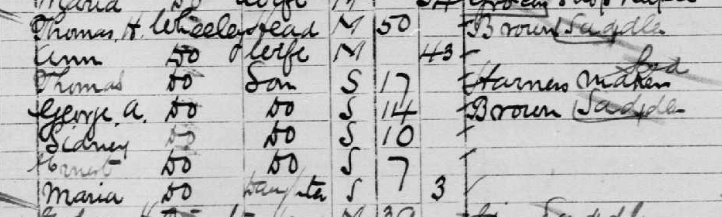
In 1901, Thomas Henry WHEELEY and Ann ROGERS had been married for 23 years and had had 8 children together.  They were living on Dalkeith Street in Walsall – a row of terraced houses built alongside the Walsall Locks less than ten years before (in the early 1890s). Thomas was a ‘brown saddler’ living in “a poor locality” so life was probably not easy for the family.

Snippet of the 1901 census page
Thomas Henry Wheeley and Ann Rogers on the 1901 census

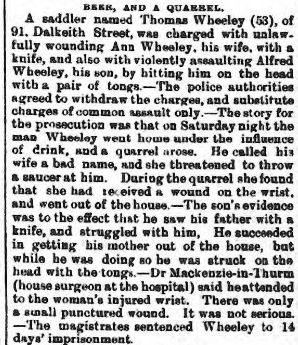
On Saturday the 20th May, 1905 – only a few years after the census was taken – the family had ‘a quarrel’. Thomas who had been out drinking, came home and argued with Ann, calling her names. Ann, in turn, threatened to throw a saucer at him and Thomas attacked her with a knife. Their 18-year-old son, George Alfred,  seeing this take place, struggled with his father and was subsequently hit on the head with some tongs [Not sure if these would be saddler tongs or coal tongs or another type). Ann had managed to escape the house during the scuffle and discovered she had been cut on the wrist.

newspaper article
Walsall Advertiser 27 May 1905 p6 c7

BEER, AND A QUARREL.

A saddler named Thomas Wheeley (53), of 91, Dalkeith Street, was charged with unlawfully wounding Ann Wheeley, his wife, with a knife, and also with violently assaulting Alfred Wheeley, his son, by hitting him on the head with a pair of tongs. -The police authorities agreed to withdraw the charges, and substitute charges of common assault only. -The story for the prosecution was that on Saturday night the man Wheeley went home under the influence of drink, and a quarrel, arose. He called his wife a bad name, and she threatened to throw a saucer at him. During the quarrel she found that she had received a wound on the wrist, and went out of the house. -The son’s evidence was to the effect that he saw his father with a knife, and struggled with him. He succeeded in getting his mother out of the house, but while he was doing so he was struck on the head with the tongs. -Dr Mackenzie-in-Thurm (house surgeon at the hospital) said he attended to the woman’s injured wrist. There was only a small punctured wound. It was not serious. -The magistrates sentenced Wheeley to 14 days’ imprisonment.  (Walsall Advertiser 27 May 1905 p6 c7)

I find it interesting that “the police authorities agreed to withdraw the charges, and substitute charges of common assault only”. Who requested the charges be withdrawn/substituted? Common assault is a lesser charge than ‘unlawfully wounding’ or ‘violently assaulting’ [source] and so appears to minimise Thomas’ actions. Was the switch to a lesser charge because: a) there was a lack of evidence of more serious injuries; b) prosecution were more likely to secure a conviction this way; or c) the general view that domestic violence was less serious?

Thomas’ two-week stint in prison for the assaults seemed to have little effect. A few weeks later, the couple were living at separate addresses – Thomas on Cannon Street and Ann at 481 Pleck Road – when Ann requested a separation order to support her and their four remaining dependent children – Sidney, Ernest, Grace Hilda and Maria (whose ages ranged from 14 to 7).

newspaper article
Walsall Advertiser 24 June 1905 p2 c5

PERSISTENT CRUELTY.

Thomas Henry Wheeley, Cannon Street, was summoned for persistent cruelty to his wife, who applied for an order against him. -Complainant stated that she had been obliged to leave her husband because of his persistent cruelty. She had been married 29 years and had eight children, four of which were depending upon her. Her husband had assaulted her several times and was always threatening her. She had had seven pair of black eyes in less than three months. -The Chairman (to defendant): How many black eyes have you given her since you were married? -Two, that’s all sir. -An order for 10s a week was eventually made.  (Walsall Advertiser 24 June 1905 p2 c5-6)

In 1895, the ‘Summary Jurisdiction (Married Women) Act’ was introduced. It allowed married women to apply to the magistrates’ courts for separation and maintenance orders if their husbands had:

i. been convicted of an aggravated assault under S.43 of the Offences Against The Persons Act 1861
ii been convicted on indictment for assault and sentenced to at least two months imprisonment or fined £5
iii. deserted them
iv. been guilty of persistent cruelty so as to make their wives leave home.
v. wilfully neglected to maintain so as to cause their wives to leave home.

(Radford, M. T. (1988) The law and domestic violence against women. PhD Thesis. University of Bradford. Available from: https://bradscholars.brad.ac.uk/handle/10454/3875 (Accessed: 13 May 2020), page 38)

Ann applied for an order of separation on the grounds of his persistent cruelty and subsequent articles definitely paint a picture of an unhappy marriage marred with ‘persistent cruelty’ and alcohol abuse.

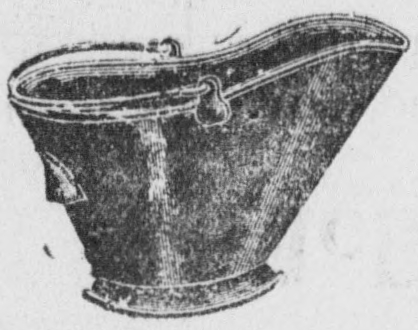
image of coal hod for sale in 1904
A coal hod for sale in 1904 – Thomas was witnessed to have struck his wife Ann with one.

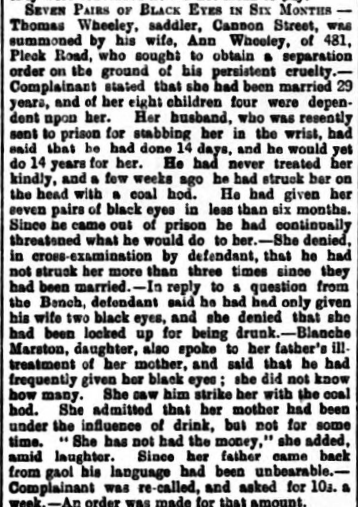
Ann told the court that her husband had ‘never treated her kindly’ and that she had had ‘seven pair of black eyes in less than three months’. Thomas denied this and claimed he had ‘only’ given her two and struck her ‘no more than three times’. Ann also claimed that Thomas had hit her on the head with a coal hod – a claim supported by their 25 year old daughter, Blanche who witnessed the incident. Blanche also confirmed that her father had ‘frequently’ given her mother black eyes. However she also said that her mother had also ‘been under the influence of drink’ but this had not been for some time since “she has not had the money”.

newspaper article
Walsall Observer, and South Staffordshire Chronicle 24 June 1905 p2 c5

SEVEN PAIRS OF BLACK EYES IN SIX MONTHS –

Thomas Wheeley, saddler, Cannon Street, was summoned by his wife, Ann Wheeley, of 481, Pleck Road, who sought to obtain a separation order on the ground of his persistent cruelty. -Complainant stated that she had been married 29 years, and of her eight children four were dependent upon her. Her husband, who was resently [sic] sent to prison for stabbing her in the wrist, had said that he had done 14 days, and he would yet do 14 years for her. He had never treated her kindly, and a few weeks ago he had struck her on the head with a coal hod. He had given her seven pairs of black eyes in less than six months. Since he came out of prison he had continually threatened what he would do to her. -She denied, in cross-examination by defendant that he had not struck her more than three times since they had been married. -In reply to a question from the Bench, defendant said he had only given his wife two black eyes, and she denied that she had been locked up for being drunk. -Blanche Marston, daughter, also spoke to her father’s ill-treatment of her mother, and said that he had frequently given her black eyes; she did not know how many. She saw him strike her with the coal hod. She admitted that her mother had been under the influence of drink, but not for some time. “She has not had the money,” she added, amid laughter. Since her father came back from gaol his language had been unbearable. -Complainant was re-called, and asked for 10s. a week. -An order was made for that amount.  (Walsall Observer, and South Staffordshire Chronicle 24 June 1905 p2 c5)

Despite the 1895 act, it’s clear that domestic violence was still not regarded as seriously as it should. Thomas’ seemingly casual, or even blasé attitude regarding the violence he actually admits to inflicting on his wife indicates that beating your wife was largely seen as ‘fine’ depending on its regularity or severity. A woman’s options were very limited and there were many reasons a wife would remain with an abusive husband – whether financial, emotional or social.

For whatever reasons, Thomas and Ann were together again by the 1911 census.

Snippet of the 1911 census page
Wheeley family on the 1911 census (130 Bridgeman Street)

I was completely unaware of the events of 1905 until recently. Thomas and Ann appeared in every census together since their marriage in 1878 (1881-1911) so I didn’t expect there to have been such a rift. We like or want to believe that the families we research lived peacefully together despite their often difficult lives. My discovery of these newspaper articles reminded me this is often not the case.

The census is only a ‘snapshot’ every ten years – it’s important to remember this. A lot can happen between these ‘snapshots’. Just as living at the same address two censuses in a row doesn’t always mean they’d actually been there all that time, a family simply living together does not always mean their lives were harmonious all that time.

This family is also featured in Wheeley Interesting and Wheeley Interesting Sequel.

Related posts:

Wheeley Interesting Sequel

The Perils of Divorce – a film from 1916

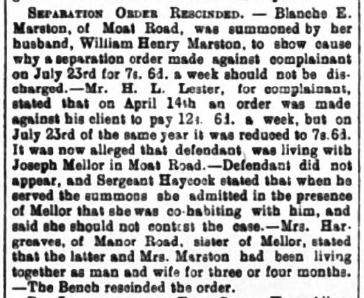
I previously wrote about the brief marriage between William Henry Marston and Blanche Emma Wheeley in the post, Wheeley Interesting.  I have just discovered that five years after their unhappy relationship broke down, there was a development…

Walsall Observer, and South Staffordshire Chronicle, 2 June 1906 , p3 c6

Basically, the amount of support Marston had to pay Blanche had been dropped to 7s.6d (approximately £29.46 in today’s money)  [The wording makes it unclear whether this happened in July 1901 or July 1906]. However, Marston was now complaining that he shouldn’t have to pay support to his ex-wife at all, since she was living with another man.

…It was now alleged that defendant was living with Joseph Mellor in Moat Road. -Defendant did not appear, and Sergeant Haycock stated that when he served the summons she admitted in the presence of Mellor that she was co-habiting with him, and said she should not contest the case. -Mrs. Hargreaves, of Manor Road, sister of Mellor, stated that the latter and Mrs. Marston had been living together as man and wife for three or four months…

The new relationship may have come to his attention through Blanche being heavily pregnant with her eldest son, Joseph, who was born only a month after the article appeared. He and his brother, Charles appear with their parents on the 1911 census – still living in Moat Road, Walsall.

The Meller/Marston family on the 1911 census – 135 Moat Rd, Walsall

Blanche and Joseph had 4 children (one who died as an infant) before they were finally wed in 1913. These children were recorded under the surname Marston as that was still Blanche’s legal name, but the parentage was made clear by also including the name, Mellor.  After their marriage, the couple had 4 more children, although one died when only a few months old. By 1939, all the children had dropped the ‘Marston’ from their name and used only ‘Mellor/Meller’.

Since divorce at that time was unlikely, and remarriage was illegal with a spouse still living, I presumed William must have died.  He was still alive in 1911, living with his new ‘wife’ and son, Percival William Marston, but there was no death record before 1913.

William Henry Marston with his new family on the 1911 census – 49 Charlotte St, Walsall

William & Lizzie listed themselves as married on the 1911 census but there is no trace of a marriage between them. [Intriguingly, there is a marriage in 1911 of a ‘Percy W Marston’ to a ‘Lizzie Jackson’ in Southwell district, Nottinghamshire but an appropriate person with this name can actually be traced through the censuses. Also, the surname of Percival’s mother is given as Mitchell in the birth indexes.] It turns out, William and his family left England for South Africa in June 1913!  They returned in 1919 for a few years before leaving permanently in 1921.

I don’t think it’s mere coincidence that Blanche and Joseph were married in July 1913. The expense alone meant divorce was unobtainable for the working class at this time. With Blanche’s ex-husband out of the country, they may have considered it their opportunity to finally marry (albeit illegally). The couple were still together in 1939 so I like to think Blanche did get that happy ending after all (at least for a while!).

Related posts:

Aunt Sally

Before Rose Richards [nee LAMB] died, we were chatting about her family history via facebook messenger and she wrote:

“… my Dad had a sister we called Sally. She married a man named Woodward who left her and went to America. During the war an American soldier had a piece in the Derby Evening telegraph asking for her, But my Dad wouldn’t let us answer it.”

Rose Richards [nee Lamb], 2 Aug 2016

I dutifully added the name Sally Lamb to the family tree as a brother of Reuben Henry LAMB (son of Hannah BATES and William Henry LAMB) but was unable to find the newspaper piece Rose refers to.

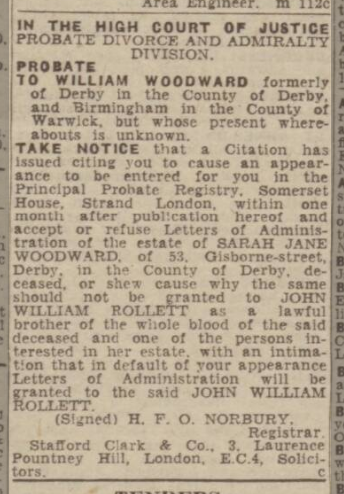
At a later point, likely trawling the newspapers for Rolletts, I came across an article requesting William Woodward come forward, or else his now deceased legal wife’s estate would be given to her brother John William Rollett:

Derby Daily Telegraph, 12 May 1947 p10

“TO WILLIAM WOODWARD formerly of Derby… and Birmingham… but whose present whereabouts is unknown.
TAKE NOTICE that a Citation has issued citing you to cause an appearance to be entered for you in the Principal Probate Registry… within one month after publication hereof and accept or refuse Letters of Administration of the estate of SARAH JANE WOODWARD, of 53, Gisborne-street, Derby, in the County of Derby, deceased, or shew cause why the same should not be granted JOHN WILLIAM ROLLETT as a lawful brother of the whole blood of the said deceased and one of the persons interested in her estate, with an intimation that in default of your appearance Letters of Administration will be granted to the said JOHN WILLIAM ROLLETT.”

Derby Daily Telegraph, 12 May 1947, p10

This showed that Sally, officially known as Sarah Jane was actually a child of Hannah BATES’ first husband, Alexander ROLLETT. Until then, I had only known him to have two sons – John William and William Henry. But since John was referred to as ‘a lawful brother of the whole blood’, I adjusted the tree and changed her maiden name to Sarah Jane ROLLETT, daughter of Alexander.

Unfortunately, this still didn’t help me in my quest for information. The closest I got was Sarah’s likely appearance in the 1939 register, where she was recorded as a widow and retired ‘rag sorter’.

Sarah Jane Woodward in the 1939 register

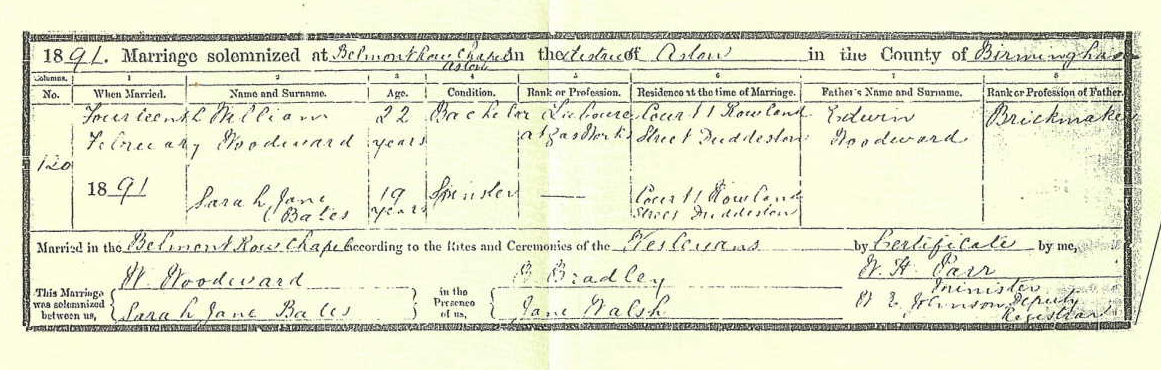
Today, however, I came across her long lost husband in an ancestry member tree. This tree gave her name as Sarah Jane BATES (her mother’s maiden name) and also shared a copy of the marriage certificate which shows the two had married in Birmingham in 1891.

The 1891 marriage of Sarah Jane BATES to William WOODWARD

Interestingly, Sally does not give her father’s name so it is still uncertain whether Alexander truly is her biological father. It is unlikely that her birth record would have his name either, since she is registered under her mother’s maiden name but I’d still like to order it one day to check. The fact that Sarah Jane was never recorded with her family intrigues me – perhaps she wasn’t actually Rollett’s child either?

It turns out that William had actually formed a relationship with his barmaid, Alice Robinson around 1907 (William & Sally ran a pub in Aston – noted on the 1901 census) and had a couple of kids with her before migrating to Canada around 1910, where they lived as a married couple and continued to grow their family.

As for the newspaper piece Rose mentioned, according to William’s family he returned to England for a few years at the beginning of the war so it’s possible William did try to reach out to his former wife at that time (for whatever reason).

It’s so amazing to actually find answers to these little mysteries and especially from another perspective. In addition, the search for Sally allowed me to unlock more doors into the intriguing life of Hannah Bates…

Update:

Due to the above article, I had assumed Sally died in 1947 but the only likely death record in the index was in 1941. I have now found the probate record that states she did die in 1941 but probate wasn’t granted until 1947. Presumably, time had to be given to locate her missing husband, William before it being passed on to her brother(?).

Next Steps:

  • order Sarah Jane BATES’ birth certificate
  • locate newspaper article mentioned by Rose

And that’s where things have stayed for a long while. I was unable even to find a likely marriage between the two. But today, all that changed when I came across an ancestry member tree, which finally blew the doors open on this couple. More importantly, the discovery has helped me unlock even more doors.

Related posts: