Bankrupt or Insolvent?

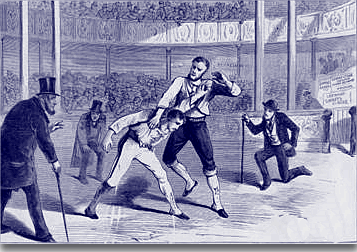
The debtors prison at St Briavels Castle c1858

The last time I looked into the financial woes of my ancestor George Wreford, I wanted a simple explanation into the change in bankruptcy laws in 1861. I’ve since learned the key to understanding is knowing the difference between bankruptcy and insolvency.

Bankruptcy or Insolvency?

Whether a person was declared bankrupt or insolvent, was dependent on the profession of the debtor.

Only traders could apply for bankruptcy and have access to some kind of relief – an ‘Order of Discharge’ – which would effectively clear the debt, and allow them to rebuild their business or finances. Any money earned after bankruptcy was theirs to keep.

Non-traders were not able to do this, and would be liable for their debts forever. Any future assets or inheritance could be seized by creditors to pay off old debts, and they could be kept in gaol indefinitely.

Why was this case?

It was a long-held belief that financial failure in commerce was a natural risk of business (think: ‘market fluctuations’), whereas failure in private life was a moral or personal failing (think: ‘extravagant lifestyles’). Debtor’s prisons were seen as a punitive measure to discourage living beyond one’s means.

What changed in 1861?

After the new Bankruptcy Act (effective October 1861), non-traders could also apply for bankruptcy – an ‘Order of Discharge’ – so that they, too, could have their debts cleared.

Unfortunately for George, he became insolvent in March 1861 while still under the old laws.

So why would George be considered a non-trader?

The answer seems to lie in the fact that as well as being an innkeeper, butcher, and journeyman butcher, George was also described as a farmer.

Farmers were excluded from bankruptcy because their livelihood depended on the ‘labour of the soil’ and the ‘uncertainty of the seasons’, NOT commercial trade.

So although George was a butcher and innkeeper, his farming defined his primary legal status. This meant the courts viewed his capital as being tied up in land and livestock reared by himself, rather than goods bought and sold. The meat he sold was likely butchered from his own animals rather than animals bought from someone else.

Being a ‘journeyman butcher’ also suggested that he was an employee rather than a business owner, and therefore could not declare bankruptcy.

The Petition
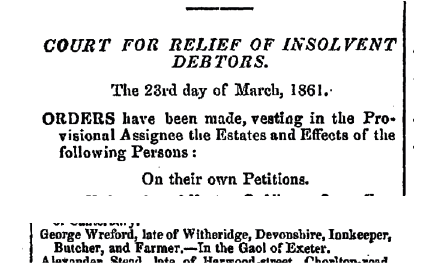
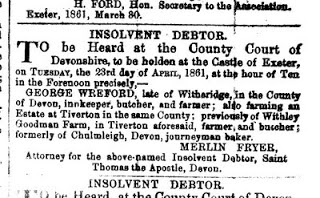
The London Gazette, 26 Mar 1861, issue 22495, pp1360-1361

This notice in the London Gazette tells us that George voluntarily declared insolvency. He would have recognised he was in serious financial trouble and filed his own petition, giving over all his assets to the court to pay off his debts. Had he not done this, a creditor could have had George sent to prison and controlled whether he was released.

The ‘Benefit of the Act’
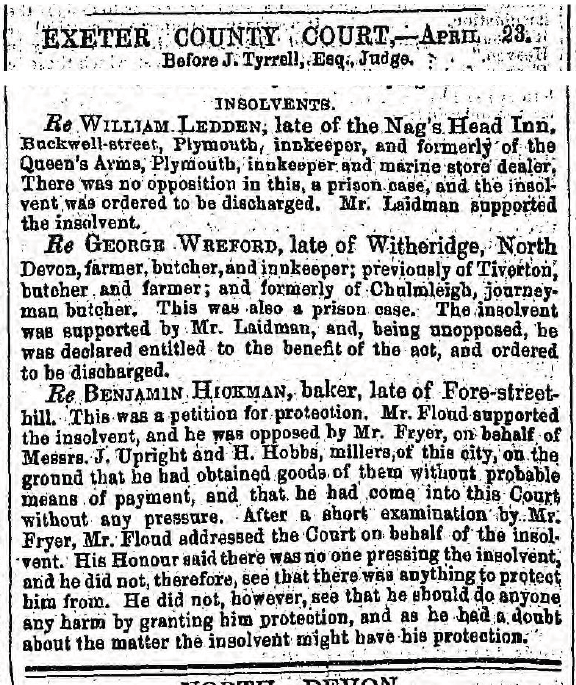
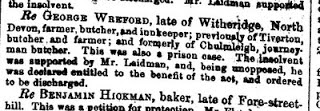
Exeter Flying Post, 24 April 1861, p7, c3
On 23 April 1861, George was declared “entitled to the benefit of the act, and ordered to be discharged”. In his case, ‘the benefit of the act’ meant that he would be discharged from prison because the court was satisfied that he’d surrendered all his assets and not committed fraud. Apparently it protected him from being imprisoned again for those specific debts BUT could still have future money and assets taken away to pay off creditors.
No wonder he took off to New Zealand a few years later!
(NB: Mr John Laidman (c. 1799–1871) was a prominent Exeter solictor (and City Treasurer) who specialised in bankruptcy law. He even wrote a legal guide, Bankruptcy and Insolvency: Practical Observations on the Laws, in 1857.)

Related posts:

Celebrity Ancestor

For a change of ‘scene’, I decided to look a bit deeper at some of my English ancestors.

illustration of men wrestling
Devonshire Wrestlers

An old family pedigree mentioned that my ancestor, William WREFORD “settled in Tiverton and was well known in the last century as a noted wrestler“.  I had searched for more information a few years back and was discovered a book which mentions him in this role – Devonshire Characters and Strange Events by S. Baring Gould.

I am very pleased that I am now able to read the entire book online (or download as various files) at the Internet Archive.  The section on William reads:

William Wreford, at the age of eighteen, achieved reputation by throwing Jordan over his head with such force that Jordan came down with a “crash similar to that produced by felling an oak tree.” But Wreford met his match in a wrestle with “the little Elephant,” James Stone. Simultaneously the men grappled each other; and although Wreford had the advantage at the outset, he was hurled into the air, and fell with such violence on his back that for a time he was incapacitated from taking part in a similar contest. Eventually the return match came off at Southmolton, and Stone was again victorious. Nevertheless Wreford remained a prominent figure in the ring, and threw Francis Olver, a Cornishman, although he came out of the contest with several of his ribs crushed by the deadly “hug.” But a greater than Wreford and Jordan arose in the person of Abraham Cann… (p519)

Hoping to find more mention of William, I searched for James Stone – the ‘little elephant’.  This lead me to a page bursting with information about wrestling – in particular, the Abraham Cann mentioned above.  The Heard Family History site records:

In his history of Crediton, Venn (Venn, T.W., History of Crediton. Typescript. 1972) tells us that the activities of the Devonshire wrestlers in London were reported enthusiastically in the Society gossip columns. Dressed in the latest fashions they would promenade in the famous Vauxhall pleasure gardens, where much curiousity was shown to catch a sight of “these extraordinary Devonshire wrestlers”. Along with the bare-knuckle fighters, the wrestlers must have had the popular appeal of football stars of old, if not quite the overblown celebrity status accorded them in today’s tabloids. Certainly local papers reported their comings and goings, and we read of a triumphant return to Devon on the express coach Celerity in 1827, when the wrestlers were greeted by cheering crowds in Exeter (Heard Family History).

It’s funny to think of William, who is listed simply as ‘farmer’ and ‘labourer’ in the 1841 and 1851 censuses, as a celebrity.  Also found on the Heard Family History site was this image of the wrestlers’ vital statistics at a fair in Tavistock,1827:

Wrestler Vital Statistics – Tavistock Fair 1827
William is listed as 34 years old, 5 feet 10 inches tall and weighing 190 pounds.  It is not often we get to know this much physical detail about our ancestors and I’m excited to have found this information. 
Next Steps:
  • Continue to research Devonshire Wrestling in and around the 1820s
  • Search newspapers for wrestling matches

Related posts:

Curious George

I have returned from my holiday/family history mission in Devon. While there, I located the homes and farms of my ancestors, visited their churches and in some cases burial grounds and generally got a feel for the layout of the places they lived.
I also got to spend some time in the West Country Studies Library in Exeter – 4 and a half hours worth of time to be precise! I looked through parish records to firm up some sources and dates and browsed through some microfiche of the Exeter Flying Post to get a bit more detail.
I’ll be posting my findings over the next few days to help me collect all my information and thoughts. To start, I think I’ll flesh out the story of my bankrupt ancestor George WREFORD.
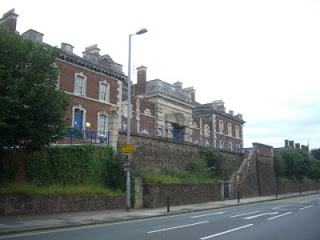
Exeter Prison (August 2009) – George may have been an inmate here in 1861

Last month, I discovered my 3rd great grandfather, George, was not found in the 1861 census partly because he was in jail for bankruptcy. You can read the story so far in my post Ancestor Found (almost).

Unfortunately, I have still not been able to locate him on the 1861 census. After eventually finding Exeter Gaol in the census records, I also found the prisoners were listed by initials only. ‘A-ha!’ I thought, ‘That explains why I couldn’t find him through a name search’ – but I couldn’t find any prisoner with the initials G.W. Not to be deterred, I then combed the entire list of prisoners by their age and birthplace looking for suitable or even approximate matches but I have still not found George WREFORD.

I am aware there was a debtor’s prison in Cowick Street but I learned on the Exeter Memories site that “the last prisoners were moved to the County Gaol in January 1855 and the facility was closed” – 5 years before George was held.
But I did find some nuggets of information in the Exeter Flying Post.
Exeter Flying Post, 10 April 1861, p1, c6

Another reference to his upcoming hearing at the county court at first seemed identical to the notice in the London Gazette EXCEPT, it claims he was a journeyman baker in Chulmleigh – this may be another lead or a Victorian typo. (The London Gazette referred to him as ‘Journey-man Butcher’, which is more likely).

More importantly, upon rereading, I noticed that it mentioned George was “to be holden at the Castle of Exeter”. This could explain why he was not in the County Gaol on the 1861 census! Census night was 7 April 1861 – this excerpt was from the 10 April 1861 edition of the newspaper.

The next ‘clipping’ concluded what must have been a very difficult time in my ancestor’s life.

The insolvent was supported by Mr. Laidman, and, being unopposed, he was declared entitled to the benefit of the act, and ordered to be discharged.

I am aware that the laws surrounding bankruptcy changed in 1861 but if anyone can explain simply to me what the change was, I would love to know. I would also like to know what being supported by someone meant. I have a feeling, old George was quite lucky to have his case heard in this particular year.

Exeter Flying Post, 24 April 1861, p7, c3

(Update: Mr John Laidman (c. 1799–1871) was a prominent Exeter solictor (and City Treasurer) who specialised in bankruptcy law. He even wrote a legal guide, Bankruptcy and Insolvency: Practical Observations on the Laws, in 1857.)

Next steps:

  • Search the 1861 census for ‘the Castle’ and its inmates not found
  • Find a simple explanation for the Bankruptcy Act  See post: Bankrupt or Insolvent?

Related posts:

Ancestor Found (almost)

Witheridge Square

For a long time, I’d been searching for one of my WREFORD ancestors on the 1861 census without luck.


On the night of the 1861 census, in the Devonshire village of Witheridge, 14 year old Drusilla was recorded as head of the household and her occupation as ‘Innkeeper ?’ (note the question mark). Also in the household were 4 siblings aged 7 and under (including my direct ancestor, Augusta Harriet), and a 17 year old servant, Emily Cheriton. Their parents, George and Harriet, were nowhere to be seen.

Wreford Family on 1861 Census – Witheridge
I knew they weren’t dead, as George Wreford and his family emigrated to New Zealand in 1864. So where were they? For years this question has been unanswered until only a few days ago, when I happened to do a random search on The London Gazette website.
London Gazette, April 9, 1861
COURT FOR RELIEF OF INSOLVENT DEBTORS.

Before the Judge of the County Court of Devonshire, holden at Exeter, on
Tuesday the 23rd day of April, 1861.

George Wreford, late of Witheridge, in the county of Devon, Inkeeper, Butcher, and Farmer, also farming an estate at Tiverton, in the same county, previously of Withley Goodman Farm, in Tiverton aforesaid, Farmer and Butcher, formerly of Chulmleigh, Devon, Journey-man Butcher.
A deeper look at the search results yielded:

COURT FOR RELIEF OF INSOLVENT DEBTORS.

ORDERS have been made, vesting in the Provisional
Assignee the Estates and Effects of the following Persons:
On their own Petitions.

George Wreford, late of Witheridge, Devonshire, Innkeeper, Butcher, and Farmer.—In the Gaol
of Exeter.

(London Gazette, March 26, 1861)


So there he was – bankrupt and in jail.

The census was taken for the night of April 6th, 1861. This now explains where George was that night. I presume his wife, Harriet had travelled to Exeter with him for moral support.

I now know where to look for them. This is brilliant, except my searches of the census are still not bearing fruit. My next step is to find ‘Exeter Gaol’ on the census and browse from there
.


Related posts: