Forbidden Marriage


While researching some extended family members, I came across an unusual marriage.

Ernest Wheeley and Emily Marian Phipps were married in 1923 and their daughter, Cissie was born the following year. Sadly, Ernest died only a few years later in 1929 and Emily married the next year. Although a widow remarrying is very common and can be expected, what makes this case unusual is that Emily had married the nephew of her deceased husband.

Ernest’s nephew, Charles Meller – who was was roughly 12 years younger than Emily – was the son of his sister Blanche Wheeley and Joseph Meller.
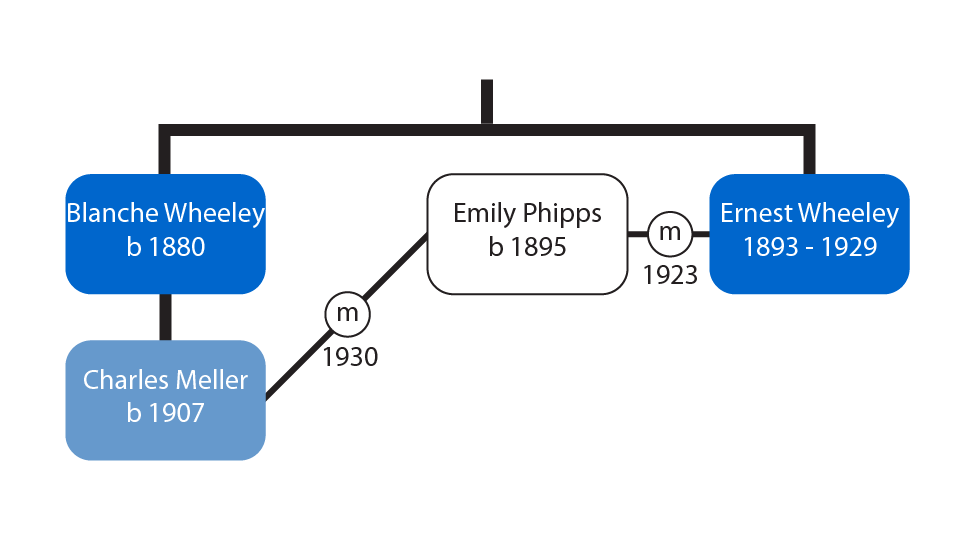
Tree diagram to illustrate family relationships
Charles was the nephew of Emily’s first husband, Ernest


There has long been a list of ‘forbidden marriages’ based on the bible. Way back in 1503, even King Henry VIII had to request a special dispensation so he could marry his brother Arthur’s widow, Katherine of Aragon. In 1907 the law changed to allow marriage to a wife’s sister or husband’s brother but only if the first spouse was deceased. In 1921, marriage to a brother’s wife or sister’s husband also became legal (only if the first spouse was deceased). This change in law likely came about due to the dramatic reduction in population after World War I. The law was again changed in 1931 to allow marriage to an aunt/uncle-in-law or niece/nephew-in-law (again only if the relevant people were deceased). [source: Forbidden Marriage Laws of the United Kingdom] However, in this case, Charles and Emily were married in 1930 – the year before it became legal for them to do so.

By 1939, the couple had a son together, Ronald, and Cissie had taken the name of her mother’s new husband (and Cissie’s first cousin), Meller. A clue to the unusual relationship can be found on the 1939 register entry – upon Cissie’s marriage in 1943, her original name of Wheeley was added along with her new married name of Dickinson (Cissie used the name Wheeley when she married).

There could be many reasons for marrying a the spouse of a deceased family member and at times it was encouraged. It is impossible to know the nature of the couple’s relationship prior to Ernest’s death (without family anecdotes to rely on). A clue that this union may not have had the family’s blessing may lie in their address. Charles and Emily were on Hollemeadow Road, whereas the rest of the family seemed to live more closely together on or near Pleck Road (the other side of town). But, of course, this is just speculation on my part.

Related posts:

Certified Muddle

Came across something interesting today…

Leah Yeomans birth date on the 1939 register is listed as 5 Jan 1896. However, on her official birth certificate, the year of birth is recorded as 1897. Since you would imagine a birth certificate to be more accurate, I’ve always recorded her year of birth as 1897. But as I was going through the records again, I wondered which was more accurate. Human error needs to be considered in both cases here.

Leah Yeomans in the 1939 register – recorded under her married name, Lamb
Certified Copy of Leah Yeomans’ birth entry

It was only minutes later that I came across another example within the same family.

The marriage certificate of Leah Yeomans’ parents lists their year of marriage as 1874.
Today, I found an image of the original marriage entry from the parish records that shows the year may actually be 1875.

Certified copy of James Yeomans & Mary Johnson’s marriage entry
Original image of James Yeomans & Mary Johnson’s marriage entry

In this case, the confusion stems from the year in the title being 1875 and the year within the entry as 1874. The other 3 entries on the image all have the same anomaly (both being recorded as 1875 and 1874). Fortunately I was able to see the previous & following pages and it seems to be an error only on this particular page – the title year should actually read 1874.

My decision is to record Leah Yeomans birth year as 1897 (since the year is repeated 3 times within the entry, it’s less likely to be a mistake) and her parents’ marriage as 1874.

Related posts:

George the Absconder

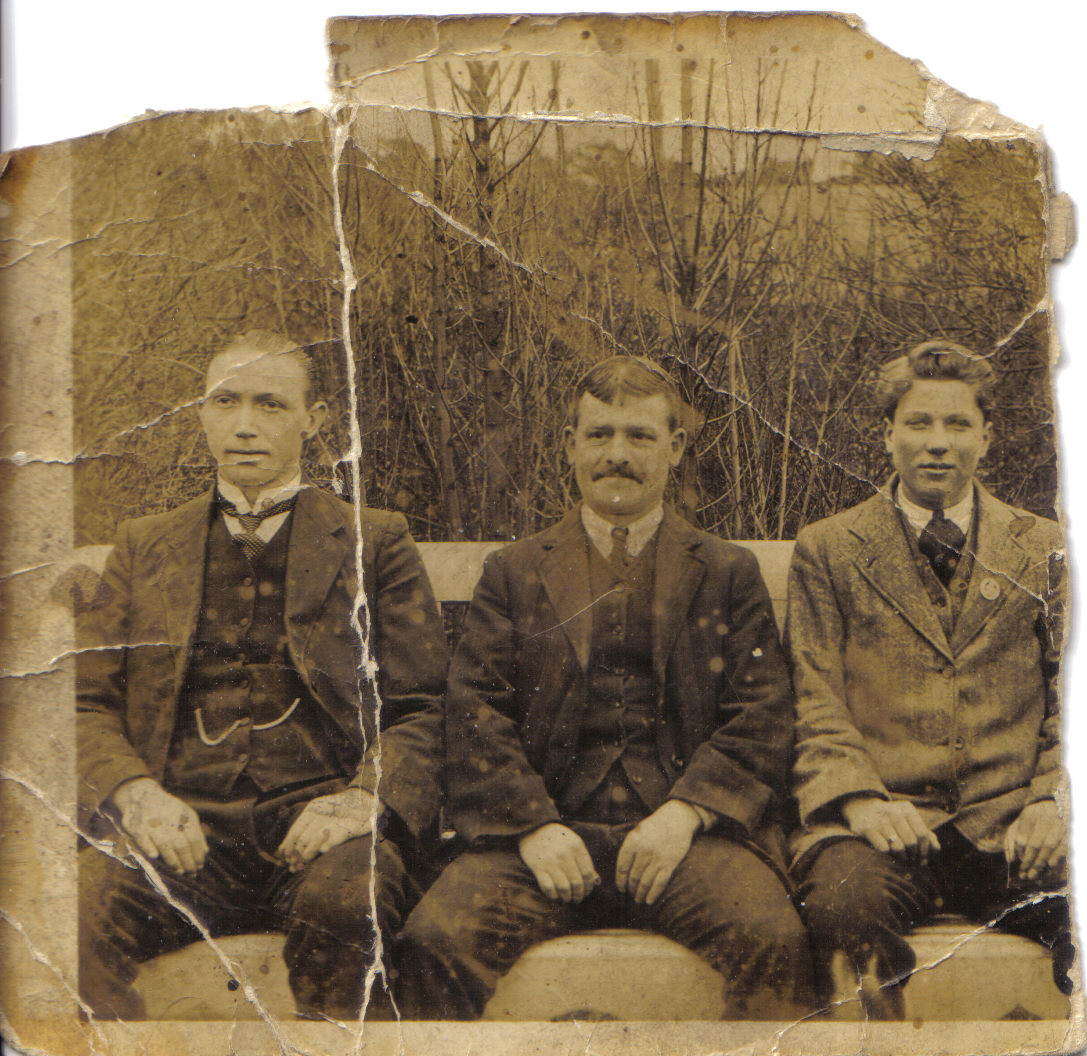
three men sitting on a bench
A young bachelor George EBBANS (far right?) with two of his brothers (c1910)

The family story goes that George Ebbans (b. 1893) left his wife and children around 1927 and started a new family with another woman.

In my mother-in-law’s words:

George Ebbans married Sarah Ann Crossley. They had 2 children, Irene and George. For some reason, my mother-in-law says George spread it around and Sarah Ann (known as Sarann) was no angel.  George left their home and could not be traced for quite a few years. It later emerged that he had gone to live in Wolverhampton and lived with another woman (can’t find any record of a divorce or remarry). They raised a family, don’t know how many but one was christened George just to complicate matters. (It was also known that Sarann and her mother didn’t want George around so his reputation could well be made up).

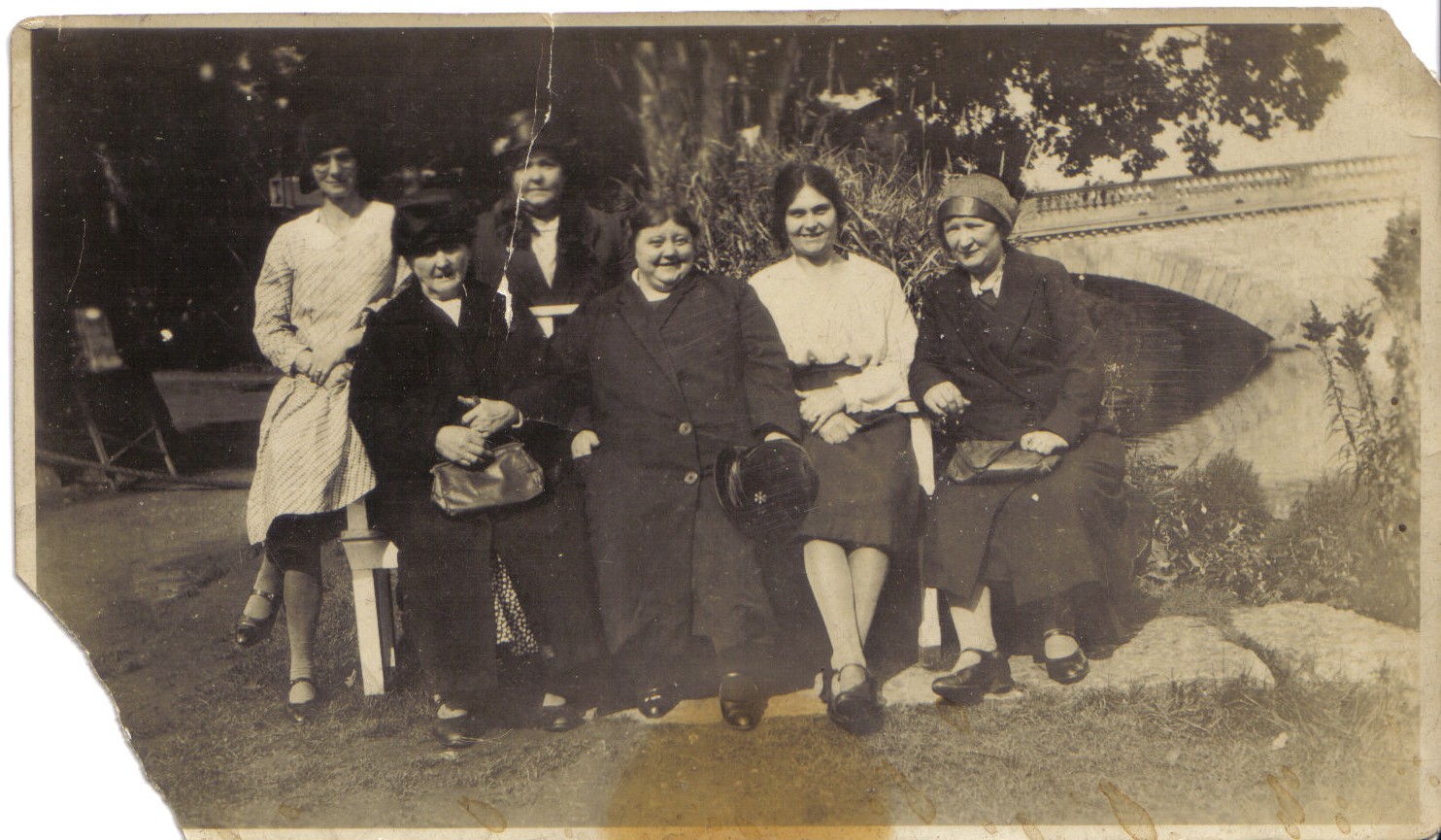
a group of women sitting on and around a bench
Sarah Ebbans (nee CROSSLEY) in centre far left

This information seemed to come from family members who had first hand knowledge of the people, so I have no reason to doubt it.  However, I have also been unable to find any evidence of this desertion…

Until now.

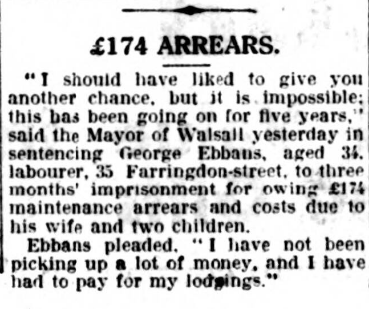
clipping from newspaper

Found in the Birmingham Daily Gazette, 25 November 1930, p3:

£174 ARREARS.

“I should have liked to give you another chance, but it is impossible; this has been going on for five years,” said the Mayor of Walsall yesterday in sentencing George Ebbans, aged 34, labourer, 35 Farringdon-street, to three months’ imprisonment for owing £174 maintenance arrears and costs due to his wife and two children.

Ebbans pleaded, “I have not been picking up a lot of money, and I have had to pay for my lodgings.”

The trail still ends there really.  Still no evidence of a second family in Wolverhampton – marriage or children – and I am yet to even find a death record for George himself.

But we now know that he did indeed desert his family and had done by at least 1925 – the same year his second child was born. It probably was hard for George to find enough money to support himself but I’m sure it was even harder for Sarah looking after two children and working as a hospital laundry maid (source: 1939 register).

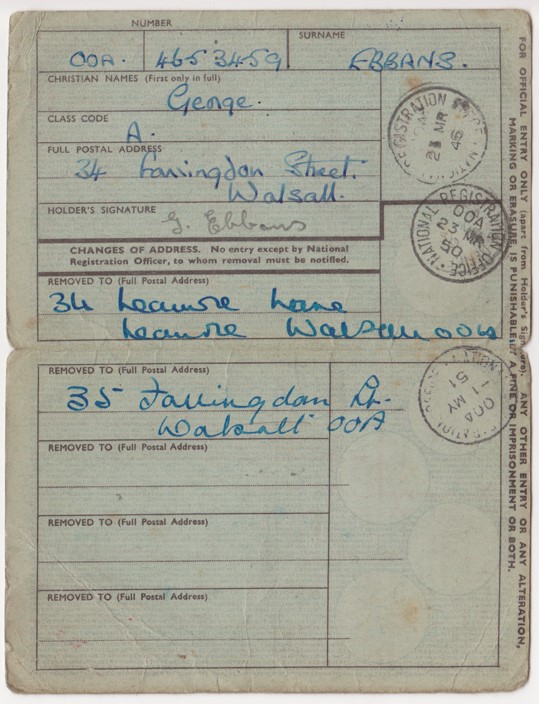
National Registration Identity card
National Registration Identity card of George Ebbans (son of George and Sarah Ann)

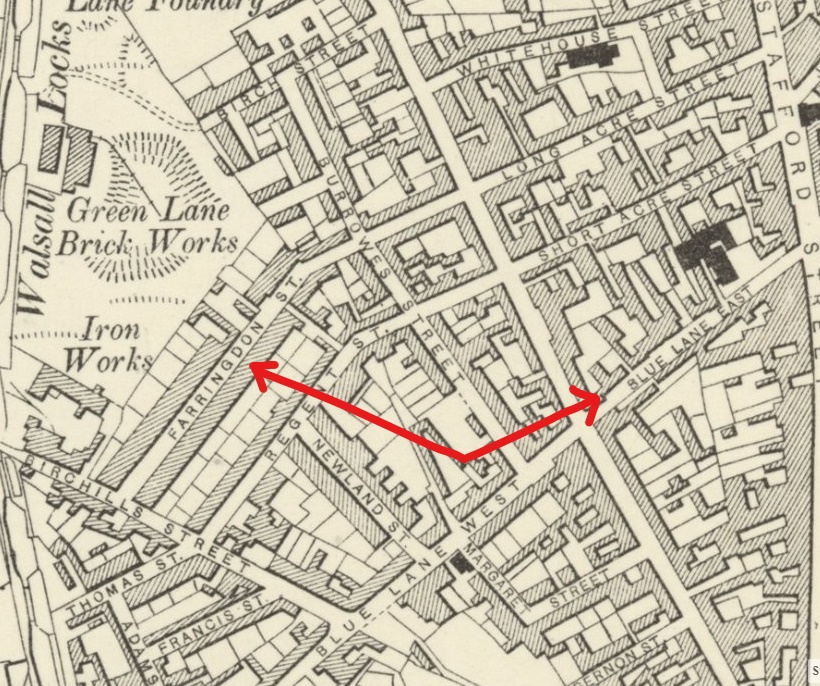
I’m a little confused by his address being listed as 35 Farringdon Street as his son lists it as an address on his National Registration Identity Card (c1945 – 1951) which leads me to believe it was actually the family address.  George mentions lodgings – presumably at a different address away from the family and therefore NOT Farringdon Street? Sarah (and I presume her 2 children – names currently redacted) are living on nearby Blue Lane in the 1939 register so this is unclear.

We may never know what really happened to George – the Ebbans name has been written in error and transcribed in so many different ways that it’s possible he’s hiding in the records under some alternative spelling I’ve yet to come across. But I’ll keep my fingers crossed…

UPDATE:

  • Sarah Ann has been identified as the woman on the far left of the picture (by her daughter/granddaughter)
  • More details of George and Sarah Ann’s relationship have been shared via the podcast 

Related posts: