At the top of my ancestry ‘To Do’ list for many years now has been ‘Find out who Blind Wreford is’.
Today I’ve finally found out…
I’m not even sure where I first heard of Blind Wreford but I’ve kept an eye out for any mention of him. Finally I found mention of him in obituary for another old wrestler, John Bolt.
He was full of anecdotes of “Blind Wreford,” a wealthy farmer of Cheriton, who died in 1835 at a very advanced age, and who, notwithstanding his blindness, was a renowned wrestler, often followed the hounds without sustaining severe falls, and was an excellent judge of the weight and general qualities of cattle.”
According to this, he had been totally blind since he was 8. “He was a strongly limbed, well grown and powerful man, about 5 feet 10 in. in height, and was usually led into the ring by a boy, as a guide, and indulged with the privilege of taking hold of his antagonist by the collar…”
I’m really surprised that it’s been so hard to find mention of this guy as he really does seem quite extraordinary.
I wrote in a previous post about pinpointing Thomas PALMER’s premises using a newspaper report of his being robbed. Living by a police station didn’t seem to give the security you’d think it would, as Palmer was robbed again in 1869:
Portsmouth Times and Naval Gazette 27 November 1869, p5 c5
A certain Henry Baker stole two books from him at the value of 4 shillings, as well as a pot of cold cream from a nearby chemist, Charles Mumby. Funnily enough a little research shows this chemist was actually the founder of Mumby’s Mineral Waters. (Read a little more about him here.) He also stole a letter stamp from a Mr Loveder but for some reason this wasn’t investigated.
Portsmouth Times and Naval Gazette 11 December 1869, p3 c3
As the ‘well-known character‘ had been convicted of a felony twice before this incident, Henry Baker was sentenced to twelve months hard labour. Out of curiosity, I found his record of conviction for his crime against Thomas Palmer in the Southampton Assizes records.
Henry Baker’s conviction at the Southampton Assizes 1869
I’m curious as to what Thomas’ ‘private mark’ looked like. Was his private mark different to his store mark? Did it look anything like this…?
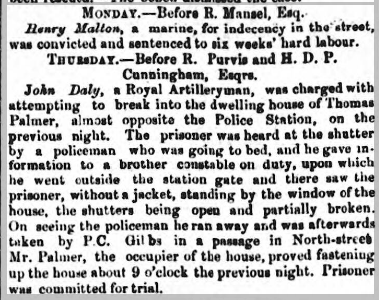
In my last post, I was trying to find a more exact address for Thomas Palmer, bookseller of Gosport. I had narrowed him down to ‘Upper South Street’ but not being a local, still had no idea where exactly upon the street he lived. The breakthrough came when I found a newspaper article reporting a robbery at his premises:
Portsmouth Times and Naval Gazette 22 November 1862, p8 c3
John Daly, a Royal Artilleryman, was charged with attempting to break into the dwelling house of Thomas Palmer, almost opposite the Police Station, on the previous night. The prisoner was heard at the shutter by a policeman who was going to bed, and he gave information to a brother constable on duty, upon which he went outside the station gate and there saw the prisoner, without a jacket, standing by the window of the house, the shutters being open and partially broken. On seeing the policeman he ran away and was afterwards taken by P.C. Gibbs in a passage in North-street. Mr. Palmer, the occupier of the house, proved fastening up the house about 9 o’clock the previous night. Prisoner was committed for trial.
The old police station in South Street, Gosport – 1949
So now I knew that he lived “…almost opposite the Police Station…”.
Unfortunately, the police station no longer exists on South Street after being destroyed by enemy action in 1941. I found a photograph of the building in 1949 on the Gosport Heritage site but it gave me no other details. Luckily however I found a c.1896 map which marked the location of the police station which made the description, ‘almost opposite’ make sense.
Location of Thomas Palmer’s book store in 1862 (map c. 1896)
Interestingly, there is also a photo on the Gosport Heritage site captioned; ‘Portland Place; south side of South Street, running north-south almost opposite to the OLD police station.’ I’m pretty sure Palmer’s old book shop is just out of shot on the far left of this image (behind the first building).
Thomas PALMER was a book seller and book binder. I know this because of census entries, parish records and marriage certificates.
Thomas was listed as a ‘Bookseller’ on his son’s marriage certificate (1848)
The first indication of his profession was his son George Wright PALMER’s marriage certificate, where Thomas’ profession was listed as ‘Bookseller’. George had given his place of birth as Portsea, Hampshire on the 1861 census which allowed me to locate his father Thomas in Hampshire on the 1851 and 1861 censuses despite George not being in the home (more about the 1841 later). Like any keen family historian, I wanted to know exactly where this family lived.
Thomas was listed as ‘Bookseller’ on South Street, Gosport (1851 census)Thomas was listed as ‘Bookseller & Binder’ on South Street (1861 census)
The censuses gave me South Street (no.53) as an address but where on South Street? House numbering has not been consistent over time and I knew from comparing historical and modern maps that South Street, Gosport is a lot longer today than in the 1800s. I turned to trade directories to assist me.
Kelly’s Directory of Hampshire 1867, p538
Thomas didn’t appear on the 1871 census but he DID appear in the 1867 ‘Kelly’s Directory of Hampshire’ as a secondhand bookseller in Upper South street, Gosport. This would’ve narrowed it down a bit except I had no idea which end of the street was upper?
Post Office Directory of Hampshire, Wiltshire & Dorsetshire, 1855, p58
The 1855 ‘Post Office Directory of Hampshire, Wiltshire & Dorsetshire’ specified number 53 Upper South Street (as did the 1861 census) but I recall the street numbers of the past may not necessarily be in the same location as street numbers today.
Directory of Hampshire & the Isle of Wight, 1859, p351
However, the 1859 ‘Directory of Hampshire and the Isle of Wight’ listed Thomas at 61 South street.
There were no other appropriate directories on the Historical Directories site for me to search. Thomas does not appear in the 1828 or 1844 Pigot’s directories of Hampshire, nor have I found him yet in the 1841 census.
So, the address list compiled so far is as follows:
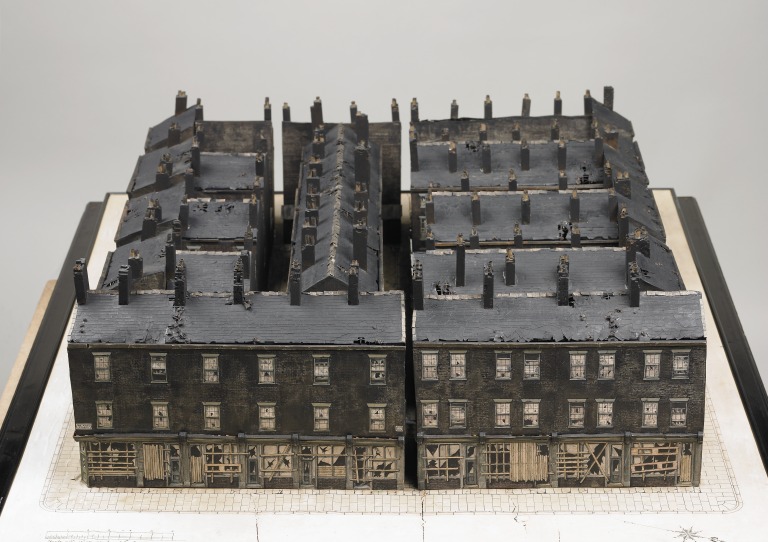
If you lived in the West End of Derby in the 19th century, you were considered to live in the slums. It is here that the families I’ve researched lived mainly in what was known as court housing (some more information on court housing here).
An article on the Derby Telegraph site mentions that this area was part of an 1849 report to the General Board of Health on “The Sewerage, Drainage and Supply of Water and the Sanitary Conditions of the Inhabitants of Derby”;
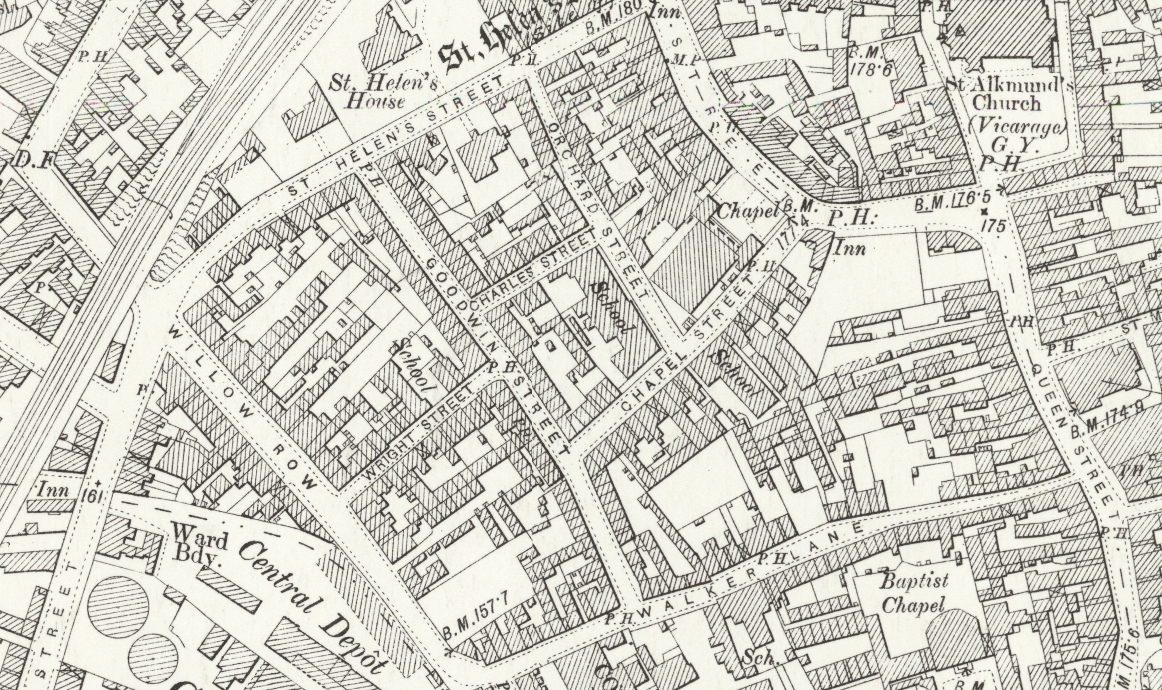
In Willow Row, Court 1, 103 inhabitants shared two privies and residents reported that milk would turn to curd when mixed with water from the communal pump…
Observations of Walker Lane, where 75 cases of typhus fever were reported between June 15 and September 14, 1847, were: “The houses are of the most inferior description and the inhabitants of a piece with their houses; to crown all, there are lodging houses, which are the principal headquarters of vagrants, and of those comers and goers who, for reasons best known to themselves, prefer darkness to light.”
It is in these conditions that Hannah Bates, William Lamb and their families lived most of their lives. The slum clearances of the 1930s mean that the court housing is now long gone but it’s important to keep these living conditions in mind when researching the people of the area and trying to understand their lives.
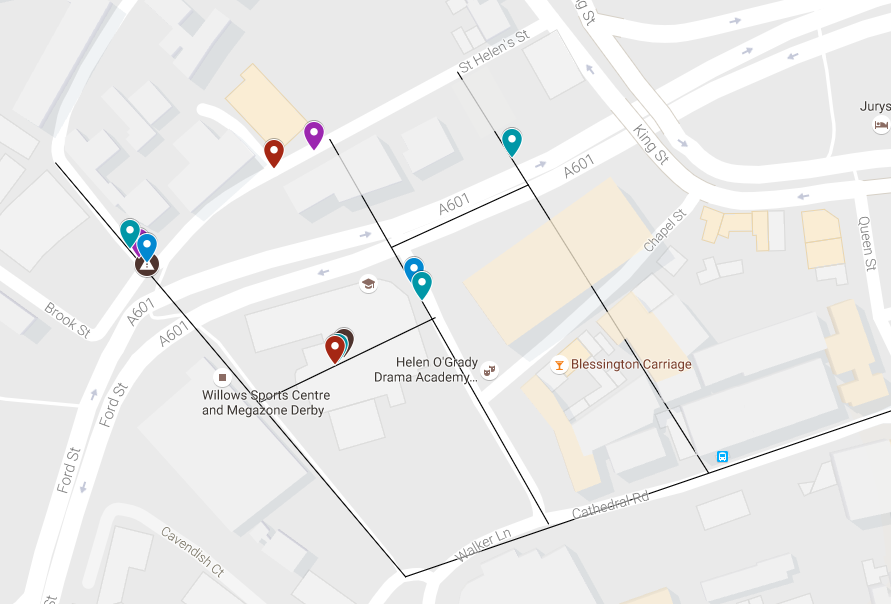
2016 map of Derby (black lines represent the old street layout)Circa 1899 map of Derby
Note: the Derby Telegraph article mentioned above is no longer available online [referred to: area-poverty-abounded-rich-community-spirit-pride/story-11591093-detail]