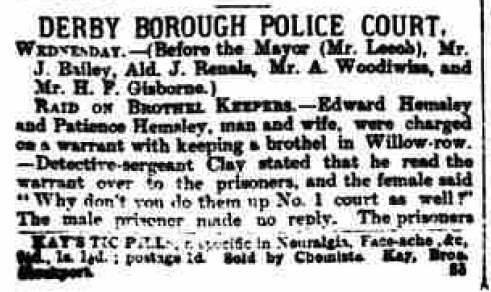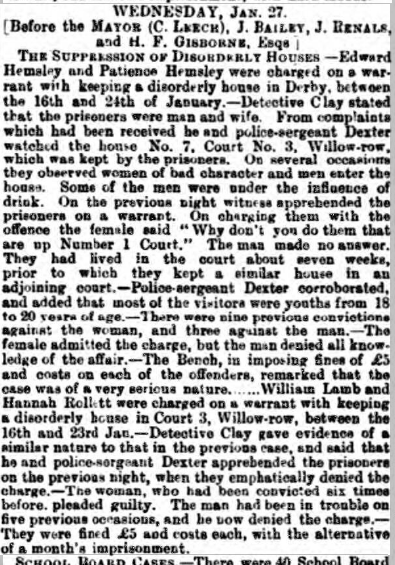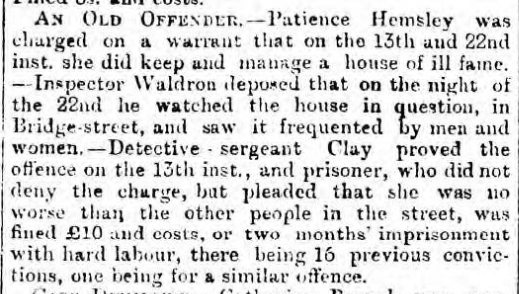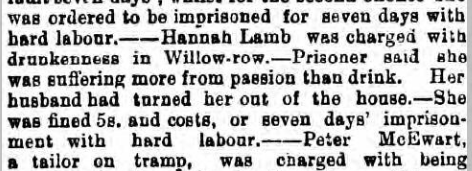
Aunt Sally

Before Rose Richards [nee LAMB] died, we were chatting about her family history via facebook messenger and she wrote:

“… my Dad had a sister we called Sally. She married a man named Woodward who left her and went to America. During the war an American soldier had a piece in the Derby Evening telegraph asking for her, But my Dad wouldn’t let us answer it.”

Rose Richards [nee Lamb], 2 Aug 2016

I dutifully added the name Sally Lamb to the family tree as a brother of Reuben Henry LAMB (son of Hannah BATES and William Henry LAMB) but was unable to find the newspaper piece Rose refers to.

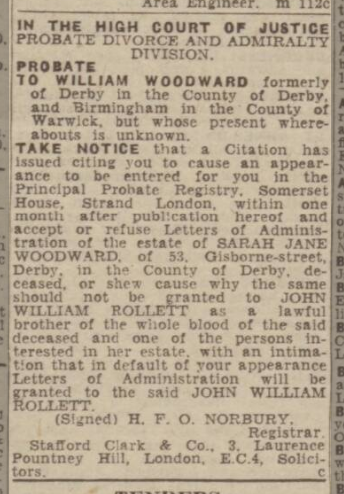
At a later point, likely trawling the newspapers for Rolletts, I came across an article requesting William Woodward come forward, or else his now deceased legal wife’s estate would be given to her brother John William Rollett:

Derby Daily Telegraph, 12 May 1947 p10

“TO WILLIAM WOODWARD formerly of Derby… and Birmingham… but whose present whereabouts is unknown.
TAKE NOTICE that a Citation has issued citing you to cause an appearance to be entered for you in the Principal Probate Registry… within one month after publication hereof and accept or refuse Letters of Administration of the estate of SARAH JANE WOODWARD, of 53, Gisborne-street, Derby, in the County of Derby, deceased, or shew cause why the same should not be granted JOHN WILLIAM ROLLETT as a lawful brother of the whole blood of the said deceased and one of the persons interested in her estate, with an intimation that in default of your appearance Letters of Administration will be granted to the said JOHN WILLIAM ROLLETT.”

Derby Daily Telegraph, 12 May 1947, p10

This showed that Sally, officially known as Sarah Jane was actually a child of Hannah BATES’ first husband, Alexander ROLLETT. Until then, I had only known him to have two sons – John William and William Henry. But since John was referred to as ‘a lawful brother of the whole blood’, I adjusted the tree and changed her maiden name to Sarah Jane ROLLETT, daughter of Alexander.

Unfortunately, this still didn’t help me in my quest for information. The closest I got was Sarah’s likely appearance in the 1939 register, where she was recorded as a widow and retired ‘rag sorter’.

Sarah Jane Woodward in the 1939 register

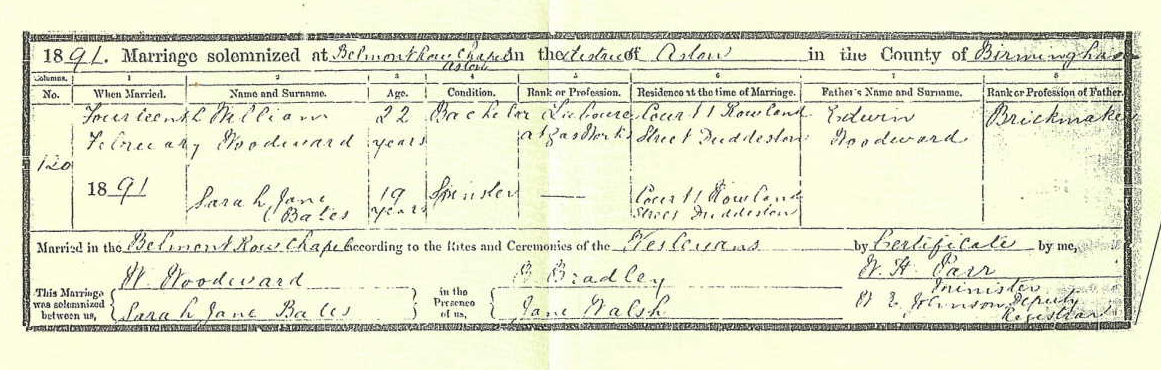
Today, however, I came across her long lost husband in an ancestry member tree. This tree gave her name as Sarah Jane BATES (her mother’s maiden name) and also shared a copy of the marriage certificate which shows the two had married in Birmingham in 1891.

The 1891 marriage of Sarah Jane BATES to William WOODWARD

Interestingly, Sally does not give her father’s name so it is still uncertain whether Alexander truly is her biological father. It is unlikely that her birth record would have his name either, since she is registered under her mother’s maiden name but I’d still like to order it one day to check. The fact that Sarah Jane was never recorded with her family intrigues me – perhaps she wasn’t actually Rollett’s child either?

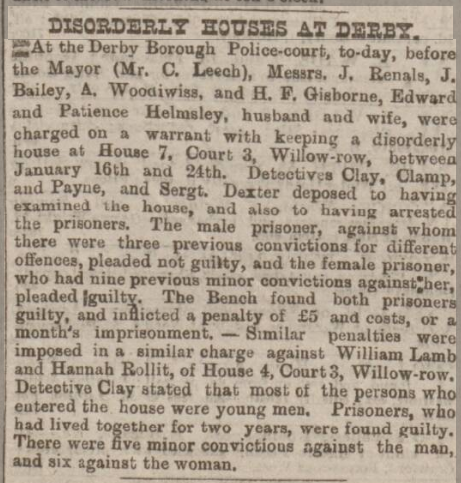
It turns out that William had actually formed a relationship with his barmaid, Alice Robinson around 1907 (William & Sally ran a pub in Aston – noted on the 1901 census) and had a couple of kids with her before migrating to Canada around 1910, where they lived as a married couple and continued to grow their family.

As for the newspaper piece Rose mentioned, according to William’s family he returned to England for a few years at the beginning of the war so it’s possible William did try to reach out to his former wife at that time (for whatever reason).

It’s so amazing to actually find answers to these little mysteries and especially from another perspective. In addition, the search for Sally allowed me to unlock more doors into the intriguing life of Hannah Bates…

Update:

Due to the above article, I had assumed Sally died in 1947 but the only likely death record in the index was in 1941. I have now found the probate record that states she did die in 1941 but probate wasn’t granted until 1947. Presumably, time had to be given to locate her missing husband, William before it being passed on to her brother(?).

Next Steps:

  • order Sarah Jane BATES’ birth certificate
  • locate newspaper article mentioned by Rose

And that’s where things have stayed for a long while. I was unable even to find a likely marriage between the two. But today, all that changed when I came across an ancestry member tree, which finally blew the doors open on this couple. More importantly, the discovery has helped me unlock even more doors.

Related posts:

The Hannah Chronicles – Shocking Immorality

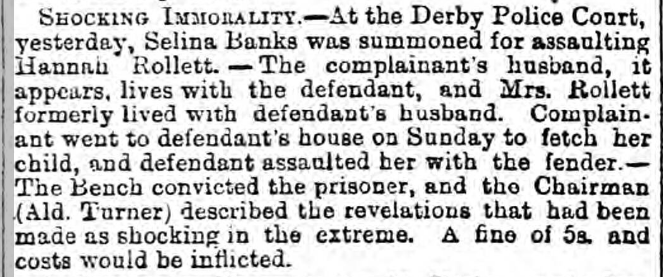
1880 – Shocking Immorality -Sheffield Independent 05 March 1880, p4 col2

In 1880, Hannah and her husband Alexander ROLLETT made the papers again with regards to their ‘shocking immorality’. According to the articles, Hannah had taken up with Henry Banks, who happened to also be married. Selina Banks, in turn took up with Alexander – in some kind of ‘wife swap’ scenario.  Hannah went round ‘to fetch her child’ (how long the child had been with his father is unclear) and an argument ensued during which Hannah attacked Selina with a fire fender.

SHOCKING IMMORALITY. -At the Derby Police Court, yesterday, Selina Banks was summoned for assaulting Hannah Rollett. – The complainant’s husband, it appears, lives with the defendant, and Mrs. Rollett formerly lived with defendant’s husband. Complainant went to defendant’s house on Sunday to fetch her child, and defendant assaulted her with the fender. – The Bench convicted the prisoner, and the Chairman (Ald. Turner) described the revelations that had been made as shocking in the extreme. A fine of 5s. and costs would be inflicted.

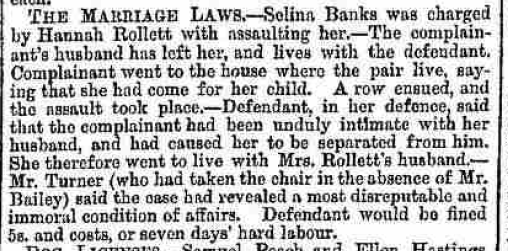
1880 – marriage laws – Derby Mercury 10 March 1880, p2 col6

THE MARRIAGE LAWS.-Selina Banks was charged by Hannah Rollett with assaulting her. -The complainant’s husband has left her, and lives with the defendant. Complainant went to the house where the pair live, saying that she had come for her child. A row ensued, and the assault took place. -Defendant, in her defence, said that the complainant had been unduly intimate with her husband, and had caused her to be separated from him. She therefore went to live with Mrs. Rollett’s husband. -Mr. Turner (who had taken the chair in the absence of Mr. Bailey) said the case had revealed a most disreputable and immoral condition of affairs. Defendant would be fined 5s. and costs, or seven days’ hard labour.

Alexander was still living with Selina at the time of the 1881 census (April) – also with them were his son William, and Selina’s son Joseph (both 6 years old). Perhaps William was the child referred to in the articles?  Either way, the incident seems to have marked the end of Hannah and Alexander’s marriage despite being unable to officially divorce.

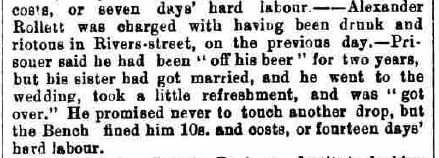
Interesting note: a few months after the 1881 census was taken, Alexander was found ‘drunk and riotous’ in Rivers Street.  He claimed to have been “off his beer” for two years before having a tipple at his sister’s wedding. The sister would have been Sarah Ann Rollett whom Hannah had attacked a few years previous.

Derby Daily Telegraph 16 August 1881, p3 col3

Related posts:

Certified Muddle

Came across something interesting today…

Leah Yeomans birth date on the 1939 register is listed as 5 Jan 1896. However, on her official birth certificate, the year of birth is recorded as 1897. Since you would imagine a birth certificate to be more accurate, I’ve always recorded her year of birth as 1897. But as I was going through the records again, I wondered which was more accurate. Human error needs to be considered in both cases here.

Leah Yeomans in the 1939 register – recorded under her married name, Lamb
Certified Copy of Leah Yeomans’ birth entry

It was only minutes later that I came across another example within the same family.

The marriage certificate of Leah Yeomans’ parents lists their year of marriage as 1874.
Today, I found an image of the original marriage entry from the parish records that shows the year may actually be 1875.

Certified copy of James Yeomans & Mary Johnson’s marriage entry
Original image of James Yeomans & Mary Johnson’s marriage entry

In this case, the confusion stems from the year in the title being 1875 and the year within the entry as 1874. The other 3 entries on the image all have the same anomaly (both being recorded as 1875 and 1874). Fortunately I was able to see the previous & following pages and it seems to be an error only on this particular page – the title year should actually read 1874.

My decision is to record Leah Yeomans birth year as 1897 (since the year is repeated 3 times within the entry, it’s less likely to be a mistake) and her parents’ marriage as 1874.

Related posts:

The Will of James Findlay


Port Henry Harbour (via The Buchan Heritage Society)

James Findlay and his wife, Helen Buchan were living at 29 Port Henry Road in April of 1881 with 6 of their 8 children (Jane Ann & Agnes appear to be in service at this time). James was a boat builder and ship carpenter and they had been married for 20 years.

The Findlay family in 1881

Sadly, only a few years later,  both James and Helen were dead. Helen died of dropsy in 1885 and the following year James died of pernicious anaemia, leaving behind their young family.

Approximate age of James Findlay’s children at the time of his death:

  • James 23
  • Jane Ann 21
  • Agnes 20
  • Margaret 17
  • William 14
  • Arthur 10
  • John 8
  • Helen 6

(note: Another daughter named Helen (b.1870) died before 1880)

James’ estate was only valued as a total of £18 14s (equivalent to roughly £1500 in today’s money) but he also owned the house on Port Henry Rd* where the family lived.

Extract Inventory of James Findlay


On the surface, there wasn’t a lot of genealogical information in these documents (the only relative named was his son), yet it still managed to indicate the care he had for his family.

1886 Will of James Findlay (img 690)


…(First) My said Trustees and their foresaids shall as soon as convenient assign convey and deliver to my son James Findlay Junior Fisherman Port Henry Road Peterhead the whole of my moveable estate in consideration of which the said James Findlay Junior shall be bound to pay my debts and funeral expenses including sums due to my children for money lent to me (Second) My said Trustees and their foresaids shall allow the said James Findlay Junior to occupy free of rent with power of subletting my house in Port Henry Road on condition that the said James Findlay Junior shall (in the first place) maintain such of my children as are under the age of seventeen years until the said children or the survivors of them individually reach the age of seventeen years or give such assistance as said children require for their maintenance in addition to their own earnings Declaring that I wish my children to understand that my desire is that they shall as soon as possible do what they can to maintain themselves Declaring further that the said James Findlay Junior shall not be bound to maintain or assist in maintaining any of said children unless they are content to live in family with him in his house and (in the second place) provide a free lodging in said house for such of my daughters as are unmarried though above the age of seventeen during such time as said unmarried daughters have no other home open to them but [beyond] the simple shelter of his house the said James Findlay Junior shall not be bound to maintain or assist in maintaining any daughter beyond the age of seventeen.  This provision in favor of unmarried daughters shall cease to be binding when as hereinafter provided my house is conveyed to the said James Findlay Junior in absolute property or is sold Declaring that the said James Junior shall not be bound to perform any of the above conditions in favor of my children and unmarried daughters unless said children and unmarried daughters conduct themselves properly and to the satisfaction of my said Trustees and their foresaids (Third) When my youngest child then alive attains the age of seventeen years if the said James Junior is alive and has fulfilled the above conditions of maintaining my younger children and providing a lodging for my unmarried daughters my said Trustees or their foresaids shall convey my said house to the said James Findlay Junior as his absolute property…

Basically, James willed that his eldest son James Jr would inherit his estate and take ownership of the house, as long as he continued to provide for the younger children until they were 17 years of age and behaved themselves (but desired that they try to maintain themselves as soon as possible). He also hoped that James Jr would allow his unmarried sisters above the age of 17 to lodge rent free in the family home if needed, but wasn’t bound to support them outside this. James Jr appeared to have honoured his father’s wishes.

On the 1891 census, Arthur & John were recorded still with him on the 1891 census. Margaret was boarding with sister, Jane Ann in Almanythie Lane (2 streets over) and the youngest, Helen, was recorded with older sister Agnes in Port Henry Lane (a lane connecting Longate to the harbour – since demolished).  I have as yet been unable to locate William.

Arthur and John living with James Findlay Jr in Port Henry Road 1891

Helen living with sister Agnes in Port Henry Lane 1891

Margaret living with sister Jane Ann in 1891


Map of Peterhead c.1900 showing Port Henry Road & Almanythie Road

Interestingly one of the named executors refused the role.  John Suttar was a long established local merchant who “carried on an extensive trade with the fishing community” [Aberdeen People’s Journal 15 December 1906 p9] and John Gilchrist Mitchell was a fish curer whose son was the solicitor named in the will, Henry Benjamin Gilchrist. Both were clearly acquainted with James and may have even been close friends but as Suttar declined it’s unclear.

*house number seems to change but still refer to same address

Related posts:

Wills and Williams

I was overjoyed to find the will of William GLAISTER (1816 – 1883) on the FamilySearch site in the Archives New Zealand probate records collection.  He was a {white & black}smith of Kelso in Roxburghshire, Scotland before emigrating to Dunedin, New Zealand in 1872.   [This William was also the subject of a previous post – Addressing Up]

In summary (from what I can make out):

  • All his tools were to be given to his son Edward
  • Ten pounds were to be given to each of his three (male) grandchildren
  • Janet was to be allowed to use and occupy his house and home and given an income for life (she was to die only 2 years later)
  • Section 235 & 236 of The Glen were to be given to his sons Edward & Thomas (as long as his debts were satisfied)
  • Everything else was to be sold off and the money shared between all his children

However, I was curious as to why only two of his sons, Edward and Thomas, and three of his grandchildren were mentioned by name in his will?  Also, his two executors, William Sinclair and Alfred Kingston Smith were not his sons so who were they?

Below is a transcription of the will (written 3rd of March 1883) with the names in bold typeface [indentation added by me for ease of reference]:

This is the last will and testament of me William Glaister of The Glen near Dunedin in the Provincial district of Otago and Colony of New Zealand Whitesmith. I appoint William Sinclair of Dunedin aforesaid Warehouseman and Alfred Kingston Smith of the same place Fishmonger Executors of this my will

I give and bequeath to my son Edward Glaister all the tools of my trade and to each of my grand children William Smith, William Sinclair the younger and William Glaister the sum of Ten pounds

I give devise and bequeath unto the said William Sinclair and Alfred Kingston Smith and the survivor of them the heirs executors and administrators of such survivor hereinafter referred to as my said Trustees all my real and personal estate upon trust to permit and suffer my wife Janet Glaister to use occupy and enjoy all my real estate whatsover without impeachment of waste and also all my household furniture and such of my personal estate (other than money) as my said attorney wife may require without being responsible for any loss or diminution in value which may arise therefrom

And as to the residue (if any) of my personal estate upon trust to sell and convert the same into money and after payment of all my just debts legacies funeral and testamentary expense to invest or apply the same as hereinafter appears

And from and after the death of my said wife as to section two hundred and thirty five (235) The Glen upon trust for my son Edward Glaister subject to the proviso hereinafter contained and as to section two hundred and thirty six (236) The Glen upon trust for my son Thomas Glaister subject to the proviso hereinafter contained

And as to all the residue of my real and personal estate upon trust to sell and convert the same (or such part thereof as shall not consist of money into money and shall stand possessed of the moneys to arise from such sale and conversion of my estate and such part thereof as shall consist of money upon trust for all my children equally share and share alike

And I hereby declare that any money in the hands of my Trustees may be invested by them of depositing the same in any Bank, Building Society or public Company or in any way which my said Trustees may seem desirable

And I hereby empower my said Trustees to pay the income thereof to my said wife during her life and if they shall deem it necessary so to do to apply the whole or any part of the principal sum then in their hands for her support and maintenance anything herein to the contrary notwithstanding.

And I do hereby declare that if my personal estate shall prove insufficient for the payment of my just debts, funeral and testamentary expenses and the legacies to my grand children the deficiency shall be paid by my sons Edward Glaister and Thomas Glaister in equal shares and if both or either of them shall fail or neglect to pay the sum necessary for this purpose within twelve months after the same shall have been demanded from them or him it shall be lawful for my said Trustees to sell the sections or section to which they or he would have been entitled and after payment thereout of all my expenses attending such sales or sale and the proportionate amount so required for payment of the said debts expenses and legacies to stand possessed of the proceeds of such sales or sale for the persons or person who would have been entitled to the said sections or section if such sale or sales had not been made [In witness] whereof I have hereunto set my hand this third day of March One thousand eight hundred and eighty three

Signature of William Glaister (1816 – 1883) as it appears on his last will and testament


William married twice; his first wife Margaret MURRAY died sometime between 1853 and 1857 when he married his second wife, Janet Waldie.  He had 8 children – 4 with each wife:

Children with 1st wife Margaret:
Robert 1844
Janet 1846
Margaret 1851
William Murray 1853

Children with 2nd wife Janet:
Barbara 1858
John 1860
Edward 1863
Thomas 1866

First step was to work out who was still alive at the time the will was written.

Janet died at just 2 years of age in 1848 and John died 2 years before the will was written at the age of 21.

Burial entry of Janet Glaister 1846-1848


Death notice of John Glaister, Otago Daily Times, Issue 6106, 5 September 1881

Next step, the surnames of the grandchildren were a hint that his executors were actually his sons-in-law.  Searching NZ BDM online gave a William Richard Smith born to Alfred Kingston Smith and Margaret in 1874 and William Donald Sinclair born to William Sinclair and Barbarain 1878.  This then led me to the marriages of William’s two surviving daughters, Margaret and Barbara confirming that they were indeed married to the two executors. I then searched for the grandchildren using the parents’ names:

Children of Margaret Glaister & Alfred Kingston Smith

Possible children of Barbara Glaister and William Sinclair

Children with 1st wife Margaret:
Robert
1844
Janet 1846 – 1848died at 2 years of age
Margaret 1851 – married Alfred Kingston Smith in 1874 (executor); their first son, William Richard Smith (b.1874) (1st grandson mentioned)
William Murray 1853 – 1917 – his son, William David Murray Glaister (b.1879) (3rd grandson mentioned)

Children with 2nd wife Janet:
Barbara
1858 – married William Sinclair in 1878 (executor); their first son, William Donald Sinclair (b.1878) (2nd grandson mentioned)
John 1860 – 1881 – died 2 years before the will was written
Edward 1863
Thomas 1866

[The names of people referred to in the will in green bold typeface]

So it seems as though only Edward & Thomas were specifically provided for as they were underage at the time (not yet 21); the 3 grandchildren were the eldest grandsons and possibly the only males alive at the time (though no deaths or other records have yet been found for James Robertson Sinclair); and the executors of the will were William’s daughters husbands. The daughters & grandaughters, as was often the custom in these times, were ignored.

It still doesn’t clear up why his eldest son, Robert (who appears not to have married) nor his second eldest, William Murray (my ancestor) were not the executors, let alone mentioned at all.

Next Steps:

  • Find out more about eldest son, Robert Glaister b. 1844

Related posts: