Hobart Town from the New Town Road by J.S. Prout (1844) (source)
Carrying on from last week’s Black Sheep Sunday post. I have managed to have find some more snippets of information of my Black Sheep duo – George WHITE and Elizabeth ALLEN.
World Vital Records offered free records until the 18th (tomorrow) so I took them up on their offer. I must say, I do find the site a bit of confusing. Searches for records of specific places (such as UK, Australia and New Zealand) tend to also include the American records in the results. This may be something an experienced user can combat but for me, time is of the essence!
Tucked away in the Hobart Town Gazette of 1844 were 2 references for each of my beloved convicts.Elizabeth Allen, Margaret, to Zachary Pocock, Hobart:
Hobart Town Gazette – 8 March 1844
George White, George III., from J. & R. Meikle, Murray-street, to Thomas Allcock, Hobart Town.:
Hobart Town Gazette – 16 August 1844
George White, George the Third, by Thomas Allcock, Liverpool-street, 2 months, 21st ditto [October]:
Hobart Town Gazette – 12 November 1844
Elizabeth Allen, Margaret, by George Lewis, Restdown, 1 month, from 10th ditto [September].:
Hobart Town Gazette – 8 October 1844
These snippets refer to whose private service they entered as a passholder.
From 1840 convicts usually served an initial period of “probation” in government work gangs, before becoming “passholders” who competed in the labour market. In the context of high unemployment, this meant that thousands of serving convicts joined ticket-of-leave holders and emancipists to roam the island in search of work. The sight of these workers, who by necessity or choice often lived rough in the bush, horrified and frightened the free settlers…(Source: Van Diemen’s Land by James Boyce – found via Google Books).
Next steps:
Search for other issues of the Hobart Town Gazette
Research the employers listed for some background information
I have returned from my holiday/family history mission in Devon. While there, I located the homes and farms of my ancestors, visited their churches and in some cases burial grounds and generally got a feel for the layout of the places they lived.
I also got to spend some time in the West Country Studies Library in Exeter – 4 and a half hours worth of time to be precise! I looked through parish records to firm up some sources and dates and browsed through some microfiche of the Exeter Flying Post to get a bit more detail.
I’ll be posting my findings over the next few days to help me collect all my information and thoughts. To start, I think I’ll flesh out the story of my bankrupt ancestor George WREFORD.
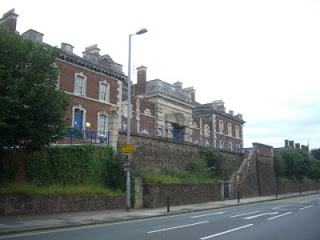
Exeter Prison (August 2009) – George may have been an inmate here in 1861
Last month, I discovered my 3rd great grandfather, George, was not found in the 1861 census partly because he was in jail for bankruptcy. You can read the story so far in my post Ancestor Found (almost).
Unfortunately, I have still not been able to locate him on the 1861 census. After eventually finding Exeter Gaol in the census records, I also found the prisoners were listed by initials only. ‘A-ha!’ I thought, ‘That explains why I couldn’t find him through a name search’ – but I couldn’t find any prisoner with the initials G.W. Not to be deterred, I then combed the entire list of prisoners by their age and birthplace looking for suitable or even approximate matches but I have still not found George WREFORD.
I am aware there was a debtor’s prison in Cowick Street but I learned on the Exeter Memories site that “the last prisoners were moved to the County Gaol in January 1855 and the facility was closed” – 5 years before George was held.
But I did find some nuggets of information in the Exeter Flying Post.
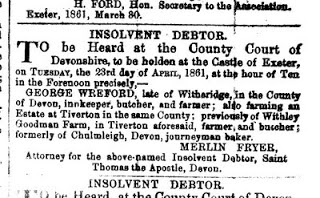
Exeter Flying Post, 10 April 1861, p1, c6
Another reference to his upcoming hearing at the county court at first seemed identical to the notice in the London Gazette EXCEPT, it claims he was a journeyman baker in Chulmleigh – this may be another lead or a Victorian typo. (The London Gazette referred to him as ‘Journey-man Butcher’, which is more likely).
More importantly, upon rereading, I noticed that it mentioned George was “to be holden at the Castle of Exeter”. This could explain why he was not in the County Gaol on the 1861 census! Census night was 7 April 1861 – this excerpt was from the 10 April 1861 edition of the newspaper.
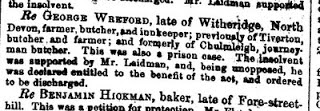
The next ‘clipping’ concluded what must have been a very difficult time in my ancestor’s life.
The insolvent was supported by Mr. Laidman, and, being unopposed, he was declared entitled to the benefit of the act, and ordered to be discharged.
I am aware that the laws surrounding bankruptcy changed in 1861 but if anyone can explain simply to me what the change was, I would love to know. I would also like to know what being supported by someone meant. I have a feeling, old George was quite lucky to have his case heard in this particular year.
Exeter Flying Post, 24 April 1861, p7, c3
(Update: Mr John Laidman (c. 1799–1871) was a prominent Exeter solictor (and City Treasurer) who specialised in bankruptcy law. He even wrote a legal guide, Bankruptcy and Insolvency: Practical Observations on the Laws, in 1857.)
Next steps:
Search the 1861 census for ‘the Castle’ and its inmates not found
Some more details of two of my family’s black sheep:
I first mentioned George White and Elizabeth Allen in my post, Woman of my Conviction. Both were transported to Tasmania, Australia (then known as Van Diemen’s Land) for their respective crimes in the early 19th century.
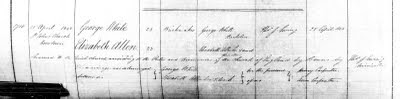
Convicts in Tasmania were not allowed to marry each other or a ‘free’ person without approval. I discovered that the Archives Office of Tasmania has a free record service for records not available online and requested a copy of the original page with George and Elizabeth’s Convict Application to Marry.
George White & Elizabeth Allen – Convict Application to Marry
The entry gives their names, and the ships they arrived on – George the 3rd and Margaret. It tells me the application was sent on the 22 March 1845 and was approved.
George White & Elizabeth Allen – Marriage Record
The pair were subsequently married the next month on the 28th of April. Nothing is mentioned about their convict status and I wonder how long they had to answer to the authorities.
For a long time, I’d been searching for one of my WREFORD ancestors on the 1861 census without luck.
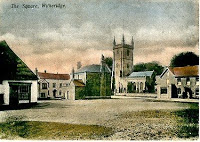
On the night of the 1861 census, in the Devonshire village of Witheridge, 14 year old Drusilla was recorded as head of the household and her occupation as ‘Innkeeper ?’ (note the question mark). Also in the household were 4 siblings aged 7 and under (including my direct ancestor, Augusta Harriet), and a 17 year old servant, Emily Cheriton. Their parents, George and Harriet, were nowhere to be seen.
Wreford Family on 1861 Census – Witheridge
I knew they weren’t dead, as George Wreford and his family emigrated to New Zealand in 1864. So where were they? For years this question has been unanswered until only a few days ago, when I happened to do a random search on The London Gazette website.
London Gazette, April 9, 1861
COURT FOR RELIEF OF INSOLVENT DEBTORS.
…
Before the Judge of the County Court of Devonshire, holden at Exeter, on
Tuesday the 23rd day of April, 1861. George Wreford, late of Witheridge, in the county of Devon, Inkeeper, Butcher, and Farmer, also farming an estate at Tiverton, in the same county, previously of Withley Goodman Farm, in Tiverton aforesaid, Farmer and Butcher, formerly of Chulmleigh, Devon, Journey-man Butcher.
A deeper look at the search results yielded:
COURT FOR RELIEF OF INSOLVENT DEBTORS.
…
ORDERS have been made, vesting in the Provisional
Assignee the Estates and Effects of the following Persons: On their own Petitions.
… George Wreford, late of Witheridge, Devonshire, Innkeeper, Butcher, and Farmer.—In the Gaol
of Exeter.
(London Gazette, March 26, 1861)
So there he was – bankrupt and in jail.
The census was taken for the night of April 6th, 1861. This now explains where George was that night. I presume his wife, Harriet had travelled to Exeter with him for moral support.
I now know where to look for them. This is brilliant, except my searches of the census are still not bearing fruit. My next step is to find ‘Exeter Gaol’ on the census and browse from there.