
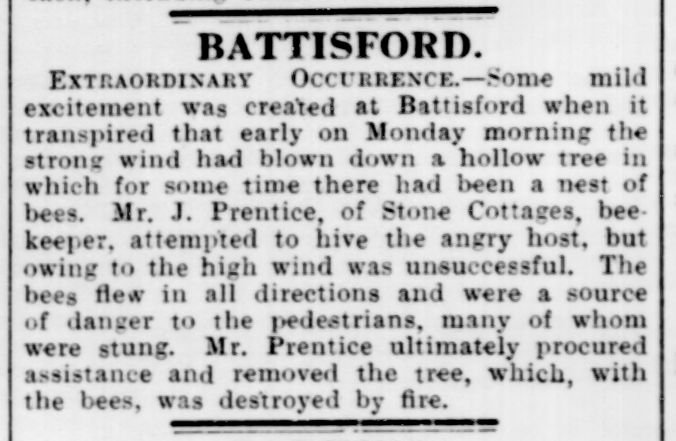
From the Stowmarket Weekly Post, 20 September 1906:
EXTRAORDINARY OCCURRENCE.—Some mild excitement was created at Battisford when it transpired that early on Monday morning the strong wind had blown down a hollow tree in which for some time there had been a nest of bees. Mr. J. Prentice, of Stone Cottages, bee-keeper, attempted to hive the angry host, but owing to the high wind was unsuccessful. The bees flew in all directions and were a source of danger to the pedestrians, many of whom were stung. Mr. Prentice ultimately procured assistance and removed the tree, which, with the bees, was destroyed by fire.
The ‘bee-keeper’, James Prentice, was born in Battisford in 1860. At the time of this ‘extraordinary occurrence’, James was 46 years old. He had been married to his wife, Sarah (nee Leggett) for 19 years but they don’t appear to have had any children.
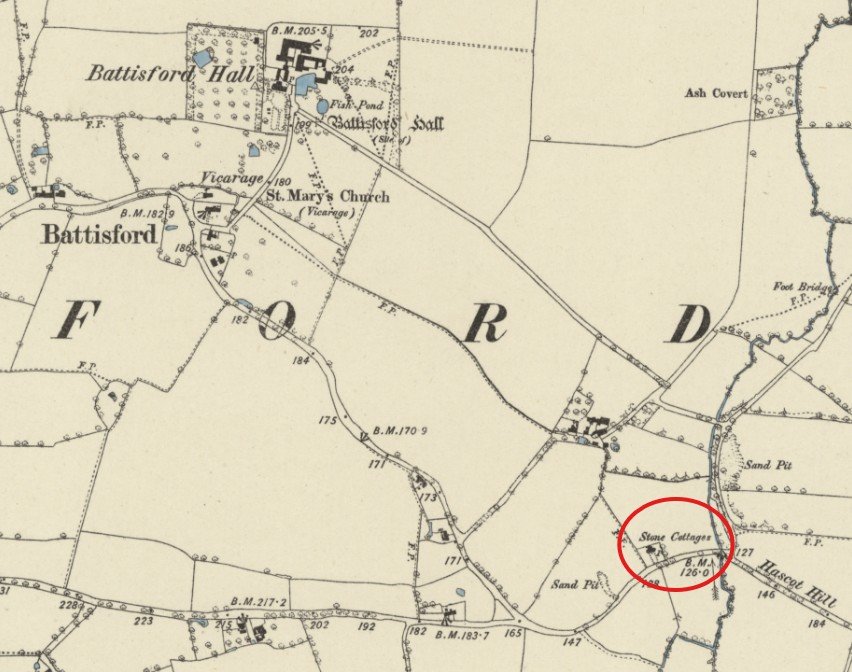
The article states James lived at Stone Cottages which can be seen on a map published in 1884. The corresponding building on a modern map is now known as Stonecroft. The article does not specify exactly where the disturbed bees were located – presumably nearer to the church where more ‘pedestrians’ are likely.
James was recorded only as an agricultural or farm labourer in the 1901 and 1911 censuses. This suggests his beekeeping was either a hobby or used for supplemental income to his meagre labouring wage.
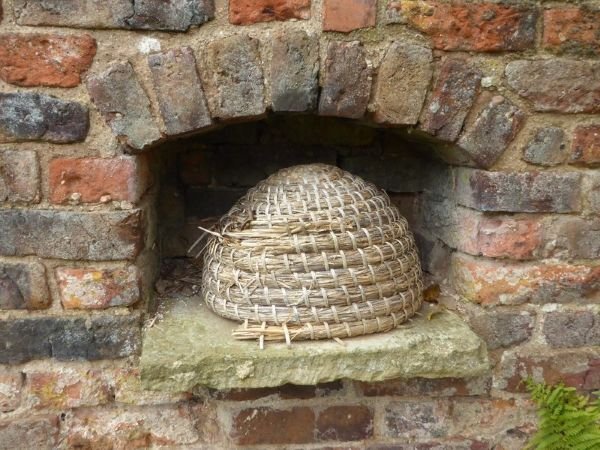
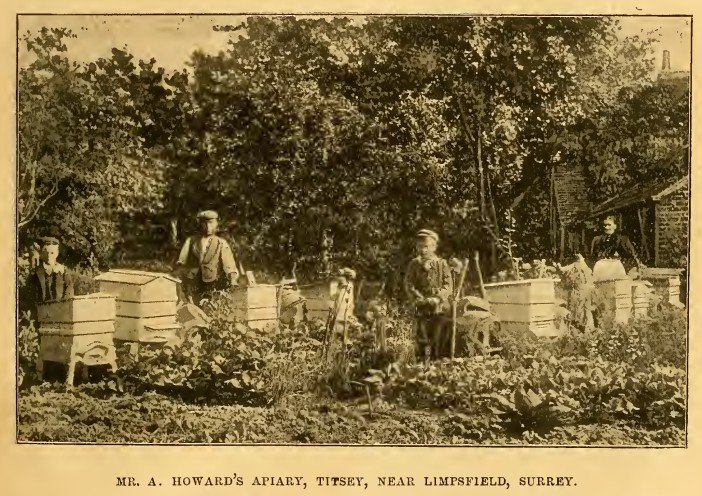
Traditionally, people used straw skeps to keep bees, but by 1906 most beekeepers had moved on to wooden movable-frame hives. The wooden hives enabled easy access to the honeycombs without harming the bees. I suspect James Prentice’s set-up may have looked a bit like Mr A. Howard’s Apiary in Surrey – a photograph of which was published in The British Bee Journal and Bee-Keepers’ Adviser in 1904. (First launched in 1873.)
James lived his entire life in Battisford. He died in 1919, aged 59, and was buried in Battisford churchyard. (The first burial in the cemetery was not until 1926).