Giving Up Housekeeping

Whilst looking for information on her daughter’s marriage in 1917, I stumbled across this intriguing advertisement in the newspaper placed by Alice Ann Glaister (nee White) the same year:

“TUESDAY, 27th NOVEMBER,
At 2 o’clock.
On the Premises, No. 17 Springhill road, Mornington (off Glen avenue).
Instructed by Mrs Glaister, who is giving up housekeeping…”

…followed by an impressive list of household possessions.
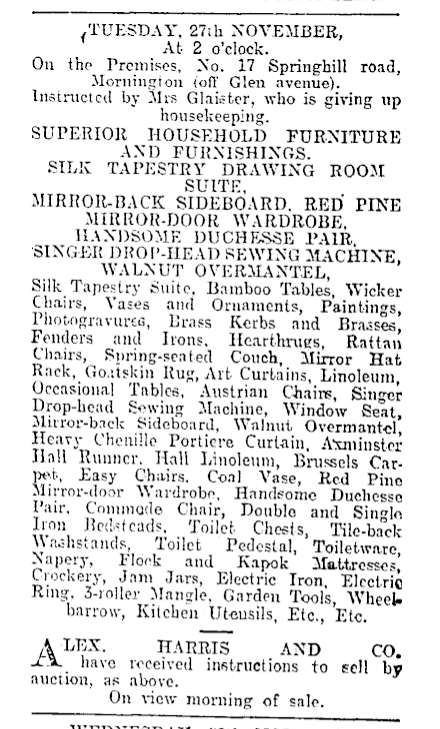
clipping of newspaper advertisement
Evening Star, 26 Nov 1917, p5

I had not heard the expression, ‘giving up housekeeping’ before but it seems to refer to a time when people are no longer able to maintain their own home and need to ‘give up’ or sell their possessions.

Alice’s husband was coachbuilder, William Glaister, who died 9 November, and was buried 11 November 1917. A couple of weeks later, Alice was auctioning off her household furniture and furnishings from her home at 17 Springhill Road – where the couple had lived since at least 1890. (Their daughter, Mary, had even married at the address earlier that year.)

Interestingly, the family had starting advertising the home to be let as early as 20 October 1917. William was suffering from stomach cancer and the family probably knew his time was coming to an end and so were making preparations for the future.
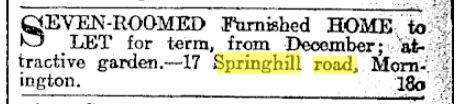
Otago Daily Times, 20 Oct 1917, p9

In 1933, 16 years after William’s death, Alice died ‘at the residence of her daughter, 616 Cumberland Street’. But which daughter? She had had seven daughters and two sons.
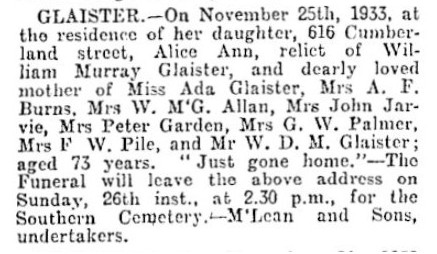
Evening Star, 25 Nov 1933, p12

Alice’s second youngest daughter, Ada, was recorded at the Springhill Road residence with her parents in 1914. Ada would remain a spinster so this seems an obvious choice of family member to live with.

However, electoral records show that the home she died in was that of her eldest daughter, Laura, who had married Alfred Burns in 1908. The electoral rolls show her living there with her husband in 1931 and 1935.
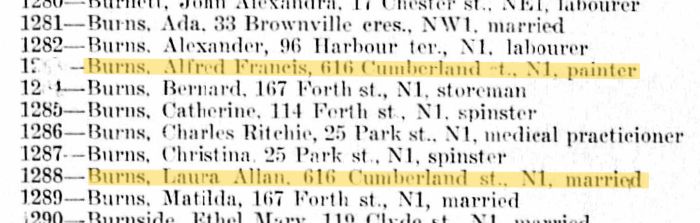
1935 electoral roll showing Laura and Alfred at 616 Cumberland Street

Why not Ada Victoria?

Alice and Ada had been recorded moving from place to place together since 1919.

  • 1919 – Hugh Street, Sawyers Bay (near Port Chalmers)  (daughter Barbara was nearby in Glendermid – possibly even the same house)
  • 1922 – 14 Maitland Street
  • 1925 – 8 Jones Street
  • 1928 – 8 Jones Street, then 117 Dundas Street
  • 1931 – 117 Dundas Street

14 Maitland Street appeared to be some kind of boarding house based on advertisements in the newspapers.
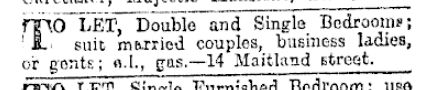
Evening Star, 6 Oct 1925, p7

8 Jones Street was let as a 4-room house in 1924 – perhaps this was the ad seen by Alice and Ada when planning their move from Maitland Street?

Otago Daily Times, 8 Jul 1924, p12

117 Dundas Street appeared to be owned (and lived in) by an Alfred Edwin Maitland and his family until at least 1949. There appears to be no family relationship to the Glaisters so perhaps they were simply renting a room?

In 1935, Ada was still at 117 Dundas Street and remained there for at least a few more years. This suggests she had not also been living in her sister’s house when Alice died in 1933. Ada may have had some form of employment which meant she could not care for her ailing mother, but no profession was given in the electoral rolls. Alice and Ada were described throughout the electoral rolls only as ‘widow’ and ‘spinster’, but this, along with, ‘married’, seemed to be the case for all the women on the page.

Although the phrase ‘giving up housekeeping’ had initially caught my attention, it led me to a valuable insight into my 2nd great grandmother’s life after her husband died and illustrated how much her circumstances changed. Alice went from having her own 7-bedroom home for about three decades, to moving between various rentals and boarding houses, possibly relying on her daughters for support.

A map of Alice Glaister’s residences from 1917 can be seen here.
Related posts:

Patently Improved

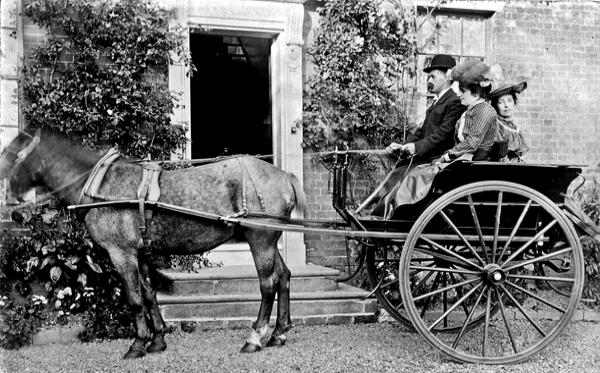
A two-wheeled dogcart (via Gail Thornton)

William Glaister, my 2nd great-grandfather, was a coachbuilder in Dunedin, New Zealand in the late 19th and early 20th century. A couple of years ago, I discovered he was also an inventor.

In 1892, William filed a patent for ‘An invention for improvement in two-wheeled vehicles’. An abstract was published in the New Zealand Gazette on 31 March 1892 (available via Ancestry).

New Zealand Gazette (Supplement), 31 Mar 1892, p1

If a member of the public wanted to purchase copies of the patent documents, they would pay 2 shillings and 6 pence for the written description of the invention, and 3 shillings for the accompanying technical illustration. William, himself, would have paid at least a few pounds for actually filing the patent. (Source: New Zealand Legislation – 1889 fee schedule)

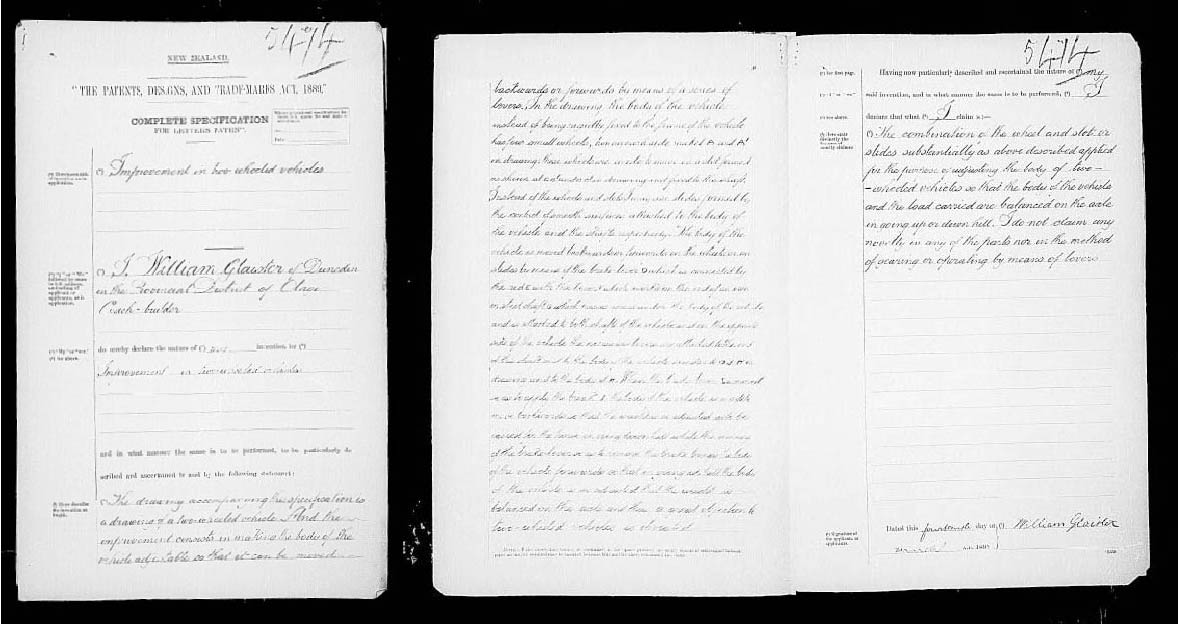
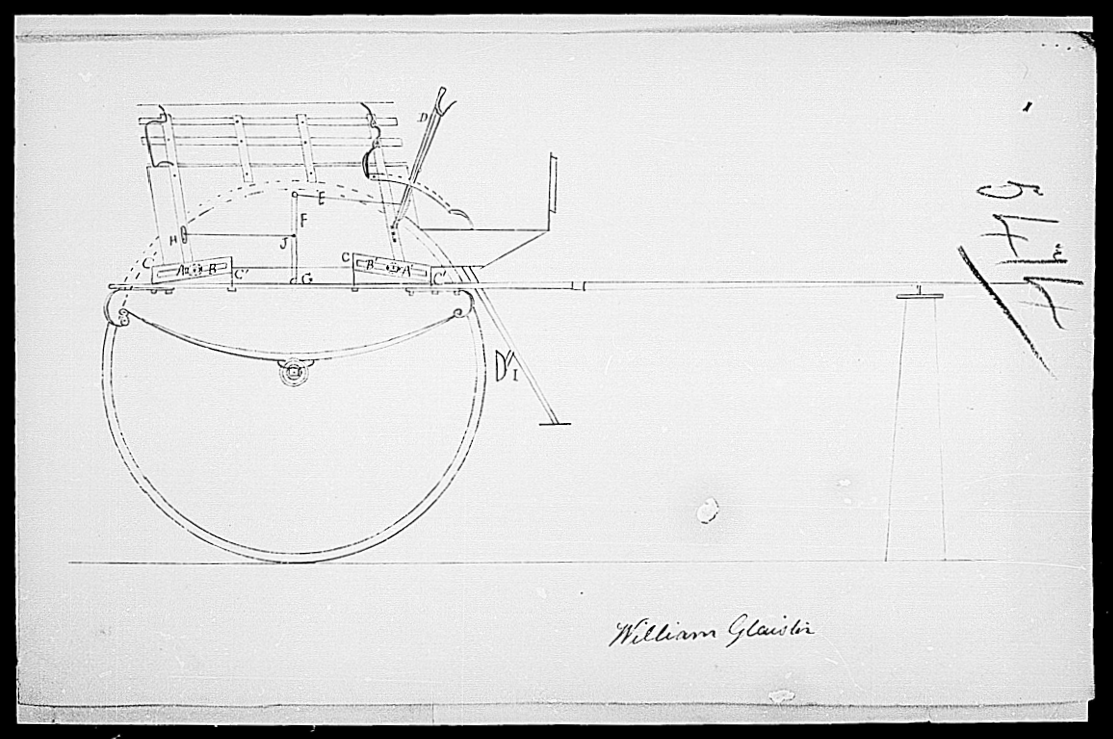
Using the Intellectual Property Office New Zealand Patents register, I was able to view the original patent document in which included a description (in his own handwriting) and a drawing of the concept.

An Invention for Improvement in Two-Wheeled Vehicles – William Glaister

I have transcribed the specification, adding punctuation and paragraphs for ease of reading.

Here describe the invention at length

The drawing accompanying this specification is a drawing of a two-wheeled vehicle, and the improvement consists in making the body of the vehicle adjustable so that it can be moved backwards or forwards by means of a series of levers.

In the drawing, the body of the vehicle instead of being rigidly fixed to the frame of the vehicle has four small wheels, two on each side marked A and A1 in drawing: these wheels are made to move in a slot formed as shown at C C1 and C C1 in drawing and fixed to the shaft.

Instead of the wheels and slots, I may use slides formed by the conduct of smooth surfaces attached to the body of the vehicle and the shafts respectively.

The body of the vehicle is moved backwards or forwards on the wheels (or on slides) by means of the brake-lever D which is connected by the rod E with the lever F which works on the end of an iron or steel shaft G which passes across under the body of the vehicle and is attached to both shafts of the vehicle and on the opposite side of the vehicle the necessary levers are attached to the end of this shaft and to the body of the vehicle similar to G J H in drawing and to the body at H.

When the brake-lever D is moved so as to apply the break (I), the body of the vehicle is made to move backwards so that the weight is so adjusted as to be easiest for the horse in going down hill, while the moving of the brake-lever so as to remove the brake, brings the body of the vehicle forwards so that in going up hill the body of the vehicle is so adjusted that the weight is balanced on the axle and thus a great objection to two-wheeled vehicles is obviated.

Having now particularly described and ascertained the nature of my said invention, and in what manner the same is to be performed, I declare that what I claim is:

The combination of the wheel and slot or slides substantially as above described applied for the purpose of adjusting the body of two-wheeled vehicles so that the body of the vehicle and the load carried are balanced on the axle in going up or down hill. I do not claim any novelty in the any of the parts nor in the method of gearing or operating by means of levers.

Dated this fourteenth day of March A.D. 1892 [signed] William Glaister

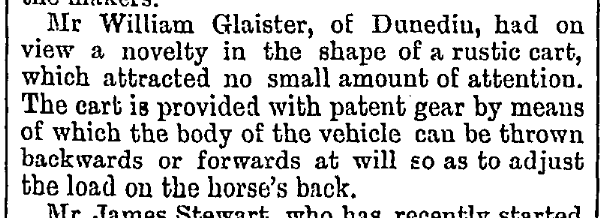
It’s still a bit difficult to understand (for me), but the Otago Daily Times gave a pretty good summary when William presented a cart using his invention at the Otago Agricultural Show that same year: “The cart is provided with patent gear by means of which the body of the vehicle can be thrown backwards or forwards at will so as to adjust the load on the horse’s back”. Load-balance was apparently a well-known issue for users of this type of vehicle.

Otago Daily Times, 3 Dec 1892, p6 (Supplement), c4

I’m not sure how successful the invention was or whether it was utilised by other coachbuilders. Perhaps someone in the know could shed some light on that for me?

Related posts:

A Grave Mistake

man in deerstalker hat laying on the groundOne of my favourite things about genealogy is feeling like a detective, and today gave me another opportunity to don my deerstalker and grab my pipe.
I noticed that Find A Grave had an ‘extra’ child linked on the page of my great grandparents, George Wright Wreford Palmer and Margaret Palmer (nee Glaister). The ‘memorial’ was for an infant, William Tracey Palmer, born and died in 1911, which included the note: ‘Accidentally killed after his sleeping mother rolled over on him in bed.’ A tragic event, but I was a bit befuddled.

The problem was, George and Margaret were married in 1913, and although I’m no stranger to discovering ‘early’ children, I had never come across this one before. So of course, I needed to either prove or disprove the connection.

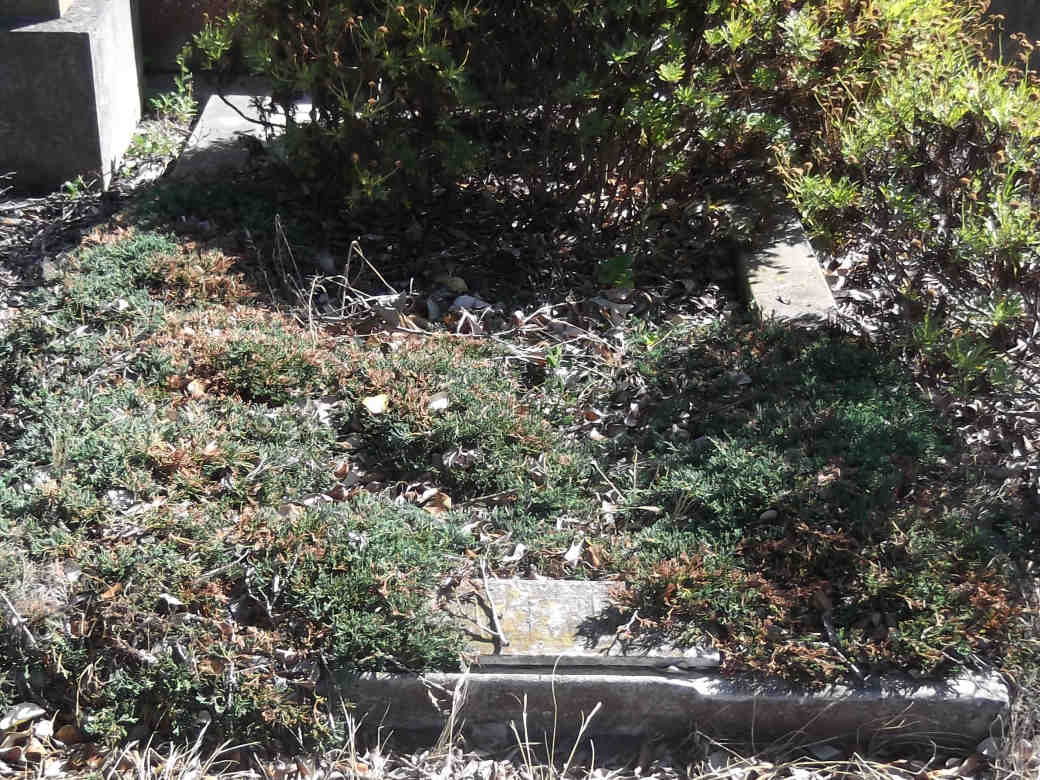
a dilapidated grave
Block 3 Plot 105 via Dunedin City Council

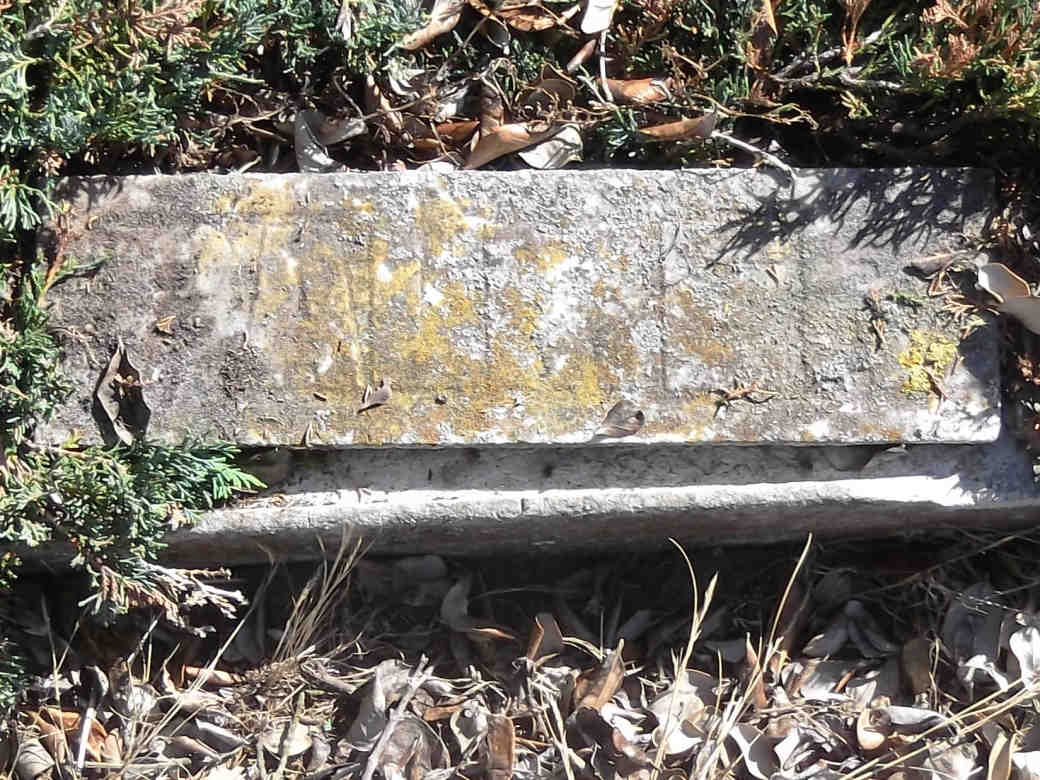
The gravesite is pretty dilapidated and only the faint outline of the name ‘Palmer’ can be seen on a marker – so no help there.

Grave marker with faint outline of the name PALMER
Block 3 Plot 105 via Dunedin City Council

I could find no birth or death record for an infant named William Tracey Palmer. There was a death record but this was for a 77-year-old man. The name Wreford Henry Palmer jumped out at me, due to my family connections with the name Wreford, but this was the child of Thomas Henry Palmer (George’s brother) and his wife Kate Palmer (nee Gilchrist).

I turned to the Dunedin City Council site which has a very helpful grave location search but there was no William Tracey Palmer buried at Anderson’s Bay cemetery between the years 1910 and 1919. So where the heck was this grave info coming from?

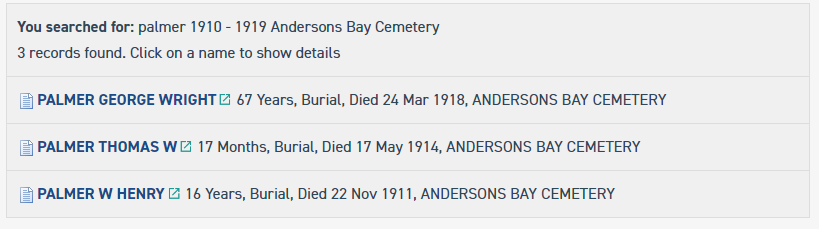
Screenshot showing 3 search results

Considering possible spelling variants may have been at play, I searched only for the surname ‘Palmer’ in that time period and got three results – none being William Tracey Palmer. The first I knew to be my great great grandfather (George’s father), the other two being children of the above mentioned couple Thomas and Kate. The only 1911 burial was for ‘W Henry Palmer’ but aged 16 years. I thought it was another dead end but lo and behold, the record page gave me the information I needed.

Screenshot of record details

Block 3, Plot 105; died 22 Nov 1911 – the same burial plot and death date given on the Find A Grave site. This was the burial record of the aforementioned Wreford Henry Palmer. Despite giving an age of ’16 years’, the notes section stated the ‘occupation’ of INFANT, so likely meant ’16 days’ – the burial register entry showed this to be the case.

Screenshot of burial entry record
Burial entry of Wreford Henry Palmer in Andersons Bay Cemetery records

So poor little Wreford Henry must have been linked accidentally as a child of his uncle when added to Find A Grave (his parents are also on the site) but I have no idea where the name ‘William Tracey’ came from. Unfortunately, at least 5 other people have since added ‘William Tracey’ as a child of my great grandparents (on Ancestry), so let this tale serve as a reminder to always CHECK YOUR SOURCES.

Related posts:

More Buchan ‘Lunatics’

I was very excited to receive an email from Roy BUCHAN – author of the book ‘From Peterhead to Passchendaele’ mentioned on this post and distant relative of mine.


He also mentioned that the Mr Peter BUCHAN listed above (on the Rimutaka 1893 passenger list) as aged 35 was, in fact, mentally retarded from birth and died 3 years after landing in New Zealand.  This was roughly the same time as his brother, and my direct ancestor, Alexander Ritchie BUCHAN died while working on a fishing boat.

Before I’d even had a chance to look into it, another distant BUCHAN relative, emailed me the information that Peter had actually died in July 1897 (seven months after his brother, Alex).  He apparently died at Seacliff Hospital, Dunedin – also known as Seacliff Lunatic Asylum.
(NOTE: A further email from the same relative warns that this may not be true)

Seacliff Hospital, Dunedin, NZ c.1910

Peter was the son of Charles and Jessie (nee RITCHIE) BUCHAN.

I will now be checking for his asylum records.

Next Steps:

  • Check for Peter BUCHAN’s death in New Zealand (Place of death – asylum?)
  • Look into story from Roy Buchan’s book that suggests he went out ‘wandering’ and died from exposure

Related posts:

Inquests and Articles

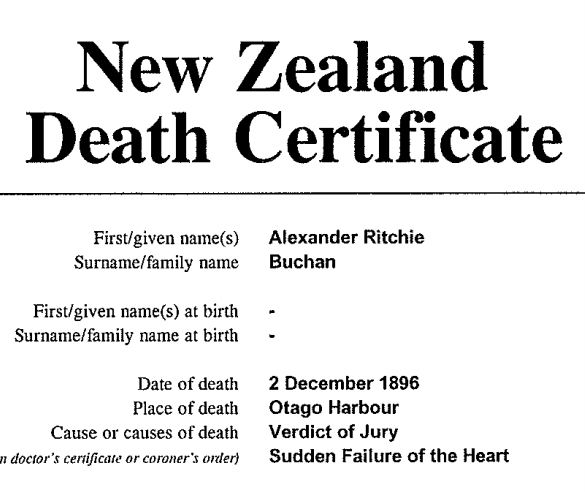
This morning I received some death certificates for members of my BUCHAN family.  On Alexander Ritchie BUCHAN’s certificate it states his cause of death as ‘Verdict of Jury – Sudden Failure of the Heart’.
Part of Alexander Ritchie BUCHAN’s death certificate – 1896

My grandmother mentioned in a letter years ago that “Grandad B [a fisherman] was actually pulling in a fishing net, when he apparently (I presume) had a heart attack & died at age 34”.  I had no idea there was an inquest into his death though.

I searched through the newspapers on New Zealand’s wonderful Papers Past site and found a mention in the ‘Casualties’ section:

A sudden death occurred about 8 o’clock on Wednesday night, 2nd. Alexander Buchan, who was engaged fishing with his brother John in the lower harbour, had just hauled in the net, when he went to the bow of the boat and fell forward, and on his brother going to him found he was dead. An inquest was held on Thursday afternoon when after hearing the evidence of Charles and John Buchan, John Keenan, and Dr Cunninghame, the jury returned a verdict that deceased died from sudden failure of the heart. Deceased leaves a wife and five children in very poor circumstances. (Otago Witness – 10 Dec 1896, p15)

Otago Witness – 10 Dec 1896, p15

His wife Agnes (nee FINDLAY) was left with 5 children under the age of 9 – their daughter was only 3 weeks old!

Alexander was buried in Port Chalmers cemetery on the 5th December 1896.  Also buried on the plot were members of the GRANT family who I believe to be unrelated and a Robert JONES (according to the Cemeteries Database on the Dunedin Ciy Council website).  On the entry in the Cemeteries Database is the note:”GRANT PLOT: CONSENT OF CHURCH”.

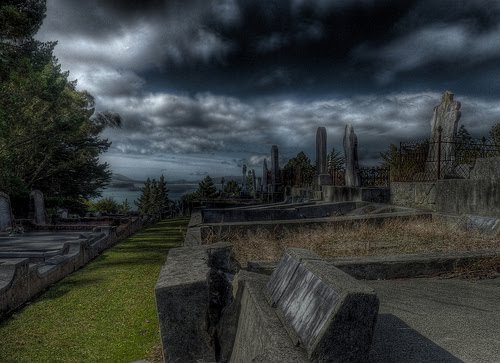
image via flickr

It seems that the church took pity on Alexander’s family (who had only arrived in the country 3 years earlier) and because of their “very poor circumstances”, buried him in this plot as an act of charity.

I am really keen to find any surviving inquest records as I know nothing about a brother called John!

Next Steps:

  • Locate inquest records (if any)
  • Search for church records that may mention the burial
  • Research ‘brother John’

Related posts: