
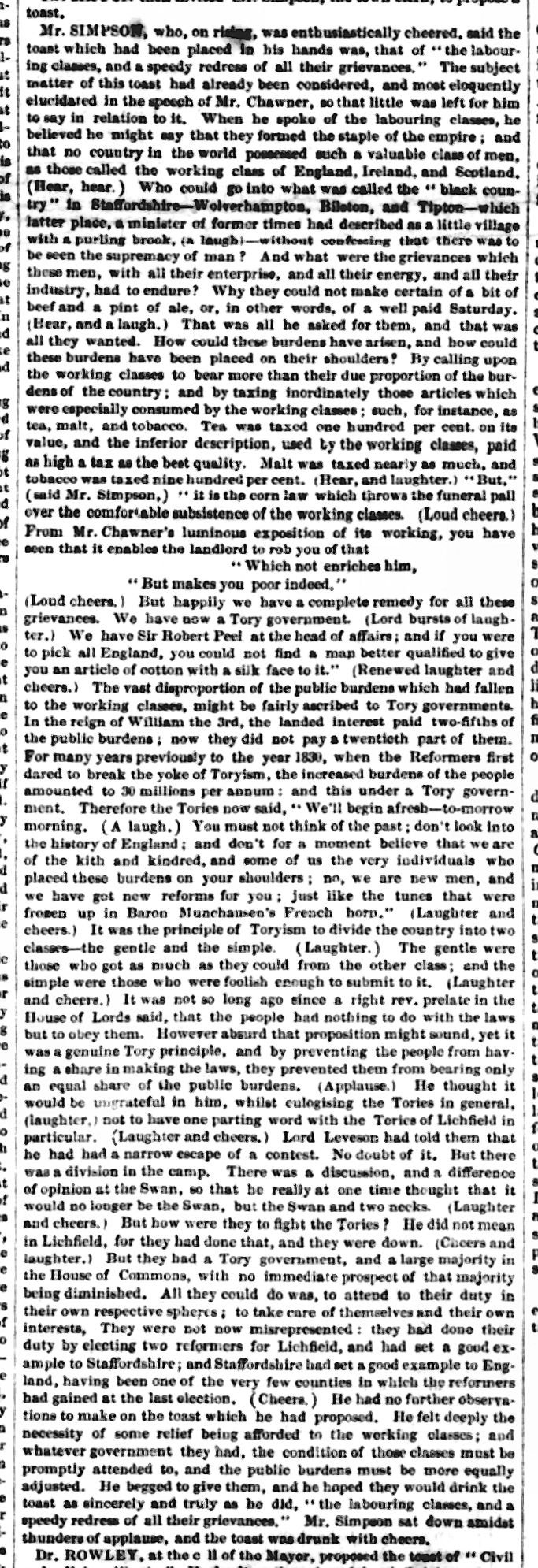
Summary of Mr. Simpson’s Speech at the Lichfield Reform Dinner 1841
Main Theme: The grievances of the working classes and the role of Tory governments in causing them.
Key Points:
On the Working Classes He opened by celebrating the working people of England, Ireland, and Scotland as “the staple of the empire,” particularly highlighting the industrial workers of the Black Country (Wolverhampton, Bilston, and Tipton). He argued their basic needs — decent food and a fair wage — were going unmet.
On Unfair Taxation He blamed the burdens placed on working people largely on unjust taxation, singling out tea, malt, and tobacco as goods disproportionately taxed yet heavily consumed by the poor. Most importantly, he condemned the Corn Laws as the primary cause of working-class poverty, using a Shakespeare quotation to illustrate how they enriched landlords at the expense of the poor.
On Tory Hypocrisy Speaking with heavy sarcasm, he mocked the idea that a Tory government under Sir Robert Peel would provide relief, arguing that Tory governments had historically shifted the tax burden away from the landed gentry onto ordinary people. He ridiculed Tory claims to have reformed themselves.
On Local Politics He praised Lichfield and Staffordshire for electing reformers, and encouraged his audience to remain engaged politically despite the Tories holding a large parliamentary majority.
Conclusion He called on whatever government held power to address working-class conditions and redistribute public burdens more fairly, closing by toasting “the labouring classes, and a speedy redress of all their grievances.”
(Summary provided by Claude.ai)
Transcription
“REFORM DINNER AT LICHFIELD
…Mr. SIMPSON, who, on rising, was enthusiastically cheered, said the toast which had been placed in his hands was, that of “the labouring classes, and a speedy redress of all their grievances.” The subject matter of this toast had already been considered, and most eloquently elucidated in the speech of Mr. Chawner, so that little was left for him to say in relation to it. When he spoke of the labouring classes, he believed he might say that they formed the staple of the empire; and that no country in the world possessed such a valuable class of men, as those called the working class of England, Ireland, and Scotland. (Hear, hear.) Who could go into what was called the “black country” in Staffordshire—Wolverhampton, Bilston, and Tipton—which latter place, a minister of former times had described as a little village with a purling brook, (a laugh)—without confessing that there was to be seen the supremacy of man? And what were the grievances which these men, with all their enterprise, and all their energy, and all their industry, had to endure? Why they could not make certain of a bit of beef and a pint of ale, or, in other words, of a well paid Saturday. (Hear, and a laugh.) That was all he asked for them, and that was all they wanted. How could these burdens have arisen, and how could these burdens have been placed on their shoulders? By calling upon the working classes to bear more than their due proportion of the burdens of the country; and by taxing inordinately those articles which were especially consumed by the working classes; such, for instance, as tea, malt, and tobacco. Tea was taxed one hundred per cent. on its value, and the inferior description, used by the working classes, paid as high a tax as the best quality. Malt was taxed nearly as much, and tobacco was taxed nine hundred per cent. (Hear, and laughter.) “But,” (said Mr. Simpson,) “it is the corn law which throws the funeral pall over the comfortable subsistence of the working classes. (Loud cheers.) From Mr. Chawner’s luminous exposition of its working, you have seen that it enables the landlord to rob you of that
“Which not enriches him,
“But makes you poor indeed,”
(Loud cheers.) But happily we have a complete remedy for all these grievances. We have now a Tory government. (Lord bursts of laughter.) We have Sir Robert Peel at the head of affairs; and if you were to pick all England, you could not find a man better qualified to give you an article of cotton with a silk face to it.” (Renewed laughter and cheers.) The vast disproportion of the public burdens which had fallen to the working classes, might be fairly ascribed to Tory governments. In the reign of William the 3rd, the landed interest paid two-fifths of the public burdens; now they did not pay a twentieth part of them. For many years previously to the year 1830, when the Reformers first dared to break the yoke of Toryism, the increased burdens of the people amounted to 30 millions per annum: and this under a Tory government. Therefore the Tories now said, “We’ll begin afresh—to-morrow morning. (A laugh.) You must not think of the past; don’t look into the history of England; and don’t for a moment believe that we are of the kith and kindred, and some of us the very individuals who placed these burdens on your shoulders; no, we are new men, and we have got new reforms for you; just like the tunes that were frozen up in Baron Munchausen’s French horn.” (Laughter and cheers.) It was the principle of Toryism to divide the country into two classes—the gentle and the simple. (Laughter.) The gentle were those who got as much as they could from the other class; and the simple were those who were foolish enough to submit to it. (Laughter and cheers.) It was not so long ago since a right rev. prelate in the House of Lords said, that the people had nothing to do with the laws but to obey them. However absurd that proposition might sound, yet it was a genuine Tory principle, and by preventing the people from having a share in making the laws, they prevented them from bearing only an equal share of the public burdens. (Applause.) He thought it would be ungrateful in him, whilst eulogising the Tories in general, (laughter,) not to have one parting word with the Tories of Lichfield in particular. (Laughter and cheers.) Lord Leveson had told them that he had had a narrow escape of a contest. No doubt of it. But there was a division in the camp. There was a discussion, and a difference of opinion at the Swan, so that he really at one time thought that it would no longer be the Swan, but the Swan and two necks. (Laughter and cheers.) But how were they to fight the Tories? He did not mean in Lichfield, for they had done that, and they were down. (Cheers and laughter.) But they had a Tory government, and a large majority in the House of Commons, with no immediate prospect of that majority being diminished. All they could do was, to attend to their duty in their own respective spheres; to take care of themselves and their own interests. They were not now misrepresented: they had done their duty by electing two reformers for Lichfield, and had set a good example to Staffordshire; and Staffordshire had set a good example to England, having been one of the very few counties in which the reformers had gained at the last election. (Cheers.) He had no further observations to make on the toast which he had proposed. He felt deeply the necessity of some relief being afforded to the working classes; and whatever government they had, the condition of those classes must be promptly attended to, and the public burdens must be more equally adjusted. He begged to give them, and he hoped they would drink the toast as sincerely and truly as he did, “the labouring classes, and a speedy redress of all their grievances.” Mr. Simpson sat down amidst thunders of applause, and the toast was drunk with cheers.”
(The quoted verse, “Which not enriches him / But makes you poor indeed”, is a paraphrase from Shakespeare’s Othello.)